In times of uncertainty, some people turn to prayer, others to therapy. I turn to words.
As a nation, we are all grappling with trauma but are unsure how to unpack it.
I had always turned to my pen to unpack my thoughts, capture my emotions, and discover a path forward. Only recently did I realize I may have inherited this from my Zeida (grandfather), Nathan Werdiger, who somehow always managed to reveal a new detail about himself the longer I got to know him, as if unpeeling another layer.
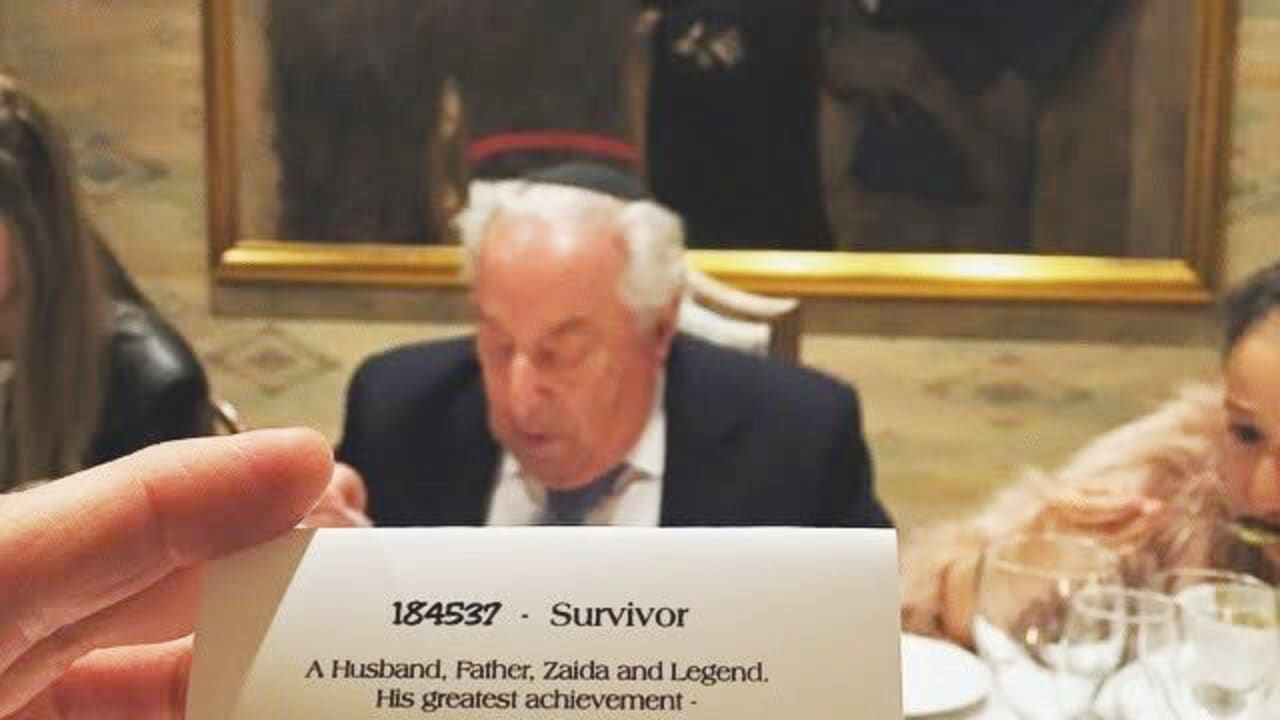
My childhood years were shadowed by the notion that my Zeida endured the camps of the Holocaust. But I didn’t really comprehend what that meant until many years later. It was only after I was 12, or bat mitzvah, that I was privy to an invitation to my Zeida’s annual liberation dinner on April 11. The night he would celebrate his redemption, surrounded by the large family he had subsequently built. And also the only night of the year when he would share his stories. He called it his birthday. He was indeed reborn.
These were the stories I had always associated with my Zeida. The stories he felt compelled to share, to give over, so that none of his descendants would ever forget.
So it was surprising to discover that my Zeida actually had more stories. Stories that lie beneath the surface, written in the quiet aftermath of war.

How a grandfather’s post-war testimony shapes coping in Israel today
IT WAS my summer break after I had completed my BA in New York, and I was visiting my family in Melbourne, Australia. I went to my grandparents’ house and sat with my Zeida in his living room, a room filled with more Judaica and historical books than the local Jewish museum.
He sat upright in his sunken brown leather armchair, wrapped in his navy woolen cardigan – a signal that he had left his office and was unwinding in his home. The glass-topped coffee table held his now-empty whisky glass and the latest three editions of The Economist. I shared stories of my studies, my basketball team, and the creative writing course I had just completed.
This was when his sunken eyes widened, and a spark emerged. He asked me what I enjoyed about writing and what compelled me to pursue it. He then told me to wait a moment, that he wanted to bring something to show me. He jumped up from his armchair with a spring in his stride.
He returned a few minutes later with a large yellow envelope and presented it to me, showing it off as if it were an award he had received. A whiff of must emanated as I extracted the pages from the envelope. The A4-size pages were a golden hue with a few stains, like a Haggadah that had been used for many years with remnants of spilled wine. Hebrew letters were sprawled across the page, clearly stamped by a typewriter.
“It’s in Yiddish,” my Zeida said as he donned his reading glasses and gave me a big grin, adjusting his black kippah on his tufts of white hair.
He explained that as he lay in his hospital bed at the Red Cross in Davos, Switzerland, back in 1946 as an 18-year-old orphan, he asked the staff if he could use their typewriter. He decided he wanted to write stories as a way to process his trauma. He captured one of his stories and carried it with him – amid the few possessions he accumulated – across numerous oceans all the way to Australia, and kept it with him all these years. But this was the first time he had shared it with anyone aside from my grandmother.
I SANK deeper in the chair, wide-eyed.
Here was a man who had never attended high school, let alone university, as it was disrupted by years of life in the ghetto and then concentration camps. And yet, he felt compelled to write, with whatever skills he had, in a language his parents had spoken with him, and how he had conversed with his friends at cheder (religious school) in Sosnowiec, Poland.
And there I was. Fresh out of college, where we analyzed texts in English literature, discussed character and story arc, and description. And yet, I still hadn’t completed anything substantial.
My Zeida decided he would translate the Yiddish for me and asked that I capture it in English and develop it from, in his words, its “primitive” state.
So we sat together every afternoon for the following week. Me with my notepad and tape recorder (it was 2005!), my Zeida with his reading glasses, as he shared his story. It wasn’t a lengthy story, but it was fascinating. He had captured life in the ghetto, created fictional characters with names, and showed what the Jews were thinking, feeling, and discussing during that time period.
The story highlights how a minyan was so fundamental to the community he was part of, that they would risk their lives in order to ensure its continuity. “Jews will stay Jews,” his story started. “How can a Jew live without a minyan?”
As he was translating, I realized we were sharing more than just a story; we were sharing a love of writing, of language, and a desire to create something. More than that, his eyes shone with pride and something gentler – a quiet relief – as if he was sharing a piece of himself, a glimpse of how he had made sense of what he endured.
“I’M A coper.” That’s how my Zeida often referred to himself. And maybe, just maybe, I had uncovered his secret sauce.
Over the next year, I worked on his story and developed it into a more modern-day rendition. I hope I did it justice. But sadly, my Zeida did not live to read my rendition. It has sat quietly on my Google Drive, intermittently making an appearance at a yahrzeit (anniversary of the day of his death) gathering with my first cousins, aunts, uncles, and grandmother.
But his words, and the use of writing itself as a vehicle to heal, stayed with me.
After the war erupted here in Israel on Oct. 7, 2023, I recall walking on the empty streets of Jerusalem in a total fog. The air was thick with dread, and the faces I encountered looked completely lost and empty, just like the supermarket shelves that week.
I recall putting my toddler to sleep in our home in Jerusalem in mid-October of 2023. She is the youngest of my four children and likely won’t remember that war at all. And while I was grateful for that, I was simultaneously feeling envious that her deep sleep wasn’t plagued with fear and unknowns that haunted mine. And how this contrasted with her seven-year-old brother, who carries my Zeida’s name, when he would come to my room in the depths of the night, complaining about a recurring nightmare of air raid sirens blaring, sending him into a flurry of fear.
It took me months to find the courage to lift my pen again. I couldn’t find the words – until a friend, an author and mother whose son was serving in Gaza at the time, encouraged me to attend her writing workshop titled “Writing in Times of Uncertainty.”
Writing is an age-old practice. It can be magical, and surprisingly healing.
During that workshop, we were asked to bring an object that held meaning and to write about it. That morning, without thinking much of it, I opened my desk drawer and saw the cassette tape marked “Zeida story part #2”. And I was swept back into this story – almost 18 years later.
It almost felt like a sign; that perhaps this, too, was how I was meant to heal.
Over the past two and a half years, I’ve often turned to my pen. While so much has been rattled and shaken – sometimes literally as missiles have been intercepted overhead at all hours of the day and night – writing became my way to make sense of it all, and a source of comfort amid the uncertainty.
My Zeida wrote to heal from the war that nearly destroyed the Jewish people. And while I could never compare my trauma to his unimaginable experience, I write now, trying to heal from these wars that continue to deeply shake us – but have made us stronger for it.
The writer was born and raised in Melbourne, Australia, studied in New York City, and now resides in Jerusalem with her husband and four young children. A marketing consultant by profession and writer at heart, she thrives on helping companies grow, and often finds her best ideas while she’s swimming in the pool or cycling in the Jerusalem Hills.