
I read a fascinating article recently about the co-founder of Netflix who, for 30 years straight, has turned off completely at 5 p.m. every Tuesday.
Every single week, no exceptions. No checking emails, no putting out fires, no “just one quick thing.” He credits this rigid boundary with keeping him mentally healthy and helping him maximize his potential in his role.
And honestly? My first thought was: “Only one evening a week? Rookie move!”
Look, I get it. In a world where work has become 24/7, where we’re connected across multiple platforms at all hours, where the lines between work life and personal life have completely dissolved, carving out any protected time feels revolutionary.
But here’s what struck me about this Netflix exec’s story: He prioritized time with friends. Not family – friends. Time for window shopping, for social connection, for what he called “staying sane.” And while I’m all for prioritizing friendship – friends are the family we choose, after all. It got me thinking about what that that looks like in my own life.
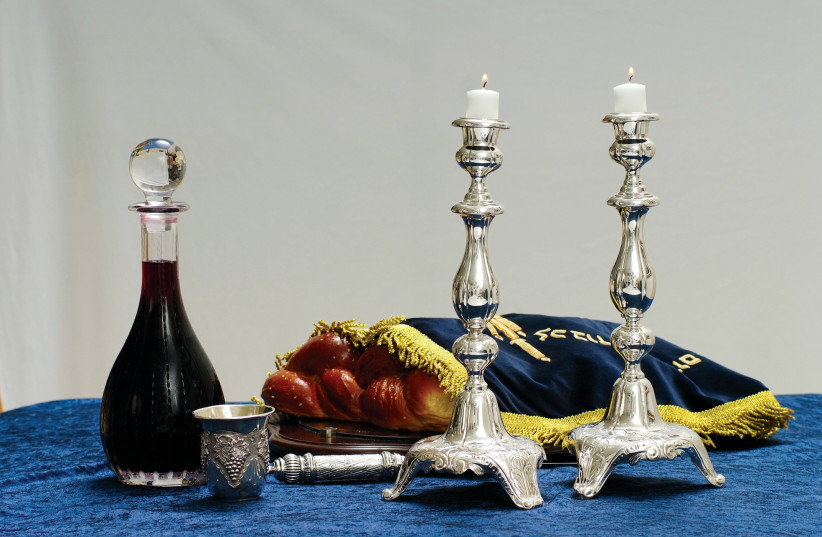
I don’t turn off for a few hours one evening a week: I turn off for 25 hours. Every single week. No matter what crisis is brewing, no matter what’s on fire, no matter how many urgent emails are piling up. This is non-negotiable. That’s Shabbat. And I honestly don’t know how I’d survive without it anymore.
The crazy thing? I didn’t always feel this way. But somewhere along the journey, Shabbat became my lifeline.
Shabbat isn’t just about “unplugging,” though that’s part of it: It’s about reconnecting and what happens in that sacred space when all the external noise stops.
Every Friday night, something shifts in our home. The table extends, literally and figuratively. My family gathers: my kids, my husband, the beautiful chaos of our crew around a table covered with challah, wine, and probably too much food. Our table almost always holds more. Friends stop by. Guests join. Community members pull up chairs. The extended family finds their way to us. It’s this incredible tapestry of the family we’re born with and the family we choose.
And recently, especially after going through a bit of a hard time on a personal level, I’ve realized just how much I need this investment in relationships. Not just want it: need it.
Kept by Shabbat
The past year has been... a lot. Especially with the war in Israel, the rising antisemitism around the world, the hostages who haunted my thoughts until they were returned, and the weight of world events that feel too heavy to process, I’ve needed Shabbat more than ever. It’s become my anchor, my reset button, my reminder that we’re still here, still connected, still grounded in something ancient and true.
Journalist Asher Zvi Hirsch Ginsberg, known as Ahad Ha’am, coined a famous saying: “More than the Jews have kept Shabbat, Shabbat has kept the Jews.” I used to think that was just a nice poetic phrase. Now I understand it in my bones. Shabbat has kept our families strong. It’s kept our priorities straight. It’s kept us sane when the world felt insane.
When I think about successful, accomplished Jews who’ve reached incredible heights in their careers while maintaining Shabbat observance – Jared and Ivanka Trump, Ben Shapiro, Ben Brafman, Mayim Bialik, among many others – I’m struck by a powerful reality: This wasn’t a sacrifice. It was fuel. That weekly pause, that forced disconnection from the grind, actually enabled their success rather than hindering it.
Shabbat gives something that a Tuesday evening off just can’t: It’s an investment in everything that actually matters.
It’s time with our kids where we’re not distracted, not half-listening while scrolling. Time with our spouses where we actually see each other. Time with extended family, where we witness one another’s lives in meaningful ways. Time with chosen family – our community, our friends – where we build the social fabric that’s unraveling everywhere else in modern life.
Twenty-five hours of peace
But it’s also time with ourselves. Time to read a book without guilt. Time to pray, to connect with our creator, to pray a little longer with nowhere urgent to go. Time to think, to process, to just be without anything hanging over our heads demanding our attention.
The mental health benefits? Immeasurable. The ability to actually maximize your potential because you’re not running on empty? Game-changing. The deep relationships you build when you show up fully present for 25 hours every week? Irreplaceable.
I recently went through something difficult in my own life. The details aren’t important. But what got me through wasn’t just determination or resilience or positive thinking. What got me through was knowing that every Friday night, no matter what, there would be a table surrounded by people who love me. There would be 25 hours when I didn’t have to perform or produce or be “on.” There would be space to feel, to heal, to reconnect with what’s real.
The transformation of Shabbat into something sacred, more than just turning off, happens when you turn toward something. When you reconnect and refill the well that everyone’s been drinking from all week. When real priorities become priorities once again.
Shabbat, as an idea that we desperately need protected, to be non-negotiable – time that’s completely free from work demands and digital connection – is immeasurable. We need weekly investments in our most important relationships. We need space to be human rather than constantly doing. We need time to connect with ourselves, with each other, with the universal.
Shabbat has kept me grounded, kept my family connected, kept my priorities clear – and, honestly, kept me from completely losing it during one of the most challenging years I can remember.
When everything else is uncertain, chaotic, and overwhelming, there’s something profoundly powerful about knowing that every single week, without fail, you have 25 hours of peace waiting for you. Shabbat is about connection, rest, and the reminder that we’re more than our productivity.
Trust me, once you experience this kind of weekly reset, you’ll wonder how you ever lived without it.■
The writer is the chief communications officer and global spokesperson for Aish, following a career as an award-winning producer and marketing executive with HBO, CNN, and Food Network. She is also a bestselling cookbook author.