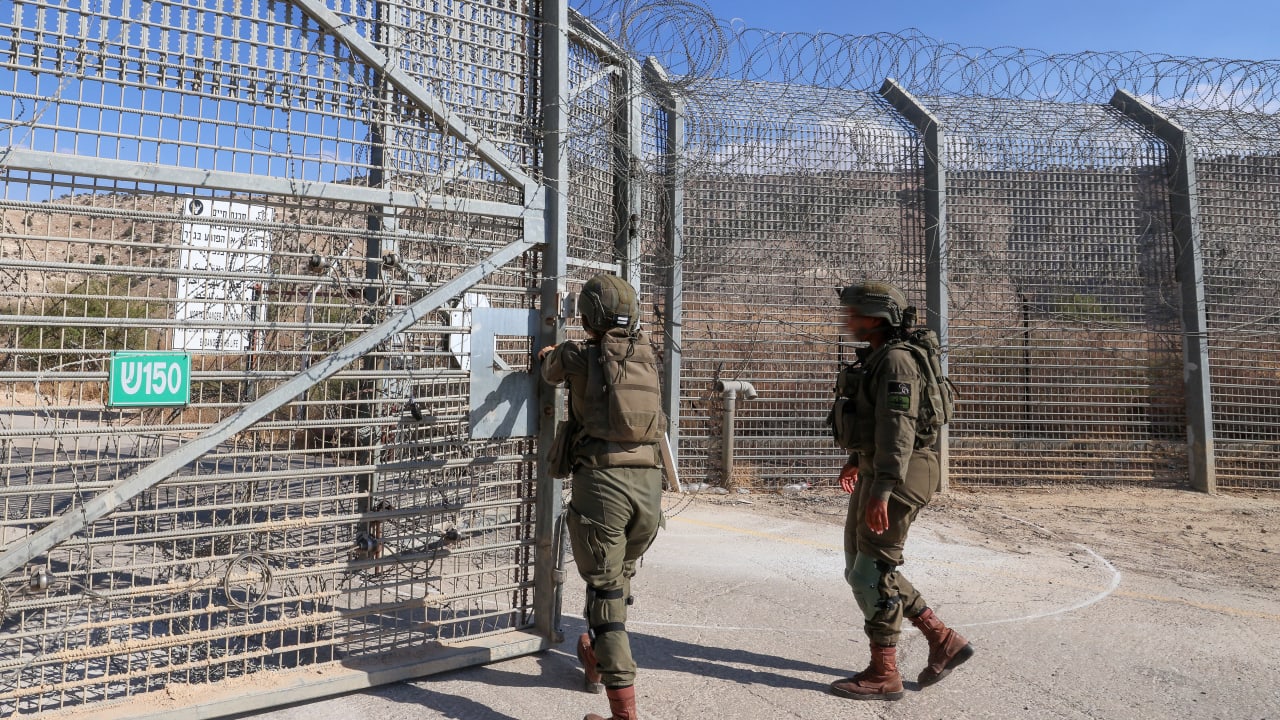
The Magazine recently embedded with a group of female field intelligence soldiers spying on hostile elements in Syria, which included a visit to Position 720 on the Israel-Syria-Jordan border tri-point.
IDF Battalion 595 Commander Lt. Col. G, his Operations Officer Maj. M, and intelligence collection soldiers S, D, and V – all of them other than G being female soldiers – were interviewed to provide an in-depth snapshot of what it’s like to sneak through Syria to help keep Israeli forces ahead of the curve.
The three female intelligence collection soldiers – S, D, and V – specialize in drone field intelligence collection.
While that might sound like they are sitting back safely in headquarters, they are very much deep in the field and potentially in danger, utilizing a tactical drone from up close so they can eyeball whatever the drone sees.
M said that since the 2023-2025 war, drone use has expanded so exponentially in the IDF that essentially every platoon commander, and sometimes even a few soldiers, have their own drone assigned for collecting forward intelligence.

G commented that one of the arts of using a drone to collect intelligence in Syria is figuring out the ideal height at which to fly the drone in differing circumstances.
In principle, it would be ideal to fly a surveillance drone as low as possible to get the most specific information and the highest resolution surveillance available. But in many situations, flying too low risks blowing the surveillance, which would alert the targets and enable them to adjust to avoid surveillance, defeating the whole purpose of clandestine intelligence collection.
Battalion 595 has helped locate and catch Iranians, Hamas members, jihadists, and just about anyone who could threaten Israel in its Syrian security zone or nearby.
S, D, and V are part of a new generation of IDF combat women who do not hesitate to pounce on enemies in hostile territory. These women seem to be precisely the kind of confident and forward-leaning field intelligence officers who are helping lead Israel’s post-Oct. 7 strategy of being more aggressive in enemy territory.
Field intelligence combat soldier S
S had no idea that she would become a combat soldier and field intelligence officer.
When the Magazine interviewed her, she had been serving for two and a half years.
Prior to the IDF’s December 2024 invasion of Syria and creation of a buffer zone, she had spent significant amounts of time in enemy territory but did not necessarily go as deep, as there were no IDF bases in Syria.
After the invasion, S has spent significant time serving in the area around Position 720 near the tri-border between Israel, Syria, and Jordan, including the Yarmuk River, which borders all three countries.
One of the biggest challenges she has encountered has been when she has spent at times up to two weeks in the field, learning how to cope with situations where she is barely sleeping at all.
When the Alexandroni Brigade took action in the area, it was always based on intelligence that she and her unit provided and with them guiding operations in real time.
In one operation, S said they went many kilometers beyond the buffer zone. That operation included their providing field guidance for the 890 Paratroopers Unit.
There was an operation where they studied four individuals working for or with associations to Iran or to agents of Iran. Each of them had to be analyzed separately in terms of their movements, timing, and habits, S said.
Field intelligence combat soldier D
D told the Magazine that they operate mostly at night to avoid detection and higher risks of conflict with hostile elements.
They study who goes in and out of each structure on which they are assigned to collect intelligence.
In one operation, D stated they spent four hours preparing a trap to ensnare a hostile individual of interest.
They explained to a large group of soldiers how the individual would likely try to escape capture and how to thwart his escape.
Field intelligence combat soldier V
V had been serving for two years and two months when interviewed.
She was involved in helping IDF forces take over new areas for the Syria buffer zone on December 8.
She also referred to the operation that was many kilometers deep into Syria and to working on significant operations with the paratroopers.
In July, the IDF admitted that it had failed to stop large numbers of Israeli Druze from entering Syrian territory.
However, G and other senior IDF officers have also said that the police must take the lead in handling such complex conflict situations with Israeli citizens.
The IDF is not generally trained to handle crowd control of Israeli citizens with non-lethal means; rather, it is focused on eliminating enemy forces with lethal force.
G says he hopes that quick warnings of initial moves by Israeli Druze will get both the police and the IDF into positions that will close off and prevent these Druze from even being able to approach the border.
M added that intelligence is crucial on the Druze and Sweida issue so that the IDF will be ahead of the curve and will not get caught flat-footed like it did earlier this year.
Also, she said that despite the IDF’s failure to block Israeli Druze from crossing into Syria, the military’s primary role during that conflict was its active pressuring of the new Syrian regime to stop attacking the Syrian Druze to avoid a pogrom.
Operations to arrest Iranians and other threats
Asked about how and when he orders an arrest or an attack on Iranian or other jihadist elements near Israel’s border or its buffer zone, G said there are many factors.
He said it was very important to know which hours of the day a specific target was alone versus surrounded by others who could put up a more difficult resistance to an IDF operation.
He also said it was crucial to understand the routines of the specific village where the target lived.
Moreover, he said it is vital to know which kinds of motor vehicles might be involved in the operation from the Syrian side and who is connected to which vehicle.
Whether the mission priority should be to try to arrest or to kill such a target is usually decided by commanders higher up in the ranks than G; but if the mission gets complicated, usually G will decide how to modify the mission parameters.
G talked about an operation in Syria in which he had set up a mobile forward-positioned command center in Syria to make it easier to observe and manage the operation up close.