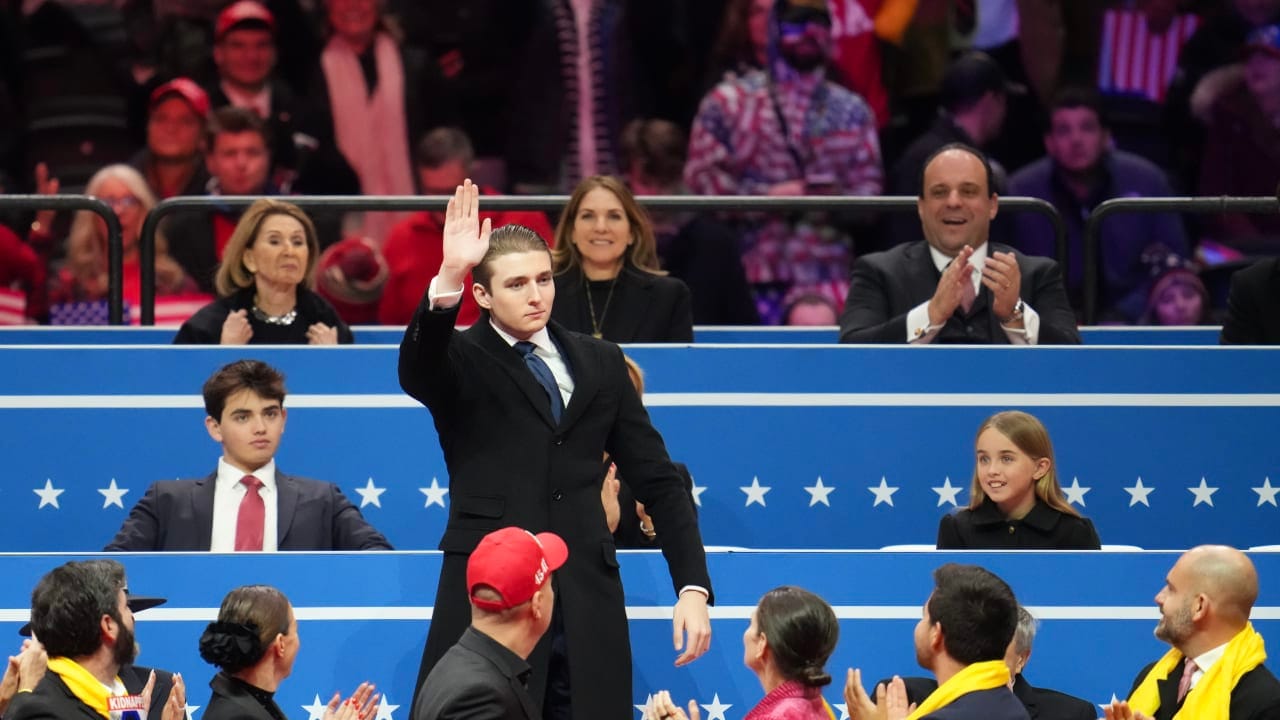
At 19, Barron Trump is presented as the brain behind a family crypto empire that has raised hundreds of millions from Abu Dhabi. But behind the astronomical jump in wealth sits a darker world, a Miami that styles itself as a digital laundering capital, and “obfuscation” tricks that make billions vanish. “The kid is a genius”? Not so sure.
Barron’s estimated worth is 150 million dollars, which means he has “overtaken” his mother, Melania Trump, in wealth. How did that happen? By carving out a lucrative niche through early adoption of cryptocurrencies.
WLFI, tokens, and the family play
Since the launch of the family crypto project, World Liberty Financial (WLFI), Barron’s valuation has surged. He is listed as a co-founder alongside his older brothers, and reports credit him with identifying the opportunity early and pushing the family to act.
According to those reports, Barron has already taken in roughly 80 million dollars from “token” sales. His current holdings of 2.3 billion WLFI tokens could, on paper, yield around 525 million dollars if he chose to sell.
At the September launch, Donald Trump laughed about not knowing what a digital “wallet” was, while his son, supposedly, had “four wallets or something like that.” Barron, we are told, spent his summer in meetings with partners, working up tech projects, and closing the strategies needed to roll out his company. The kid is a genius.
Three billion dollars a year
Per the numbers circulating in the business press, the second Trump term boosted the children’s fortunes dramatically. Donald Trump Jr. allegedly saw his wealth jump to 500 million dollars in a year, and Eric Trump’s to 750 million. The president himself remains the biggest crypto winner, with two billion dollars from crypto investments contributing to a three-billion-dollar annual gain. That jump, to 7.3 billion dollars in total, reportedly lifted him into the Forbes 400 at No. 201. All perfectly legal, of course.
Crypto makes laundering easy, because its pseudo-anonymity and global scale are perfect for masking the origins of dirty money. Typically, criminals follow three steps: placement, getting the “dirty” crypto into wallets or mixers; layering, using cross-chain bridges or “hops” between multiple wallets to hide the trail; and integration, converting through exchanges or P2P platforms back into the system.
Reports point to nearly 100 billion dollars laundered via crypto since 2019, with a 2022 peak near 30 billion, often through licensed exchanges. The use cases run from narcotics to ransomware, fraud, and corruption. Those 100 billion estimates are conservative, to say the least.
And since “Donald Trump was previously convicted in various corruption and fraud matters,” it is worth asking where the truly big money that his son now enjoys came from. Enter Sheikh Tahnoon bin Zayed Al Nahyan of Abu Dhabi, whose side backed a 500-million-dollar deal for 49 percent of WLFI, signed by Eric Trump just before the 2025 inauguration; 187 million dollars flowed directly to Trump-family entities, according to those accounts. Aryam Investment, linked to Tahnoon, became the largest external shareholder and placed senior figures on the board. Separately, MGX said it would use WLFI’s stablecoin for a two-billion-dollar investment into Binance.
Miami, the beachfront laundromat
If you track crypto and the sons of corrupt leaders, you know this already, Miami is one of the cities where crypto use is sky-high, retail and institutional. The city branded itself the “Crypto Capital,” with a mayor who publicly cheered crypto and even took part of his pay in bitcoin.
Blockchain firms and major exchanges set up offices, start-ups and fintechs flocked in, and Miami rolled out a city token, MiamiCoin, funneling proceeds into municipal services. The real-estate market records direct-crypto deals, including a 14-million-dollar purchase paid in USDT, part of an estimated 4.2 billion dollars of crypto real-estate buys in 2025.
Beyond “crypto capital,” Miami is also a major American laundering hub, mostly through real estate, narcotics, and now crypto. Since the cocaine-cowboys era of the 1980s, banks there have logged more suspicious activity than New York or Los Angeles, according to reports. Criminal groups from Central and South America launder through luxury property with shell companies, and there are notable crypto cases too, from a local resident who washed 230 million dollars in stolen crypto to seizures of 10 million dollars tied to the Sinaloa Cartel’s crypto wallets. You do not need to understand crypto to see its laundering potential.