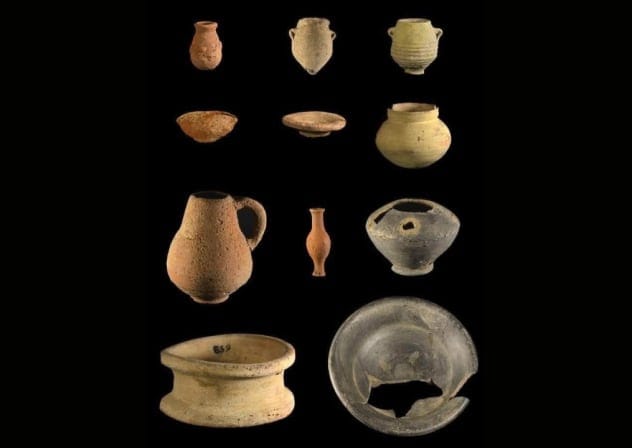
Hanukkah discovery: Rare Hasmonean lamp, Second Temple stylus found near Jerusalem
The Civil Administration said the artifacts add to a growing corpus of Second Temple–era material recovered in recent years across the West Bank.
"We think humans brought pyrite to the site with the intention of making fire. And this has huge implications, pushing back the earliest fire-making," said archaeologist Nick Ashton.
Research focused on human remains found at the Troisième caverne of Goyet, a cave site in present-day Belgium that contains one of the largest known assemblages of Neanderthal bones in northern EU.
Archaeologists uncovered the first known thalamegos near Alexandria’s ancient port, a 35-meter pleasure boat matching Strabo’s account and preserved with Greek graffiti and timberwork.
Israel’s Heritage Minister, Rabbi Amichai Eliyahu, called the discovery: “tangible and moving evidence of Jerusalem’s might and stature during the Hasmonean period.”
The experts who analysed the coins believe, based on the dates on the coins, that the discovery unburied a treasure which was buried between A.D. 280 and 310.
Research published in the Internet Archaeology Journal found that the pits are man-made and were constructed during the late Neolithic period, making them over 4,000 years old.
The slaves lived on the ground floor, in rat-infested 16-square-meter cells that contained up to three people, but archaeologists think their nutrition was enhanced to keep up their productivity.
A targeted operation at "Burj Lasana," in Area B, near Wadi Haramiya, recovered Crusader- and Byzantine-era items from a villa built inside the site.
“It sheds light on the architectural style and the function of the site, which is not mentioned by Josephus, our only historical source for the period,” Dr. Raviv, director of the excavation, said.
Scientists say microscopic magnetite fossils may have enabled an ancient creature to detect Earth’s magnetic field, offering clues to how early species navigated long distances.