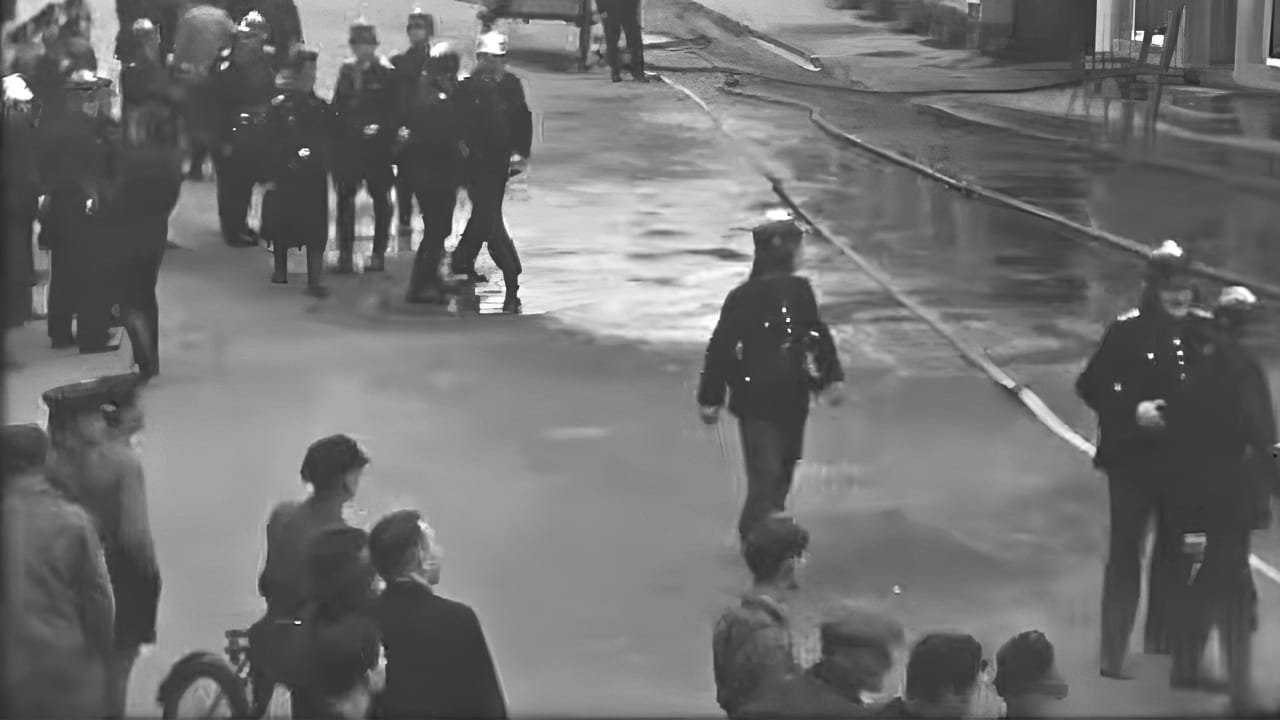
The state-sponsored antisemitic violence of Kristallnacht (“Night of Broken Glass”) on November 9-10, 1938, was a cataclysmic turning point in history.
Over 1,400 synagogues were burned and ransacked, including Germany’s then-largest Neue Synagogue in Berlin. Because of one police officer’s moral conviction, this historic synagogue was saved.
Wilhelm Krutzfeld, the commander of Berlin’s Police Precinct 16, and his fellow officers chased away the attackers, and the fire was extinguished in time, preserving this landmark place of worship. He defied Nazi orders that disallowed fires from being put out in synagogues and Jewish schools, residences, and businesses.
Eighty-eight years later, on November 5, 2026, approximately 150 police leaders convened inside the Neue synagogue to commemorate Kristallnacht for the first time. Instead of protecting the synagogue from the outside, senior police leaders and representatives from the United States, Canada, Germany, and Europe stood inside in solidarity with Jewish congregants to show their commitment to combating antisemitism and securing a democratic society where people can worship freely without fear.
The event was organized through a partnership between Rutgers University Miller Center on Policing, Germany’s GDP (the German police), and the University of Virginia Center for Public Safety and Justice in collaboration with the International March of Living.
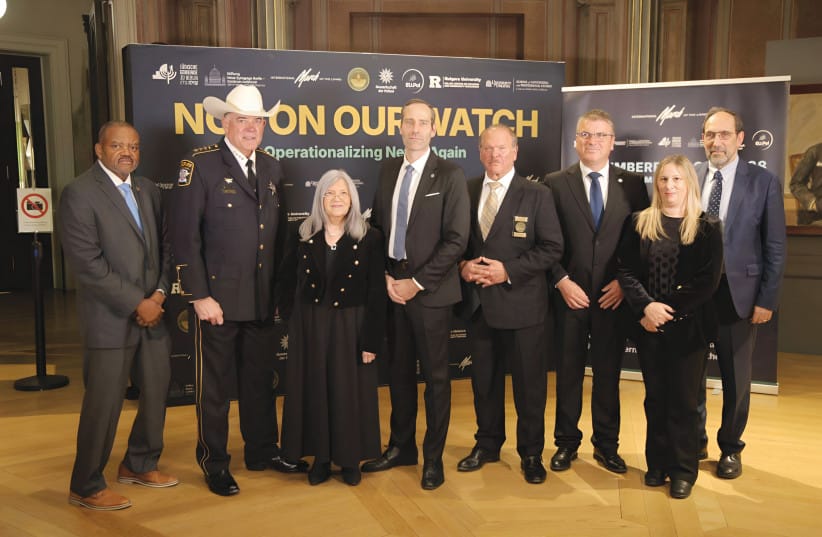
It is part of the international police leadership initiative, “Operationalizing Never Again – Not on Our Watch,” a police training program which examines the Holocaust and the role of police in society, and asks them to confront the painful past.
Never again: Law enforcement
During Kristallnacht, there were law enforcement agents who partook in the violence, facilitated it, or looked away while Jews were beaten and persecuted. Paul Goldenberg, chairman of the international delegation for “Operationalizing Never Again – Not on Our Watch,” and representing the Rutgers University Miller Center on policing, told the Magazine, “We cannot change what happened in 1938, but we can decide what our institutions will do when hatred, dehumanization, and threats to democratic values emerge today.”
Goldenberg has extensive experience investigating hate crimes, has served in the top senior position in domestic terrorism in New Jersey, and has been named America’s Most Influential Person in Homeland Security in 2021 and 2024.
He said that in the last 10-15 years, antisemitism “has evolved into a very dark place. It’s no longer antisemitism; it is targeted violence against a religious community that is supposed to have every freedom of every other religion.”
He said the meaning of a “threat to democracy” has become diluted and politicized, and defined it as “when a religious group no longer feels safe in their houses of worship.”
Referencing the alarming rise in violent attacks against Jews worldwide, he described how, for the first time since the Holocaust, Jews across the US, Canada, and Europe are afraid to go to synagogues and Jewish schools.
He emphasized that when hatred threatens a community, “police cannot afford to stand on the sidelines. Our duty is to recognize the warning signs, confront antisemitism and persecution, and act decisively to protect those at risk. ‘Never Again’ must be a commitment reflected in every action we take – not simply words we remember.”
He stressed the importance of Jewish communities building trusted relationships with police, who are on the first line of defense. “We’re in a very dangerous place. That’s why we need to ensure that our relationships stay close with those that are sworn to protect us,” he said.
At the Neue Synagogue Berlin commemoration, Goldenberg announced that a proclamation to uphold these principles had been signed that morning by police associations, including The International Association of Campus Law Enforcement Executives, which represents chiefs of police at universities.
The ceremony opened with the operatic voice of Israeli soprano Dana Marbach hauntingly singing, “Our Town is Burning,” written by Polish Jewish poet and songwriter Mordechai Gebirtig in 1936.
Jews in camps and ghettos would sing this song about an apathetic crowd watching with folded arms, watching as their beloved town went up in flames. Today, it resonates as a call to action and a desperate plea for help.
Survivor testimony
George Shefi, 94, was seven years old on the “Night of Broken Glass.” Sitting onstage at the Neue Synagogue, he relayed to the audience how he remembers his mother telling him, “You’re not going to school” that day. Shefi sheltered in his family’s apartment in Berlin’s Schoeneberg district for three days while their world shattered and burned down around them.

When he was permitted to go outside with an adult, he saw a Jewish-owned hat shop with broken windows, with hats strewn all around. Another image he said he will never forget was seeing antisemitic graffiti on the sidewalk outside of a stationery store owned by a Jewish man and a Christian woman, that said, “This store belongs to a Jewish pig who is married to a German swine.”
A crowd of about 50 people was screaming outside as someone tried to wash the hateful words away.
On the evening of July 24, 1939, Shefi’s mother told him he was going to travel by train and ship to a foreign country. “She made it sort of an adventure for me,” Shefi recalled.
The next morning, his mother took him with a suitcase of clothes and toys on a train to England. Shefi was one of approximately 10,000 children, most of whom were Jewish from Nazi-occupied countries, who were sent to the UK through Kindertransport after the Kristallnacht pogrom.
“It’s incomprehensible. It’s against all motherly instincts. I admire, but I can’t understand and I never will,” Shefi said. When asked if he could tell her one last thing, he responded that it would be, “Thank you for saving me.” Shefi and his wife, Yael, have three daughters, six grandchildren and five great-grandchildren.
Shefi showed the audience a triangular piece of tile salvaged from the Jewish school he attended that had been burned down. It was given to him as a present by a 12-year-old boy who attended a school Shefi spoke at.
For the past 20 years, Shefi has shared his testimony with more than 12,000 students in Germany. The president of the Republic of Germany honored him with the Federal Order of Merit for his commitment to Holocaust education.
He also authored a memoir, published in 2016, The Way of Fate: A True Story From the Kindertransport.
Phyllis Heideman, president of the International March of the Living (MOTL), met Shefi three years ago, when they brought a delegation of Holocaust survivors, hostage families and victims of Oct. 7 on a march to Auschwitz, which he was a part of. She said that Shefi “embodies living history.
He’s determined to tell the story as loudly and as often and as succinctly as he possibly can. He feels that he is the voice of those who no longer have a voice.”
Referring to what it’s like for a survivor of Kristallnacht to see the frightening spike in antisemitism around the world again, she said that it is “Dangerous, threatening, unbelievable for him that he has to live through it again.
He believes, as many of us do, that there was always antisemitism. It has now risen to a place of social acceptance, and political acceptance. I think it’s actually a badge of honor people have begun to wear.”
She said that Shefi and the other survivors she is in touch with “see this as prewar Germany; as in the days of their youth.” She asked, “Why isn’t anybody listening?”
Heideman said that “one of the most heart-wrenching experiences” of her trip was seeing “Free Palestine” painted in red and green in English and German on the entryway where Shefi’s childhood apartment building used to be, in a historic Jewish neighborhood ransacked on Kristallnacht.
Outside of the building are two brass plates atop stones called Stolpersteine to commemorate his mother and his aunt, who were murdered in Auschwitz. In September 2026, the city council of Heidenau voted to ban future installations of Stolpersteine on public walkways.
Stolperstein has been embedded in sidewalks in Germany for 34 years. The decision was made by secret ballot by representatives of the right-wing Christian Democratic Union (CDU), Alternative for Germany (AfD), and the “Oberelbe Alliance for More Democracy.”
The International March of the Living requested that Heidenau revoke this decision, calling it a “grave warning sign” and “an act of erasure that compounds the crime of extermination.”
Jochen Kopelke, president of the European Federation of Police Unions and the federal chairman of the German Police Union, commented, “History bothers people… We have to bring up Kristallnacht. It’s very important to see the long run in how a Shoah has been planned over the years.”
Paying the courageous act forward
Der beherzte Reviervorsteher, the story of Wilhelm Krützfeld’s courageous act saving the Neue Synagogue, was reproduced by the GdP (German police).
Kopelke said the book shows how important the connection between people and police is. “He knows everything about the people he had to protect… His moral compass was, ‘I have to protect my people and my houses, the synagogue, the churches’… You won’t do cruel things to people you love, or you see, or you know. That’s community policing.”
Kopelke advised young police officers to go to synagogues and kindergartens. “Get in touch with these people you have to protect because if there is an extremist coming with a machine gun and killing everybody, you have to know why you run against him…
“For the three-year-old girl, for the 10-year-old boy. He added, “You have to know them because this gives you power in protecting. That’s why we bring the faces and the human touch into policing.”
Sven Huber, representative of the GdP (German Police), federal executive board for the project “Jewish Life and Police,” told the Magazine that being at the Neue Synagogue in Berlin was very emotional.
He remembered hearing about a Canadian police officer, Jeff Smith, who was shot multiple times and critically injured while heroically saving the lives of about 24 congregants at an Ontario synagogue during Yom Kippur.
“It’s totally crazy that it’s necessary to protect a place of God,” Huber said. “Churches will never need protection in Germany, and mosques don’t need it. It’s only the synagogues.”
Huber was a representative of 50,000 officers, vice president of the federal police union in the GdP and head of staff counsel for the eastern district of federal police unions. He barely learned about the Holocaust in school and grew up not knowing any Jewish people until 1997, when he took a trip to Israel at the age of 33.
When he was walking to the Western Wall, he saw a bookstore with Hebrew letters and “got a very big feeling that we lost a part of ourselves, of our culture.”
He felt an immediate connection with Jewish people and created a “Stelae of Remembrance” memorial in a Jewish cemetery in Gorlitz, Germany, to commemorate 147 victims of the Holocaust, with names displayed on glass panels framed in steel.
Huber said that Shefi addressed young police officers at the Neue Synagogue, concerned about who will share their message with the world when the last survivor has passed away.
“That’s our task, and the generation behind me, too,” he said. “To take the flame of this message from the hands of the last survivors and bring that into the future.”■
November 1938: State-sponsored terror
Beginning in 1933, when Adolf Hitler and the Nazi Party came to power, restrictions and bans were placed on Jewish teachers, lawyers, and doctors; they were excluded from professional organizations, Jewish stores were boycotted, and after Kristallnacht, a decree was issued that eliminated Jews from economic life.
On September 15, 1935, the Nuremberg Laws were enacted, which stripped Jewish people of their voting and political rights. Marriage was forbidden between Jews and non-Jewish Germans. By the late 1930s, German Jews could not own record players or radios.
In 1938, the Nazi regime required stamping a red letter “J” on the passports of Jews to restrict their travel. In 1941, all Jews over the age of six had to wear a yellow Star of David on the left side of their chest and on their back.
By this time, Jewish people were even forbidden from having pets. Signs reading “Jews not wanted” or “Forbidden for Jews” started appearing in parks, movie theaters, restaurants, hotels, department stores and municipal districts throughout Nazi Germany and Nazi-occupied Europe.
In November 1938, riots broke out across Germany, Austria, and the Sudetenland border of Czechoslovakia after a 17-year-old Jewish student, Herschel Grynszpan, shot and killed German diplomat Ernst vom Rath in Paris because his parents had been forced out of Germany for being Jewish.
To retaliate, the Nazi Party’s SS and SA paramilitary and security forces, along with the Gestapo, Hitler Youth, and German civilians, murdered almost 100 Jewish people and rounded up about 30,000 Jewish men, sending them to concentration camps.
Nazi mobs assaulted women and children physically in their homes. Seventy-five to 90% of Jewish homes across several cities were ransacked or destroyed to the point where they were unlivable. Windows were smashed, and merchandise was stolen or burned in approximately 7,500 Jewish-owned businesses.
The state-sponsored pogrom, straight out of Joseph Goebbels’s playbook, laid crucial groundwork for the physical open terror marking the Holocaust.
– E.G.
Click here to view the Kristallnacht commemoration at the Neue Synagogue in Berlin.