NASA
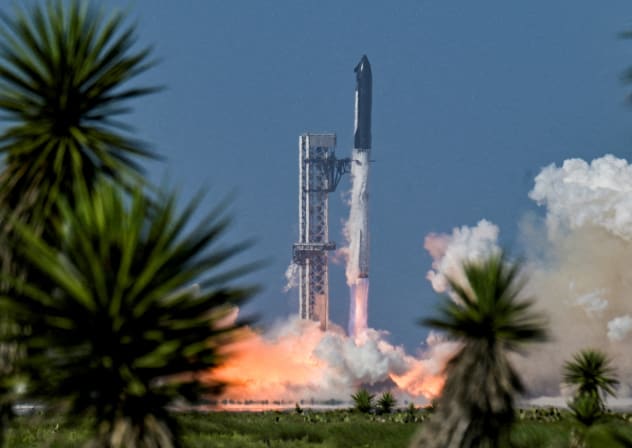
SpaceX's Starship engine failure could cause problem for NASA's 2028 moon mission objectives
A longer delay would pose not only a greater setback to SpaceX's commercial ambitions to rapidly expand its Starlink broadband satellite network, but its pivotal role in NASA's Artemis moon program.

US, China arm for space warfare, raising stakes in race for military control of orbit

NASA launches powerful Roman Space Telescope, a spy satellite turned to the stars

NASA finds some microbes could survive on moon, raising concerns over unintended life transfer
How the world won’t be destroyed: NASA found a solution to a worrying problem
NASA proved for the first time that a small spacecraft can deflect an asteroid. The DART mission collided with Dimorphos, showing humanity can protect itself from cosmic disasters.

Asteroid the size of 59 Avi Loebs to pass Earth on Wednesday, Aug. 27 - NASA
Avi Loeb, a Harvard astrophysicist, kindly provided his measurements for use in this article during an interview with The Jerusalem Post.

NASA finds new tiny moon around Uranus, raising total to 29
The 10-kilometer-wide body orbits 56,000 kilometers from uranus's center between ophelia and bianca and awaits an IAU-approved name.

Powered by Google's AI, NASA's new Crew Medical Officer could be deep space's ER on demand
Physicians rated diagnostic accuracy at 88% for ankle injuries, 74% for flank pain, and 80% for ear pain in early tests, according to NASA presentations.

Mars’ Newest Wonder: Coral‑Style Formation That Has Virtual Botanists Buzzing
“Curiosity has discovered many small structures like this one, formed billions of years ago, when water was still liquid on Mars,” NASA said.

Asteroid the size of 3 T. rex dinosaurs to pass Earth Sunday - NASA
Asteroid 2025 PM is around the size of three Tyrannosaurus Rex dinosaurs. The asteroid won't hit the Earth, according to NASA calculations, and even if it did... life finds a way.
Apollo 13 commander Jim Lovell dies at age 97, NASA says
Jim Lovell, the NASA astronaut who commanded the Apollo 13 mission around the moon and back, has died.

Beijing tests lunar lander tasked with putting first Chinese on the moon
The lunar lander will be used to transport astronauts between the lunar orbit and the moon's surface, as well as serving as a living space, power source, and data center.

SpaceX launches joint astronaut crew to ISS in NASA's Crew-11 mission
While normal crew rotation missions last roughly six months, the Crew-11 crew may be the first to settle into a new routine time of eight months.

Harvard astrophysicist warns interstellar object 3I/ATLAS may be alien technology on sunbound path
Avi Loeb: 'the orbit of 3I/ATLAS coincides with the plane of the Earth by only 5 degrees - the probability of such a coincidence occurring randomly is only 0.2%'.
