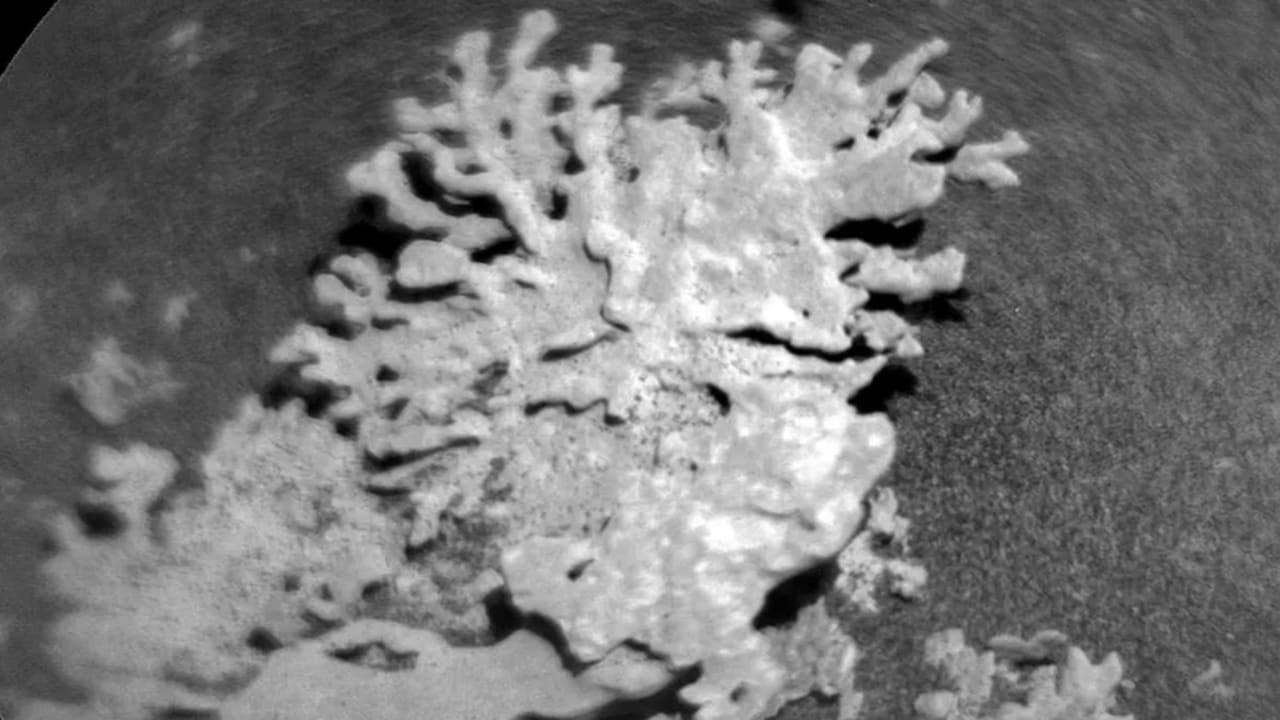
NASA shared a black-and-white image from the Curiosity rover’s ChemCam Remote Micro Imager that showed a small, coral-like rock formation on the floor of Gale Crater. The telescopic photo, taken on July 24, 2023, depicted a structure about 2.5 centimeters wide with intricate branches.
The formation resembled branched corals and even fulgurites, which on Earth form when lightning melts minerals in sandy soil. Although the shape was similar, scientists said it was neither coral nor a fulgurite. The structure likely formed when water, once present on Mars, carried dissolved minerals into tiny cracks in bedrock. As the water dried, the minerals hardened. Over time, wind-driven sand eroded the surrounding rock, leaving the mineral-filled veins standing in relief. “Curiosity has discovered many small structures like this one, formed billions of years ago, when water was still liquid on Mars. Water transported dissolved minerals into the cracks of the rock, then dried, leaving behind the hardened minerals. Centuries of windblasting have worn away the surrounding rock, creating the unique shapes we observe today,” NASA representatives said.
NASA noted that minerals of different compositions responded differently to natural sandblasting, which produced the distinctive shapes and exposed internal structure. What remained was the tougher material that once filled the cracks, creating an inverse of the original voids. Mars no longer had surface oceans, but it still held water as ice at and below the surface. Dust-laden winds, including planet-encircling storms, continued to sculpt the landscape.
Curiosity had cataloged other unusual shapes, including a flower-like rock, a solitary object that resembled a mushroom or a flower, spirals, slender towers and spires, a bubbly rock that looked like frog eggs, and several rocks whose outlines resembled animals or faces. NASA scientists said these objects did not grow; they formed. Scientifically, they were diagenetic crystalline clusters, made of multiple minerals. According to Abigail Fraeman of the Curiosity team, coral-, cabbage-, and stick-like features were likely formed from sulfates precipitated from ancient water. NASA stated these were mineral formations and were never alive.
Images of the coral-like and flower-shaped rocks drew attention from virtual botanists, who spotted plant-like patterns in ancient geological features. The formation, like many others found by the rover, was shaped by long-term erosion and the past action of water.
The find offered clues to how water, wind, and sand molded Gale Crater over millions of years. Like water on Earth, ancient Martian water carried dissolved minerals that seeped through small fractures and gradually formed solid veins. Scientists also noted similar “boxwork” patterns, adding context to Gale Crater’s history.
Gale Crater lay at the boundary between Mars’s cratered southern highlands and smoother northern plains, making it a key site for studying the planet’s geological and climatic evolution. It also remained central to the search for past habitability. Curiosity, part of NASA’s Mars Science Laboratory mission led by the Jet Propulsion Laboratory in California, launched in November 2011 and landed in 2012 after an eight-month, 566-million-kilometer journey. Over 13 years, the rover traversed about 35 kilometers inside the 154-kilometer-wide crater on a winding route that included drilling, sampling, and in-place analysis.
During its mission, Curiosity collected chemical and mineral evidence that suggested Mars once had environments capable of supporting life similar to that on Earth. There were indications that Mars once had a carbon cycle, and the rover found long carbon chains in rocks dating back 3.7 billion years. “Curiosity continues to collect samples and data to deepen our knowledge of Mars’ past, especially in the period when it may have harbored microbial life. We are excited about what is yet to be discovered,” a NASA spokesperson said.
The preparation of this article relied on a news-analysis system.