Byzantine
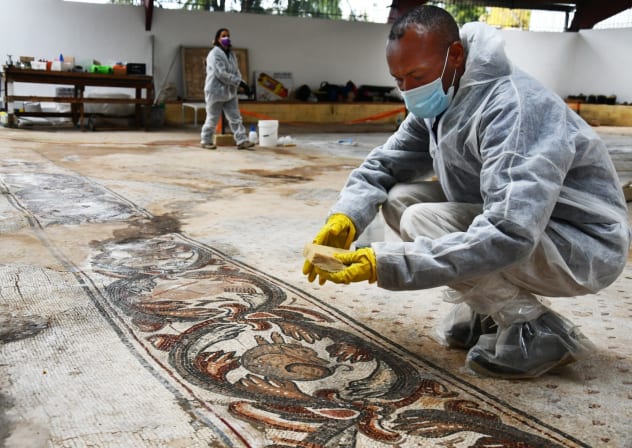
Nahariya's Byzantine church hit by Hezbollah rocket reopens to public after four months
At the time, the IAA had shared with The Jerusalem Post that only the site's modern, protective structure had been damaged in the strike.

Byzantine gold artifacts help archaeologists uncover past of ship wrecked off Croatian coast

Mudbrick Byzantine city unearthed during excavations at Egypt's western desert oasis

Secrets of Huqoq: New Galilee exhibit premieres mosaics, coins found at ancient Jewish settlement
Recycled glass was used in floors of ancient Greek luxury villa
The seven glass samples from the House of Charidemos show a composition quite typical of the late Antiquity soda-lime-silica glass, six of which likely included decolored recycled glass.

Ancient gold ring with amethyst stone found in Byzantine Israel
An ancient jeweled ring was unearthed at the site of an ancient Byzantine winery in Yavne, Israel.

Largest wine factory in the world from Byzantine period unearthed in Yavne
The sophisticated facility was probably able to produce as many as two million liters of wine per year.

1,600-year-old fountain discovered in Istanbul
Turkish archaeologists found a Byzantine-era fountain while repairing an ancient palace in Istanbul.
On This Day: Arabs win historic victory over Byzantines at Battle of Yarmuk
The victory marked the rise of the Caliphate as it expanded outside the Arabian peninsula, and marked the first major clash between Muslims and Christians.

Cookware, gold coin shed light on life in Ramat Hasharon 1500 years ago
Archaeologists found ancient artifacts in a salvage excavation prior to the construction of a new neighborhood near Tel Aviv.

Jewish amulet against ‘evil eye’ offers insight into Talmudic Israel life
The artifact was discovered some 40 years ago in the Galilee village of Arbel by one of its first residents, the late Tova Haviv.

Ancient Greek inscription found by chance in the Negev
The stone was found by a "Project 500" worker from the Parks and Nature Authority while cleaning and preparing nature paths in the Nitzana National Park.

Altar to Greek god found in wall of Byzantine church raises questions
This excavation is now focusing on figuring out how this pagan altar came to be part of the church wall and what the inscription on it means.

2,900-year-old Urartu archeological park to be opened to public
Three sarcophagi containing the sole specimens from the Urartu Kingdom were found at the site.
