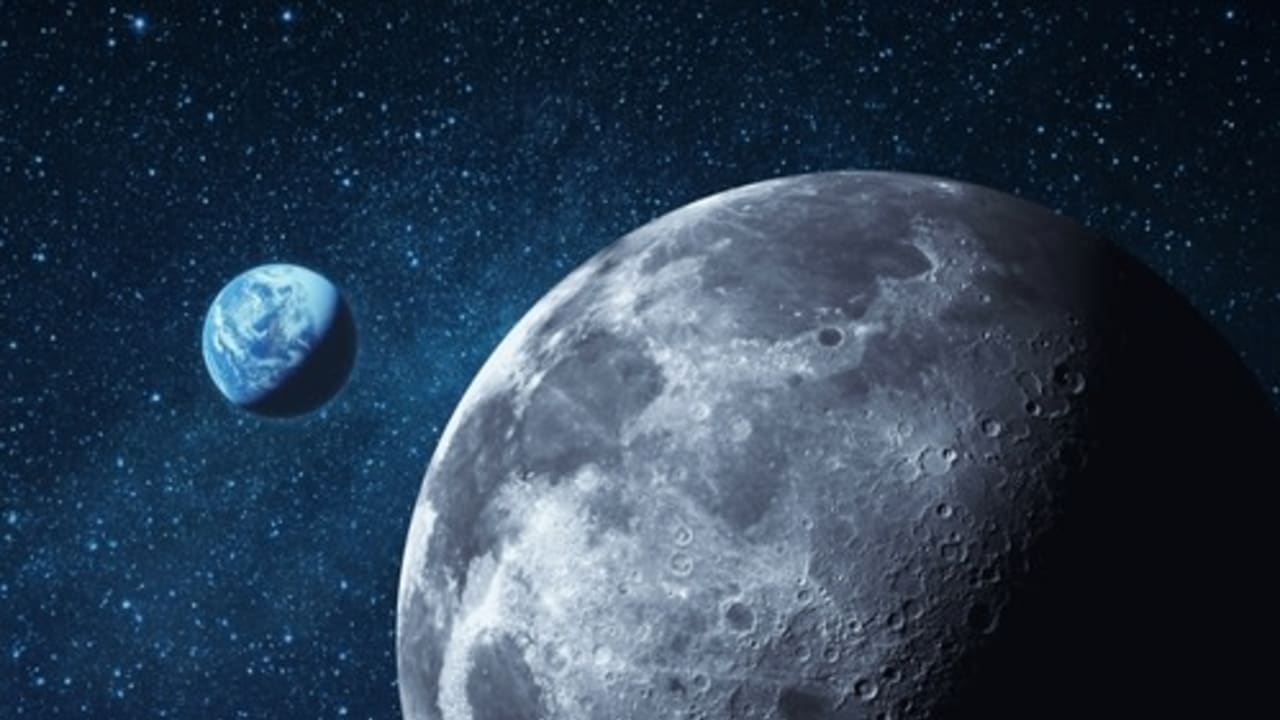
If you thought Earth has only one moon – think again. A new study claims that our planet is actually almost always surrounded by about half a dozen tiny moons that orbit it briefly and then leave Earth to continue orbiting the Sun on their own paths.
But that's not all. Contrary to the previously held belief that these are small asteroids temporarily caught by Earth's gravity, the new research points to a completely different origin: The Moon itself. In other words, the Moon gives birth to its own small moons.
The study, published in the journal Icarus and conducted by a team of researchers from the United States, Germany, Sweden, Finland, and Italy, found that when asteroids strike the Moon, they eject rock fragments and dust into space. Some of these particles are small, but sometimes there are fragments one or two meters in diameter – large enough to be captured by Earth's gravity and become "minimoons."
The researchers compare this cosmic dance to a waltz where each partner changes and leaves the floor intermittently. Likewise, these minimoons orbit Earth for a short time (on average about 9 months), and then continue on a path toward the Sun. In rare cases, they even strike Earth or crash back onto the Moon.
Two Main Suspects: Kamo'oalewa and 2024 PT5
Two minimoons discovered in recent years helped turn this new hypothesis into scientific reality. The first, Kamo'oalewa (the Polynesian name for object 469219), was discovered in 2016 and found to reflect light in almost the same way as lunar rocks – reinforcing the theory that it’s a lunar fragment ejected from the surface.
The second, 2024 PT5, was discovered only last year and was immediately dubbed "Earth’s second moon." It, too, according to researchers, doesn’t resemble a typical asteroid but reflects light in a way that closely matches lunar rocks. It may be a fragment thrown from the Moon by an ancient asteroid impact, just like its predecessor.
The Grandfather, the Father, and the Tiny Moon
If this hypothesis is correct, it forms a fascinating cosmic lineage: The Moon is essentially the parent of the minimoons, and Earth is their proud grandfather. It also supports the “giant impact hypothesis,” which suggests that the Moon itself was formed from the collision of a Mars-sized body with Earth about 4 billion years ago, ejecting material into orbit that eventually coalesced into a full moon.
How Many Minimoons Are Orbiting Us Now?
According to researchers’ calculations, there are on average 6.5 minimoons with diameters larger than one meter orbiting Earth simultaneously at any given moment. But as researcher Robert Jedicke from the University of Hawaii admits, “The uncertainty is huge. We’re talking differences of several orders of magnitude, so the estimate could be off by a factor of a million.”
How is that possible? Some minimoons are extremely small, about the size of a car, and they move fast. It’s very difficult to detect them with telescopes. Sometimes they appear in images as a blurry streak, which algorithms simply ignore.
Nevertheless, thanks to new technologies, a few have been identified. One of them, 2020 CD3, was within viewing range for about a thousand nights – but was detected on only two of them. And that’s considered an achievement, not a failure.
Not Just Science – Also a Commercial Opportunity
These minimoons may have commercial potential: They’re much easier to reach than the distant asteroids in the Mars-Jupiter belt. Instead of spending fuel to get there and mine minerals, perhaps these little visitors can be intercepted while bouncing around us.
But researchers emphasize: The real value is scientific. These minimoons can help better understand how craters form on the Moon and Earth, how material is ejected from celestial bodies, and perhaps even shed new light on the formation of the solar system.