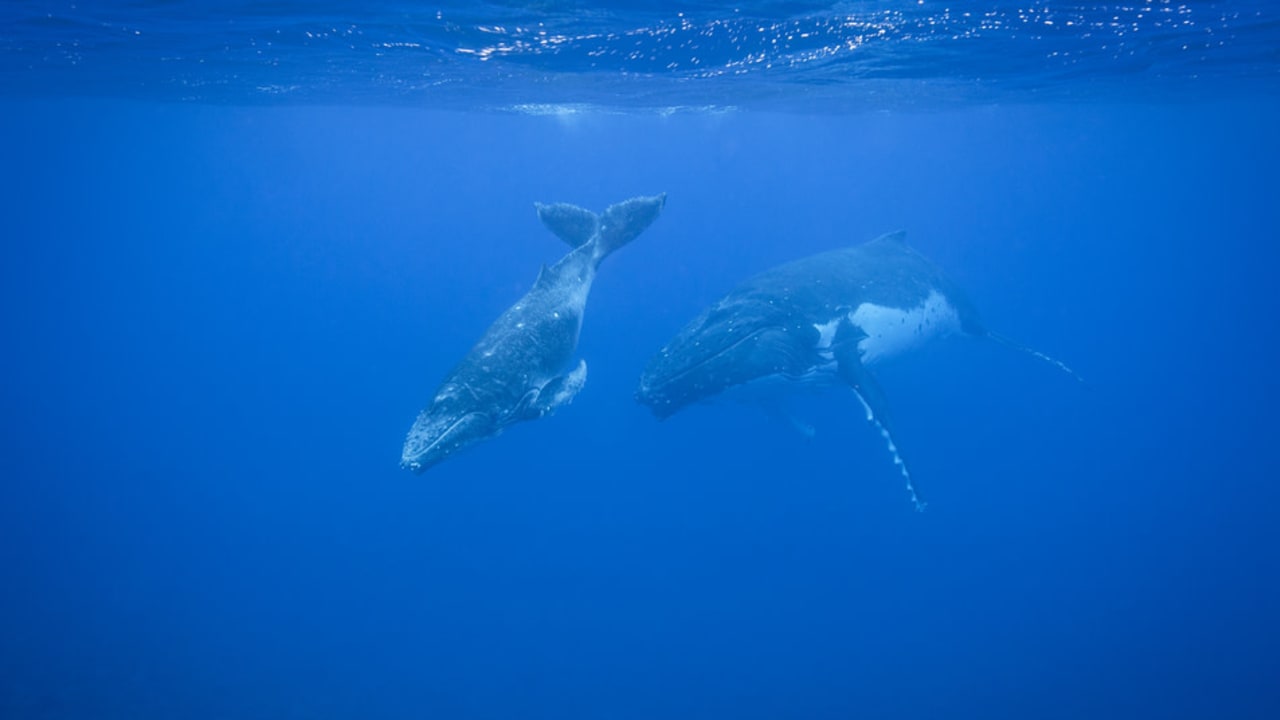
A strange phenomenon has been observed in oceans around the world: Mysterious "smoke" rings that have taken over the internet in viral videos. A new study reveals that these rings are created by humpback whales—marine giants known for their long pectoral fins and mesmerizing songs. Surprisingly, this discovery may serve as a key in the search for intelligent life in space.
In a study published in the journal Marine Mammal Science, researchers from the SETI Institute and the University of California, Davis, revealed an extraordinary behavior of the whales, which they called "poloidal vortex bubble rings."
"Humpback whales live in complex societies, are vocally diverse, use bubbles as tools, and even assist other species that are harassed by predators," explained Dr. Fred Sharpe, a co-investigator from the University of California. He referred to the whales' ability to create bubble “nets” to trap fish or bubble trails to attract mates. "Now, similar to a communication signal candidate, we show that they are releasing bubble rings toward us, possibly as an attempt to play, test our response, or communicate."
Whales Are Teaching Us How to Talk to Aliens
The study, conducted as part of the WhaleSETI project, documented 12 instances in which 11 humpback whales released 39 bubble rings toward humans, mainly when passing near boats and swimmers. Unlike the use of bubbles for capturing fish or attracting mates, this behavior appears to be a friendly attempt to communicate with us. "We found a dozen whales in different parts of the world, most of which voluntarily approached boats and swimmers and released bubble rings during curious behavior," said Judy Fredianni, a marine wildlife photographer and co-investigator.
Researchers see this behavior as a clue to how intelligent beings, such as aliens, might communicate—a signal that extraterrestrials might send to make contact, just as whales are reaching out to us with their rings. "Due to technological limitations, an important assumption in the search for alien intelligence is that aliens will want to make contact and will reach out to humans," explained Dr. Laurence Doyle of the SETI Institute. "This assumption is certainly supported by the independent development of curious behavior in humpback whales."
More Than Just a Game: A Key to Life in Space?
This phenomenon may shed light on how non-human intelligence manifests itself and prepare us to identify signals that could come from aliens. "Just as researchers study Antarctica as a model for Mars, we study communication by non-human intelligent beings in the sea to develop tools for detecting life in space," the researchers explained. Karen Pryor, a marine behavior researcher, noted that "the patterns of bubble creation in whales constitute a form of communication not available to terrestrial mammals."
The study also touches on other theories about aliens. A 2024 study by Harvard and Montana universities suggested that aliens might already be living on Earth in disguise, possibly in underground bases. But while that theory remains speculative, the whales' bubble rings are tangible findings that show how curiosity and communication can bridge species that do not share a common language.