
Rosh Hashanah is not only the Day of Judgment, it is mainly the day of the creation of the world and of crowning the Holy One, blessed be He, over us. Kingship has no existence and no foundation without unity.
Therefore, on Rosh Hashanah, in every heartfelt and tearful prayer, even before we ask for “joy for Your land and gladness for Your city; that all wickedness should vanish like smoke, and that You, O Lord our God, reign soon, alone, over all Your works…” we make one important request:
“And they shall all form one union to do Your will with a whole heart” (from the prayer liturgy, High Holy Days).
Rosh Hashanah is a day of unity. For indeed, God wants us to be in unity: that we honor one another, and that we respect each other’s wishes and aspirations.
Unity does not mean uniformity of opinion. The people of Israel will always be divided into communities, classes, tribes, and congregations. But what is necessary for us as a people is to be tolerant of the opinions of others, even when they differ, and also of their mistakes. No person is infallible. And when blind hatred is absent from public and personal discourse, the way is paved toward a pleasant and rectified world.
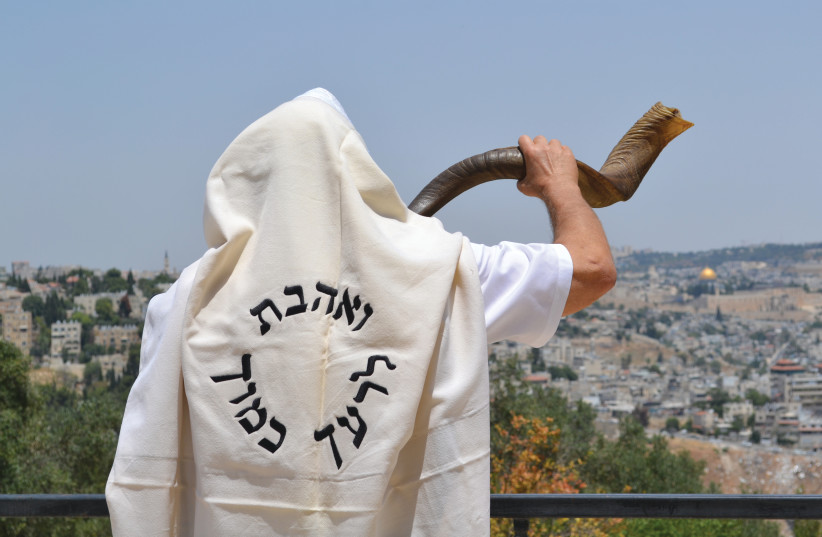
The people of Israel have always been known to be in solidarity in the face of another’s distress. The Jewish heart has never remained apathetic in the presence of the suffering of individuals or communities. The pages of history are filled with such stories.
Jewish strength lies in unity and mutual support
Who has not read of Jews who sold all they had to redeem captives, including those they had never even known before? Jewish women agreed to give their last piece of gold jewelry for a stranger, only because he was a captive, because she was sick, because he was an orphan, because she was a widow...
Exactly 85 years ago, on the eve of Yom Kippur 5701 (1940), the ship Atlantic, bound for Mandatory Palestine, anchored at the shore of Istanbul with 1,600 refugees from Central Europe on board. (These refugees would become “the exiles of Mauritius,” being detained by the British at Haifa and interned on the remote African island, about 900 km. east of Madagascar, for five years).
Suddenly, as if from nowhere, Turkish Jews appeared on the Atlantic with 1,500 fresh loaves of bread. Suddenly, the weary passengers had food for the meal before the fast. That in itself was wonderful, but much more so, the gesture of solidarity uplifted their spirits. For they felt the embrace of brethren, and this gave them strength for the continuation of the journey.
In that same period, a group of Jews from Germany who had fled the Third Reich arrived in Panama. They had nothing in that land; all their possessions had been left behind. Despairing and destitute, they remained in detention as “enemy aliens.”
All this, until local Jews, immigrants from Aleppo, Syria, heard about it. They paid all they had to release the group from detention, and with all their strength and wealth, they helped to establish the German-Jewish community in Panama.
The Jewish nation has always known how to unite and to open its heart to one another in times of trouble. But the true work is to love and to respect always, in every situation.
Our work on Rosh Hashanah is to stand before God in unity and in love of our fellow Jews.
The Torah portion read every year before Rosh Hashanah opens thus:
“You are standing today, all of you, before the Lord your God - your leaders, your tribes, your elders, and your officers, all the men of Israel…” (Deuteronomy 29:9).
The commentators explain that this verse hints to Rosh Hashanah. “Today” – the holy Zohar teaches – refers to the Day of Judgment. On Rosh Hashanah, God wants us to stand before Him, all levels of the people of Israel, together, as one person with one heart, without separations or divisions.
“Your children, your wives, and the stranger that is in your camp, from the hewer of your wood to the drawer of your water…” (ibid., v. 10).
On Rosh Hashanah, we will purify our hearts from feelings of hatred and division of hearts, we will topple the walls of social separations, and we will stand together before God, “one union.” Thus we will merit a good and happy year.
The writer is rabbi of the Western Wall and the Holy Sites.