
The Holocaust in Norway was especially devastating relative to the size of the country’s small Jewish community. Of the roughly 1,100 Jews who remained in Norway and did not flee, about 770 were murdered, mainly in Auschwitz.
There was almost no Jewish community in Norway until the mid-19th century because Jews had been explicitly barred from entering the country. The community that did emerge after 1851 was badly damaged in the Holocaust and never truly recovered. To this day, it remains one of the smallest Jewish communities in Europe.
The rate of destruction during the Holocaust was high because of the cooperation of the government led by the traitor Vidkun Quisling, “the Norwegian Führer.” At the same time, compared with other occupied countries in Western Europe, the rescue rate was also notable.
About 1,000 Jews managed to escape earlier to neighboring Sweden, with the help of civilians and underground networks. Sixty-eight Norwegians were recognized by Yad Vashem as Righteous Among the Nations.
Against this backdrop, one story stands out, about a remarkable bond between a pastor in the northern city of Trondheim and the rabbi of the Jewish community, and between the local Methodist congregation and the Orthodox synagogue community.
Who was Pastor Einar Anker-Nilsen?
The Germans invaded Norway in April 1940, and local authorities, including the police, helped arrest and deport Jews. In Trondheim, on the shores of the fjord of the same name, they established a naval base for submarines. Nearby, Hitler had grandiose plans: a forward naval base for Nazi Germany was to be built there.
A year after the invasion, the Nazis turned their attention to the city’s beautiful synagogue, housed in a building that had once been Trondheim’s first railway station. The building still stands in the city center today, bearing on its façade the striking inscription, “And I will be to them a small sanctuary,” a common term for synagogues in the Diaspora.
The Nazis confiscated this “small sanctuary” and turned it into soldiers’ quarters and horse stables. The building suffered extensive damage. Benches were thrown out the windows, and the stained-glass windows decorated with Stars of David were shattered and replaced with swastikas. The synagogue’s ornate chandeliers were used by the Nazis as target practice. The mikveh in the basement was also disabled.
The Germans who took over the synagogue also forbade Jews from gathering, either publicly or privately, even for religious ceremonies. At that point, Methodist pastor Einar Anker-Nilsen came to the aid of his longtime friend, Rabbi Abraham Israel Jacobson.
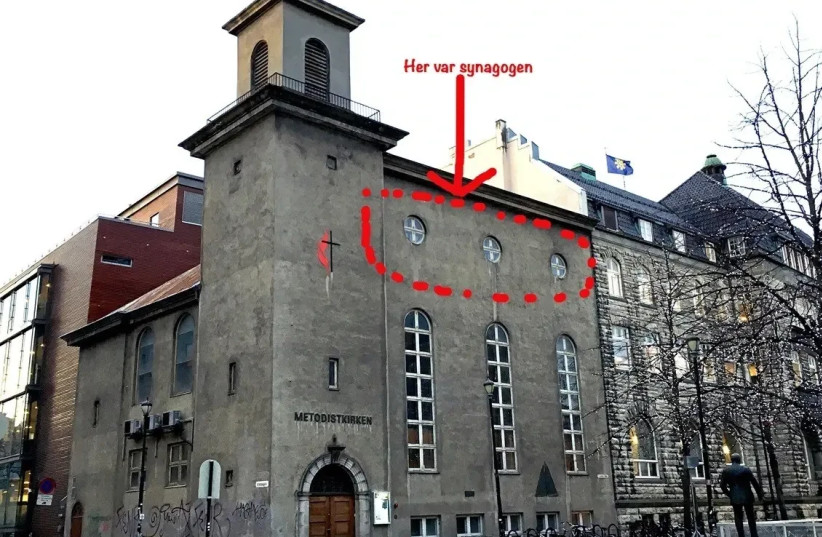
Under the occupation, and with Gestapo soldiers threateningly present in the streets, Anker-Nilsen allowed the city’s Jews to use a small hidden space in the church. They came one by one and climbed up to pray in their secret synagogue in the attic, a room that today is used for meetings of the Methodist scouts. Bar mitzvah ceremonies were also held there.
From the round windows, they could look down to see whether danger was approaching, and the church also arranged an escape route into the neighboring building through a small opening connecting the two. It was clear that if the Germans discovered the arrangement, everyone involved would face deportation. That did not deter the pastor or his partners in secrecy, and this was only one of their courageous acts on behalf of the city’s Jewish community.
Pastor Anker-Nilsen, together with Andreas Uneland, the head of his church community, also helped hide the Jewish community’s property, which had been smuggled out of the synagogue at the last moment and concealed in the attic of the Methodist church. The two men crawled on all fours through a narrow opening in order to place the valuable items, including Torah scrolls, tefillin, the curtain bearing the community’s symbol, and other sacred objects, in a safe place.
“And then came the terrible day when the hunt for the Jews began,” Pastor Einar Anker-Nilsen wrote in his memoirs. “They were captured brutally and sent to concentration camps in Germany. Their fate is known and engraved forever in our consciousness. We identified deeply with them, but there was so little we could do. Our helplessness was unbearable.”
In October 1942, the Germans arrested all Jewish men aged 15 and older, and they were eventually sent to camps. The women and children were gathered into two apartments owned by Jews. One of them belonged to the family of 13-year-old Sissi Klein, who was taken from school by Norwegian police, murdered, and later became a symbol. They, too, were later sent by ship to Poland. All of them were murdered or died.
In 1943, from what had once been Trondheim’s thriving Jewish community of about 330 people, only three elderly and sick women remained: Fanny Berman, Sarah Jacobson, and Deborah Klein. At the time, they were hospitalized and on their deathbeds in a local hospital. The Germans, perhaps wanting to preserve appearances, or assuming the women would die soon anyway, left them there.
Rabbi Abraham Israel Jacobson could not bear the thought that these three Jewish women would not receive a final honor according to their faith. Jacobson, a rabbi, mohel, and shochet, had actually been born in Tiberias. He emigrated to Eastern Europe, made his way to Trondheim, and settled there. But he traveled frequently, among other reasons, to arrange the import of kosher meat to Trondheim, after kosher slaughter had been banned in Norway as early as 1929.
By chance, on the day the Nazis entered the city, he was in Sweden and received a telephone warning that his name was on the arrest list. He remained in neutral Sweden, but then asked another favor of his old friend, Pastor Anker-Nilsen, and together they devised a secret and dangerous plan that would ensure the three women received Jewish burials.
The rabbi smuggled a secret envelope into Norway and hid it in a local shop. It contained precise instructions: where to find the keys to the gate of the Jewish cemetery and how to carry out a proper Jewish burial. The hospital received a secret message instructing staff to contact the pastor if one of the women died.
And indeed, when Sarah Jacobson died on March 7, 1943, Pastor Anker-Nilsen did not hesitate, and he did not fail her. He acted according to the detailed instructions he had received from the rabbi.
“My task as a ‘substitute rabbi’ was to care for the elderly women hospitalized there and make sure they received a dignified burial,” Pastor Einar Anker-Nilsen later wrote. “I received detailed information about what the burial should look like: a rectangular coffin without nails, unpainted, covered with a black cloth, and without flowers. The deceased was to be wrapped in shrouds according to Jewish law. With strange feelings, I read from our own ritual: ‘I am the resurrection and the life; whoever believes in me, even if he dies, shall live.’ The small crowd was deeply moved.”
And so the pastor walked through the city streets at the head of a small funeral procession, reciting psalms and prayers. Although he was forced to use Christian texts, he did so with a profound sense of mission toward the Jewish people. “I saw the Germans stop to watch what was happening, but they found nothing suspicious and moved on.”
After the war, four of the men who survived Auschwitz returned to the city of Trondheim. The few survivors of the Jewish community discovered that, thanks to the pastor’s secret actions, the sacred items had been preserved in excellent condition throughout the war and, to their astonishment, were returned to them when they came back to the city.
They did not forget the pastor who had helped them pray in secret, bury their dead, and preserve the city’s Jewish heritage. As a gesture of gratitude, they offered him the chance to choose one item from a community member's silver collection. The modest pastor chose only a small silver sugar utensil.
The rabbi himself did not return to lead the shattered community. Abraham Israel Jacobson remained in Sweden after the war and served as a multi-purpose rabbinic figure, rabbi, mohel, and shochet, in four small Scandinavian communities, until he was formally appointed rabbi in Stockholm.
His grandson, Tzemach Jacobson, who was a child at the time, remembered him after the Holocaust as being deeply occupied with helping around ten thousand refugees who had arrived in Sweden, handling immigration matters, and providing social and medical assistance. He later donated his archive, which contains about 12,000 documents, to Yad Vashem.