
‘Just as Israel was redeemed from Egypt in the merit of righteous women, so they will be redeemed in the future in the merit of righteous women.” This rabbinic saying puts women at the very center of the story of the redemption of the Jewish people, both past and future.
The Az Nashir Haggadah does not allow the Exodus from Egypt to remain merely a memory. It reminds us that redemption is real. But it is also incomplete.
A very moving and deeply feminine contribution appears in the preparatory section. In Ruti Eastman’s tehinah (prayer) for Passover eve, she pleads: “Hashem, remind me that dust is not hametz and the people I love are not korbanot [sacrifices].” In one line, she rescues the stressed-out Jewish woman from the tyranny of misplaced piety as she prepares her home for Passover.
Similarly, Rachel Weinstein’s “Looking for Breadcrumbs” transforms bedikat hametz into an inner reckoning with the trauma of these past few years. She writes of “scraps of sadness prompted and provoked by piercing sounds and unsettling booms.” The ritual of burning hametz becomes an act of reclaiming Weinstein’s sense of freedom in a time of war.
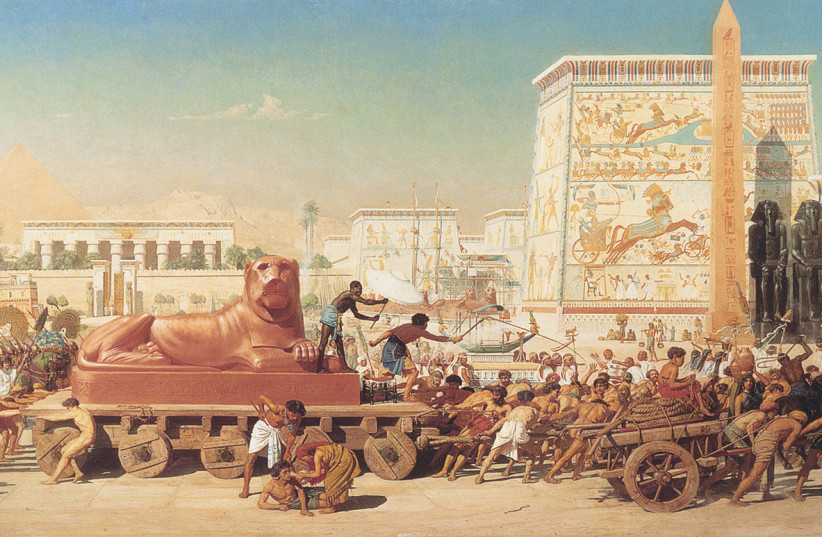
'Our story is not only one of survival'
There is also a deep national consciousness running through the volume. In an essay reclaiming Arami Oved Avi (“My father was a wandering Aramean”), author Tamar Weissman reminds us that “our story is not only one of survival, but also about self-discovery, self-determination, and, ultimately, of becoming God’s people in the land that responds to us as we respond to Him.”
These pages were shaped in the shadow of Oct. 7 and its aftermath, and the writing carries that weight without collapsing under it. It is the third volume in a series of books, published by Shira Lankin Sheps of The SHVILLI Center and The Layers Press, giving voice to the manifold emotional expressions that poured out of Jewish women in Israel after Oct. 7. The series is named Az Nashir: We Will Sing Again. That tension, between tears and song, runs through the entire Haggadah, which is a joint endeavor with Matan, a Torah learning institute for women.
Sheps reminds the prospective reader, “Torah that comes from women doesn’t only benefit women. This scholarship is profound, insightful, and rich. I know that anyone can find inspiration in these pages.”
It includes educational, storycrafting, and psychological insights, conversation prompts, and other design elements, in addition to full-color reproductions of women’s art and photography. The art is produced by women whose spiritual lives are inseparable from the land and the redemptive significance of the hour.
This Haggadah is ideal for Orthodox or traditional households seeking women’s Torah voices grounded in Halacha and classical sources; Israeli families or Diaspora Jews connected to contemporary Israeli reality; educators and communal leaders looking for prompts to spark intergenerational conversation; and those who find that the standard Haggadah no longer speaks adequately to a post-Oct. 7 reality.
Most importantly, this Haggadah enhances the Seder by restoring its urgency. It reminds us that we are not reenacting a distant myth. We are participants in an unfolding redemption.
“The essence of the Haggadah is asking that question of what it means to walk that path to redemption. It sees all of us as standing on the shore, watching miracles unfold, catching our breath from the last few years, ready to step into our future,” writes Sheps.
“The voice is unique, the Torah is deep, the insights are fresh, and after being immersed in this work for the last year, I can say that I think there has never been a Haggadah like it. This Haggadah is a product of our time,” she concludes.
Available on www.shvillicenter.org and in local bookstores.
The writer is a freelance journalist and expert on the non-Jewish awakening to Torah happening in our day. She is the editor of three books on the topic: Ten from the Nations; Lighting Up the Nations; and Adrift among the Nations.
THE AZ NASHIR HAGGADAH ON THE PATH TO REDEMPTION
Anthology of Women’s
Seder Insights
Matan Edition
340 pages; NIS 150