Post-Soviet Union Jewry suffered lingering shame and self-depreciation following the collapse of the communist empire, and according to Dnipro Chief Rabbi Shmuel Kaminetsky, fostering pride and joy in Judaism and Jewish identity in Dnipro has shown how to restore such communities.
When he was younger, Kaminetsky aspired to live in New York City and study and work with its Lubavitch community. Yet this was not to be, as Lubavitcher Rebbe Menachem Schneerson asked him to rebuild the Jewish community in Dnipro. This was no ordinary task, but a “deeply personal mission” in the city where Schneerson had grown up.
Kaminetsky related that Schneerson had spoken often about his father and mother’s contributions to the community in the Ukrainian city. Rabbi Levi Yitzchak Schneerson had been Dnipro’s chief rabbi until he had been imprisoned and exiled for his defiance of communist efforts to suppress Judaism.
When Kaminetsky arrived in the Closed City in 1990, the years of pogroms, Nazi conquest, and Soviet oppression had reduced almost fifty synagogues to one small house of worship.
The congregation was not happy about being Jewish, said the chief rabbi, ascribing to what he called “oy vey Judaism.”
“Many were ashamed to be Jews,” said Kaminetsky.

From shame to pride
The rabbi faced a great task in changing the mentality from shame to pride. While many Dnipro Jews were concerned about any Jewish displays of celebration, Kaminetsky said that he hosted parties with singing and vodka to break the grim fear that had crystallized around the stagnant community.
“My job is to make Jews happy,” said Kaminetsky, rejecting any grand purpose or recognition for himself.
He saw himself as only a small lever that had raised rhetorical community, attributing everything to “luck” and the goodwill of donors and partner organizations, such as the American Jewish Joint Distribution Committee and the Combined Jewish Philanthropies of Greater Boston.
The Dnipro Jewish community built itself around a synagogue that had been a dance club and warehouse during the Soviet period, before being reconstructed. It also shares the site of a residence of the Schneerson family.
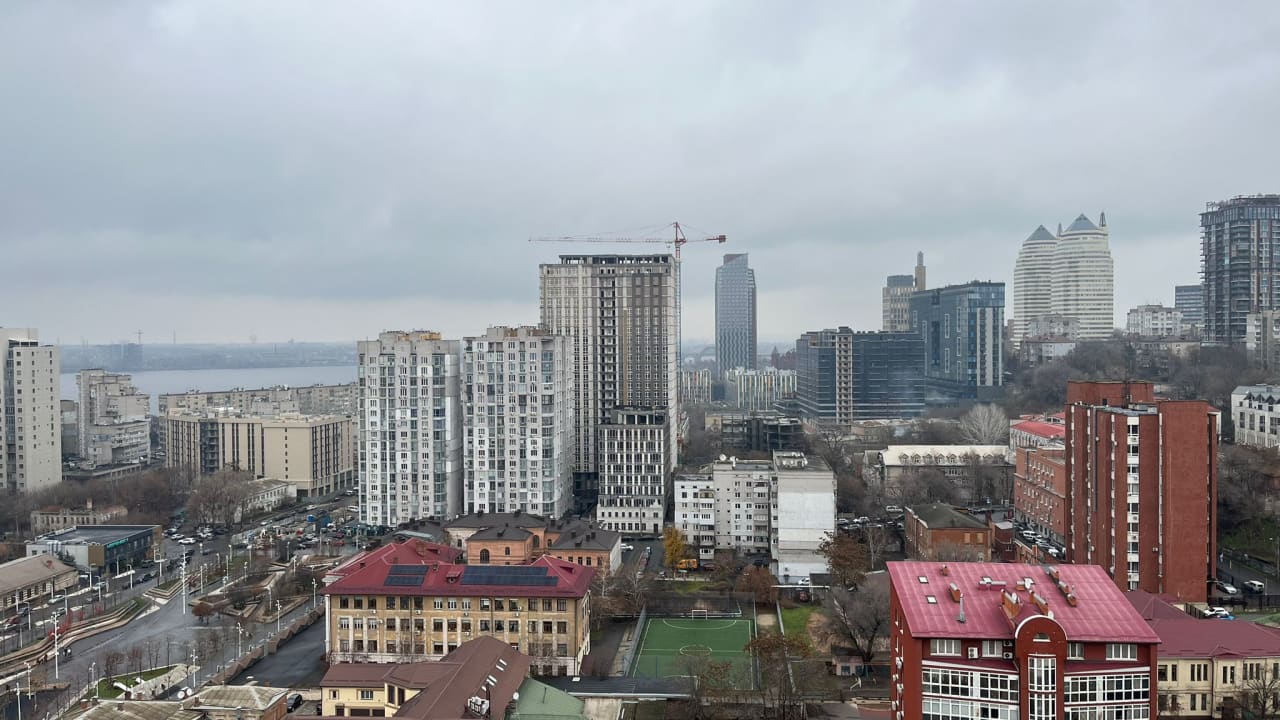
Far from the subdued community of post-Soviet Jewry, the Jewish Center that was built around the reclaimed synagogue was an unabashed statement of Jewish pride. The Menorah Center stands 22 stories tall, with seven towers topped with glass domes. While now unlit due to the ongoing Russia-Ukraine War, the tower tops normally light like candles in the dark Eastern European night.
The 50,000 square meter Jewish Center is home to two hotels, two restaurants, a kosher supermarket, a museum, a lecture hall, and offices.
The Chabad house maintains a home for the dozens of Israeli dental students who have braved the war to live in what they described as an “amazing” community. The students, a small clan of often related Bukharian Jewish students, needed a place outside of Israel to gain their certifications, which also provided kosher food and Jewish community opportunities. Despite the war, Dnipro seemed a natural choice to them.
Foreign aid was not the sole element that led to the building of such an impressive community; Kaminetsky also credits the local Jewish residents for rising to the opportunities that were presented.
In addition to the Jewish Medical Center attached to the Menorah Center, which treats Jews and Non-Jews alike, there were also plans to build an emergency room with attendant ambulances.
The local community recognized that the leading cause of death among Dnipro’s Jews was delayed emergency response times. A Dnipro man whose father died from a fish allergy because an ambulance failed to arrive in time became a major donor for the project, one of the many locals to support such endeavors.
The Menorah Center holds great importance not just to the local community, but also for Jews across the region. The Federation of Jewish Communities in Ukraine (FJCU) is based at the center, reaching out to a network of almost 178 communities, according to FJCU chairman Rabbi Mayer Stambler.
Dnipro is a major hub for the Jewish Relief Network Ukraine, which uses the Menorah center facilities to prepare holiday packages for needy and elderly Jewish people in the country. Kolel Torah in Ukraine operates from the building, with 20 centers, 100 kolels, 1900 students, and thousands more participants across the region.
Kolel head Rabbi Moshe Weber explained that not many in the region had a connection to Judaism, and the education system had to build the ties “from zero.” For many in the region, Jewishness was just Hanukkah, and Hebrew and other basics had to be taught for further learning.
Teaching these fundamentals led to the distribution of 10,000 mezuzahs and three thousand pairs of teffilin. A leader of the Dnipro Kolel said that the Kolel and Menorah Center performed a Jewish “revolution in the city.”
Jewish education has expanded in other areas, with a Yeshiva with dozens of students, and the Levi Yitzhak Schneerson school, which has a mixed school, boys school, and girls school.
Founded in 1991, its 500 students who receive Hebrew lessons and Judaic studies in addition to their secular curriculum.
Dnipro Jewish community director Zelig Brez said that having children who could speak Hebrew as a second language in the same way that their parents spoke Russian was a source of pride.
Growing up, Brez was subjected to persecution and bullying, which he said was typical for Jewish children under communist rule. He couldn’t understand why his teacher denigrated him, what made him different as a Jew.
While bullied at school for his differences, at home, families like his struggled to hold on to the Judaic practices that the Soviets so despised. His family didn’t know enough about their heritage to tell the story of the exodus at Passover Seders, nor to have bread alongside matzah at the meal.
Brez wanted to ensure that the story would continue to be told, that Dnipro’s Jewry would know their heritage. Now there was a school in which children were rewarded for embracing their Jewish roots, featuring a merit system in which they could win prizes for learning a page of Mishna, participation in classes, and other special activities. Many of the children were listening to Israeli music.
It wasn’t just the children learning. At a kindergarten, Brez said parents learned from their sons and daughters about Kosher food. A girl had told her mother about the challahs they baked at school, which encouraged the woman to bake the traditional bread for the first time.
The renewal of traditions among Dnipro Jewry is not just a matter of pride, but also hope. Before the collapse of the Soviet Union, Brez said that there were 100,000 Jews in the city and the surrounding area.
Almost half left in mass Aliyah and mass emigration, and the Jewish population was further halved by flight from the 2022 Russian invasion. It was difficult to know how many Jews there were in Dnipro in 2026, but Brez estimated 15,000 to 20,000, of which 10,000 were active in Jewish life.
Assimilation was also a challenge, according to Kaminetsky, and hard work was needed to reverse the phenomenon, but the congregation was seeing positive results.
Kaminetsky said that a good life could be had living in Dnipro, a nice city with a large boardwalk along the river of the same name, ample parks, and hope for the future.
Brez compared the reconstruction of the city’s Jewry to the destruction of the city’s large Jewish cemetery. The tombstones had been repurposed by the communist government for construction materials.
The modern community built a memorial in the cemetery’s place, and tombstones were still being discovered and repatriated to the site. Dnipro’s Jews, like many Soviet Jews, suffered persecution and degradation.
By breaking free from the shadow of the past, they’ve been able to build a monument to Judaism worth being proud of, a beacon for ingathering the Jewish community remnants discovered daily.
When asked about the difficulties of the Dnipro Jewish community and how it felt to see how far the congregation had come, Kaminetsky quoted Psalms.
“They who sow in tears shall reap with songs of joy.”