
Written with the sensitivity of a female Torah scholar, Rabbanit Alissa Thomas-Newborn’s Shabbat Guidebook for Parents: Halacha of Caring for Infants, Toddlers, and Children on Shabbat and Yom Tov speaks to parents and grandparents and anyone entrusted with young children. It is a guide to balancing Halacha (Jewish law) and spirituality at the heart of family life.
I only wish I’d had this resource when my children were young, and I’m delighted to have it now that I’m a grandmother.
In the chapter on Shabbat day, the author addresses a question many people ask: Why are so many details necessary, and do they all really matter?
Quoting the Aish Kodesh (Rebbe Kalonymus Kalman Shapira, 1889-1943, the grand rabbi of Piaseczno, Poland), she explains that just as shmita (the sabbatical year, when land rests in the agricultural cycle) teaches us to value both attention to detail and the ability to step back from it – to care for both the physical and the spiritual aspects of the work we do – so every halachic detail carries holiness that is at the level of Mount Sinai.
“When we love someone (like a spouse, friend, or our children), we care about everything.... Preparing for and relishing Shabbat and Yom Tov are the same... because through the details, we show love and commitment,” she writes.
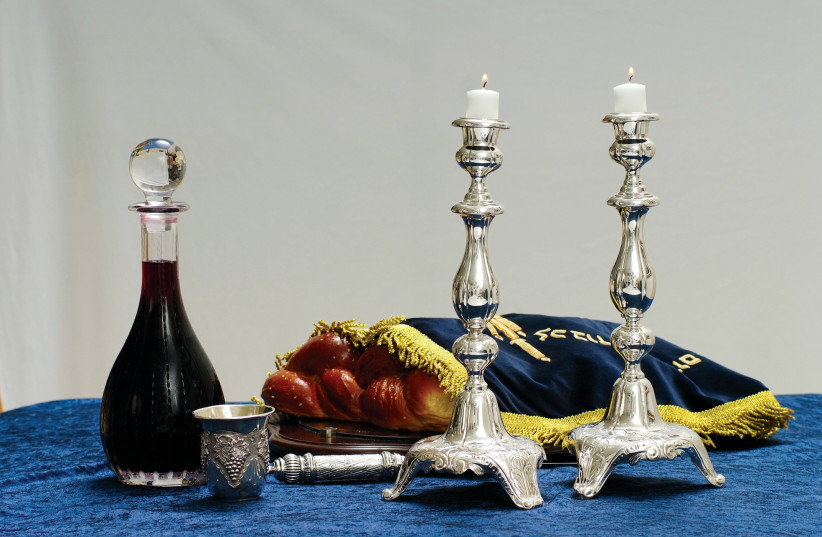
Years ago, when I was a young mother, raising children was often seen as a responsibility, almost an obligation, and not as a spiritual activity.
Starting out in my career as an educator, I would visit colleges and talk to the students, recruiting young women to study Torah in Israel. When explaining women’s exemption from most time-bound mitzvot, I commented to a group that, as a young mother, the exemption had proven helpful to me and allowed me more time for raising my children, developing their minds, and shaping their Jewish values and way of life.
Then, one of the women asked a striking question: “Is there a bracha [blessing] that you make when you’re raising your children?”
The beauty and depth of the question stayed with me.
I explained that there is no formal bracha because raising children is an all-encompassing, timeless mitzvah – like giving tzedakah (charity). However, I shared that on many occasions when taking care of and raising my children, especially when the going got rough, I just looked up and said: “Dear God, please give me wisdom, patience, and love!”
This guidebook shows us how Shabbat and Jewish holidays can be lived as more than just a checklist of halachot but rather as a joyful and spiritual moment in time.
The author writes, “As modern parents, we are always planning, packing, and preempting our children’s needs. On Shabbat day, we get the chance to just be.
“Be with our child and children. Be with our spouse and partner. Be with our friends and community. Be with Hashem. Even just be with ourselves. Now that we have prepared for Shabbat... let’s... enjoy the unique little people in front of us who are literally part of our creation in this world.”
The book begins with a brief outline of halachic principles for parents, then moves through the timeline of Shabbat and Yom Tov, addressing the applicable halachot along the way. Each section is well sourced, with ample references for those who want to delve deeper.
In many ways, it functions like a kitzur halachot – a guidebook of short statements of Halacha, similar to the method of the Kitzur Shulhan Aruch, with the additional infusion of warmth and spirituality.
I thought that ending each chapter with a section on kavana (intent) was an inspiring touch. After learning the many halachot of Shabbat and Yom Tov, readers can reflect on the spiritual dimension.
The importance of rest
Thomas-Newborn highlights the importance of rest as a basic human need – modeled by God as an essential part of creation. But she says that for parents with young children, rest can feel elusive, and Shabbat can sometimes feel like the most exhausting day of the week.
She offers practical strategies for how parents of young kids can reclaim Shabbat as a day of renewal and spiritual energy.
“Taking care of ourselves is part of taking care of our families and communities. God stopped and rested in order to teach us the value of recharging, and we do the same for our children. In short, when we rest on Shabbat, we honor God, ourselves, and our children all at once!”
She weaves together psychological insight and real-time advice, while recognizing that “everyone’s circumstances are different, but asking the questions and brainstorming together with our significant other to create more space for rest on Shabbat is holy work.” This is wise advice that can help transform Shabbat into a more harmonious, uplifting, spiritual, and restorative day.
The author has succeeded in writing a book that provides a clear, modern, pastoral resource to empower parents in observing the halachot of Shabbat and Yom Tov with their families in a way that nurtures their spiritual lives.
This guidebook, whose accessible and engaging style makes it a pleasure to read, will enlighten and enrich the Shabbat and Yom Tov experience for generations of parents and children for years to come. It is a well-researched, authoritative reference that belongs on every family’s bookshelf.
The reviewer is a preeminent Torah scholar and rabbanit in Jerusalem, and founder of Matan, an innovative institution dedicated to furthering excellence in women’s Torah study, including Talmud, Bible, and Jewish law.
- SHABBAT GUIDEBOOK FOR PARENTS: HALACHA OF CARING FOR INFANTS, TODDLERS, AND CHILDREN ON SHABBAT AND YOM TOV
- By Alissa Thomas-Newborn
- Urim Publications
- 128 pages; $25