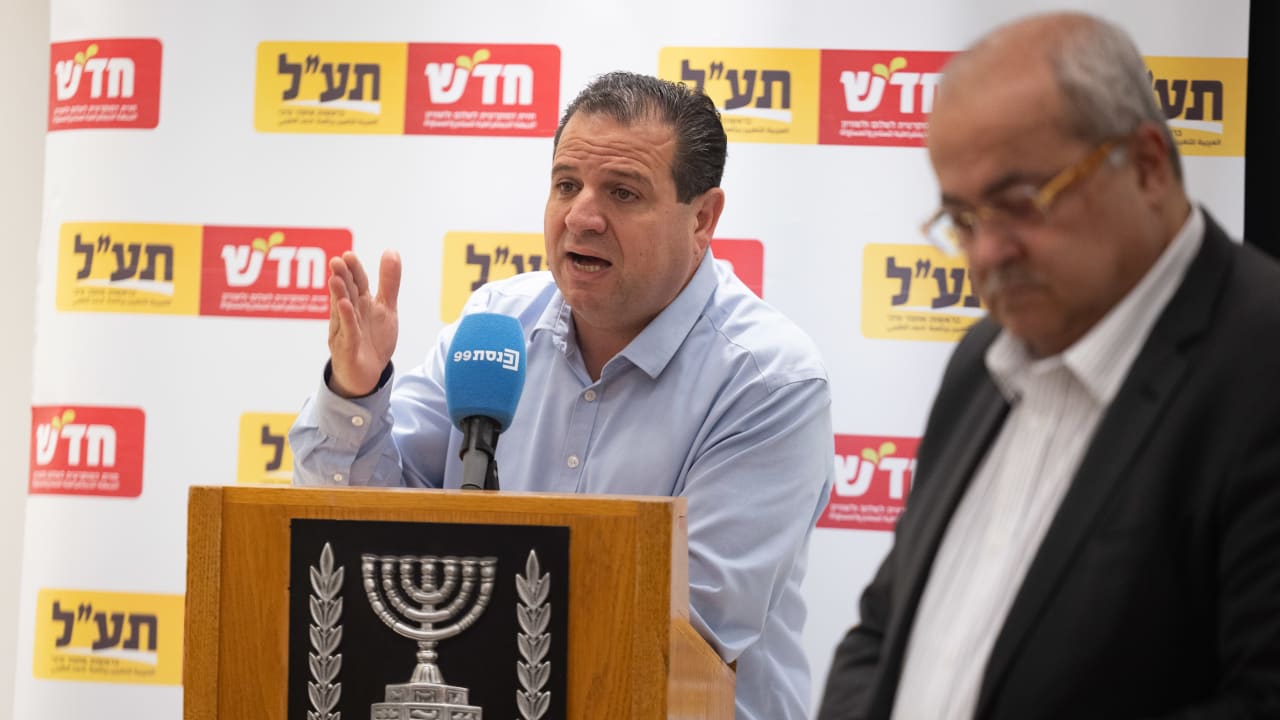
A supermajority of Israeli Arabs support the reestablishment of a Joint List party, a poll carried out by ArPanel published on Thursday found.
Of those polled, 82% supported reestablishing a list that would unite Arab parties in a Knesset election, 9% opposed the move, and another 9% were not sure.
The poll also questioned who should lead the Joint List.
The most popular choices were MK Ahmad Tibi (Ta’al) and former MK Yousef Jabareen (Hadash), each with 23%, followed by Mansour Abbas (Ra’am) with 20% and former MK Sami Abu Shehadeh (Balad) with 10%.
Further, a supermajority of those polled wanted to renew Arab political representation, with 79% stating they would prefer to see new candidates on the Knesset election list in an upcoming election, while 11% stated they did not know.

Notably, among those polled, 68% said they would vote for the Joint List, while 11% said they would not vote for it if it runs in the upcoming elections. The poll also found that 66% of respondents voted in the previous Knesset election.
The poll was conducted among a sample of 500 participants between January 26 and 29, with 270 completing a digital survey and 230 completing a telephone survey.
Of the 500 respondents, there was an equal split between male and female respondents, and 53% were residents of the Galilee. Furthermore, 82% identified as Muslim, 9% as Christian, and 9% as Druze.
Slight gains for Bennett
Former prime minister Naftali Bennett’s party gained two seats in a possible Knesset election vote after announcing that he would not form a coalition with Arab parties, a poll published by Maariv on Friday found.
Under the current expected party vote, excluding the Joint List Arab party, the largest single party is expected to be Prime Minister Benjamin Netanyahu’s Likud with 26 seats, followed by Bennett’s party with 24.
These two would be followed by Yair Golan’s Democrats (10), and Gadi Eisenkot’s Yashar, Itamar Ben-Gvir’s Otzma Yehudit, and Avigdor Liberman’s Yisrael Beytenu, with nine seats each.
Additionally, Shas would receive eight seats, United Torah Judaism and Yair Lapid’s Yesh Atid would receive seven each, and the Arab parties, Hadash Ta’al (6) and Ra’am (5), would complete the parties passing the electoral threshold in this scenario.
Benny Gantz’s Blue and White, Bezalel Smotrich’s Religious Zionist Party, and Yoaz Hendel’s Reservists party would fail to pass the threshold with 2.5% of the vote each.
Further, Balad, also an Arab party, would not pass the threshold with 1.9% of the vote. In the event that Bennett and Eisenkot form a list together, they would grow to 32 seats, becoming the largest party, the poll found.
Majority support women in IDF combat roles
The poll also queried support for recruiting women into IDF combat roles.
A majority of Israelis, at 65%, supported recruiting women into combat roles, provided that the criteria for joining the units are the same for both men and women.
This was even higher among Jewish respondents of the survey, at 71%.
The poll, conducted February 4-5, surveyed 501 respondents representing the adult population, with a maximum sampling error of ±4.4%.
Findings were reported by Maariv and compiled by Lazar Research, led by Dr. Menachem Lazar, in cooperation with Panel4All.