You can’t really understand Jerusalem without understanding its Ethiopians.
Not the postcard version, not the surface-level “diversity” narrative – the actual complicated, beautiful reality of what it means to be Ethiopian in Jerusalem today.
Jerusalem has long been a focal point for Ethiopians, regardless of faith. But the relationship is not some abstract historical footnote. It’s lived every single day in neighborhoods across the city, in the faces of people navigating what it means to belong somewhere that doesn’t always make space for them.
The legacy of Beta Israel
The Beta Israel – Ethiopia’s Jewish community, who arrived in Ethiopia over a period of several centuries, coexisting and conflicting with Ethiopian Orthodox Christians – has made an indelible mark on this city through the dramatic aliyah waves of the late 20th century.
Proof of Zionism in Ethiopia can be traced to a 1848 letter sent by Beta Israel to Jews in Europe, praying for the unification of all Jews everywhere. During Operation Moses (1984-1985) and Operation Solomon (1991), thousands of Ethiopian Jews were airlifted to Israel in operations that captured global attention. Some 35 years later, Operation Solomon still holds the record for the most people on a single aircraft – 1,088, including two babies born mid-flight.

But these were not just logistical achievements. They were families leaving everything behind, stepping onto planes for the first time in their lives, arriving in a land they had prayed toward for generations – a place they had never seen.
The Beta Israel trace their identity back through millennia, with much of their history unfolding outside the dominant Jewish centers of Europe and the Middle East.
For centuries, they preserved distinct religious traditions in relative isolation, maintaining practices that set them apart even as they held fast to their Jewish identity. Their connection to Jerusalem was spiritual and aspirational – until it suddenly became physical and immediate.
Ethiopian Orthodox roots in Jerusalem
Ethiopian ties to Jerusalem extend beyond the Jewish community.
The Ethiopian Orthodox Tewahedo Church established sacred sites here centuries ago, such as the historic Deir es-Sultan monastery, perched atop the Church of the Holy Sepulchre. That monastery alone reflects Ethiopian determination: It occupies one of the most contested religious spaces on Earth, a testament to centuries of complex ecclesiastical claims and the enduring Ethiopian Orthodox presence in the Old City’s sacred geography.
There is also Debre Genet monastery and its Kidane Mehret Church, physical markers of imperial ties stretching back to the late 19th century. These are not tourist attractions; they are living institutions where monks chant ancient liturgies, and pilgrims seek connection to something larger than themselves.
Their institutions stand alongside synagogues and communal centers where Beta Israel traditions are kept alive. This multifaceted imprint adds depth and nuance to Jerusalem’s already intricate identity.
Dispersed presence, strong roots
Today, Jerusalem’s Ethiopian communities are spread across multiple neighborhoods. Their dispersed presence allows for wider integration, but it also presents challenges in terms of consolidated political power.
There are community centers, social organizations, and religious gatherings across the city. The physical landscape bears witness to this in distinct pockets.
Ethiopia Street, for example, where the Ethiopian Church maintains its historic presence, stands as perhaps the most visible marker of this longstanding connection.
The street reflects the architectural legacy of Ethiopian patronage during the late Ottoman and British Mandate eras – a physical reminder that Ethiopian ties to Jerusalem are neither recent nor incidental. They stretch back generations.
Walking along this street is to walk a path that Ethiopian pilgrims, monks, and community members have followed for more than a century.
Just off Jaffa Street lies what locals call Ethiopia Town, a small cluster of Ethiopian restaurants and businesses that serves as a cultural anchor. It isn’t a large neighborhood, but it is a significant one.
The restaurants serve traditional injera and wat, and conversations in Amharic are heard as often as in Hebrew. This is where Ethiopian Israelis come not just to eat but to connect – to hear their language spoken, to be in a space that reflects something of the culture they or their parents left behind.
For the broader Jerusalem population, it has also become a destination, a place to experience Ethiopian cuisine and culture without tourist polish – the real thing.
Sigd celebration and visibility
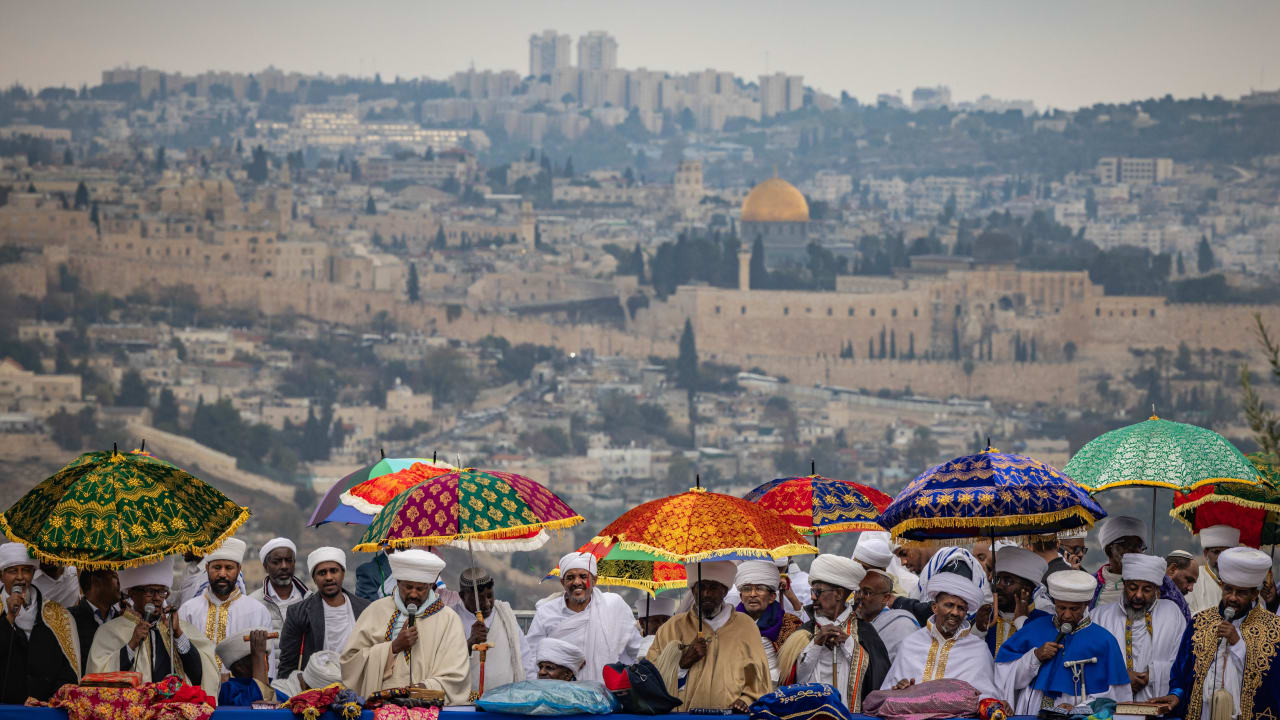
For the Beta Israel community, religious life centers around traditions such as Sigd, an annual festival that draws thousands to Jerusalem. While the festival commemorates spiritual themes of renewal and covenant, it also embodies the community’s historic yearning for Jerusalem and Zion.
Watching families gather on the hillsides, fasting and praying together, it becomes clear this is not performance. It is the living expression of an identity shaped by centuries of longing and perseverance. They declare: “We are here. We matter. Our traditions have value.”
Challenges of integration
Despite their deep contributions to Israeli society and the rise of many Ethiopians in professions across the board, there are still many who endure socioeconomic and integration challenges.
Employment disparities are persistent. Educational gaps remain. Discrimination is not an occasional outlier; it is a documented pattern, recognized by community advocates and researchers alike.
Second-generation Ethiopian Israelis increasingly navigate their dual identities, preserving their culture in complex urban environments. Community organizations are doing critical work to promote educational achievement and cultural pride, though they often face resource limitations and systemic obstacles not designed with them in mind.
Belonging and transformation
The Ethiopian presence in Jerusalem – both Christian and Jewish – adds genuine depth to the city’s cultural and spiritual landscape. These communities are raising families, building lives, and pushing for dignity and recognition in the land of their prayers.
As Jerusalem continues to evolve, the rhythms of Ethiopian heritage shape its character in unmistakable ways. This is not about diversity for diversity’s sake. It is about acknowledging that the story of Jerusalem is incomplete without understanding how Ethiopian communities have claimed space here and how they’ve transformed the city, even as it transforms them.
The bridge between past and present is not always smooth. There are tensions, disappointments, and gaps. But there is also resilience, creativity, and an unshakable insistence on belonging – a determination that is deeply inspiring.
Ethiopian Jerusalem is not a sidebar. It is woven into the fabric of the city itself: essential, living, and irreplaceable.