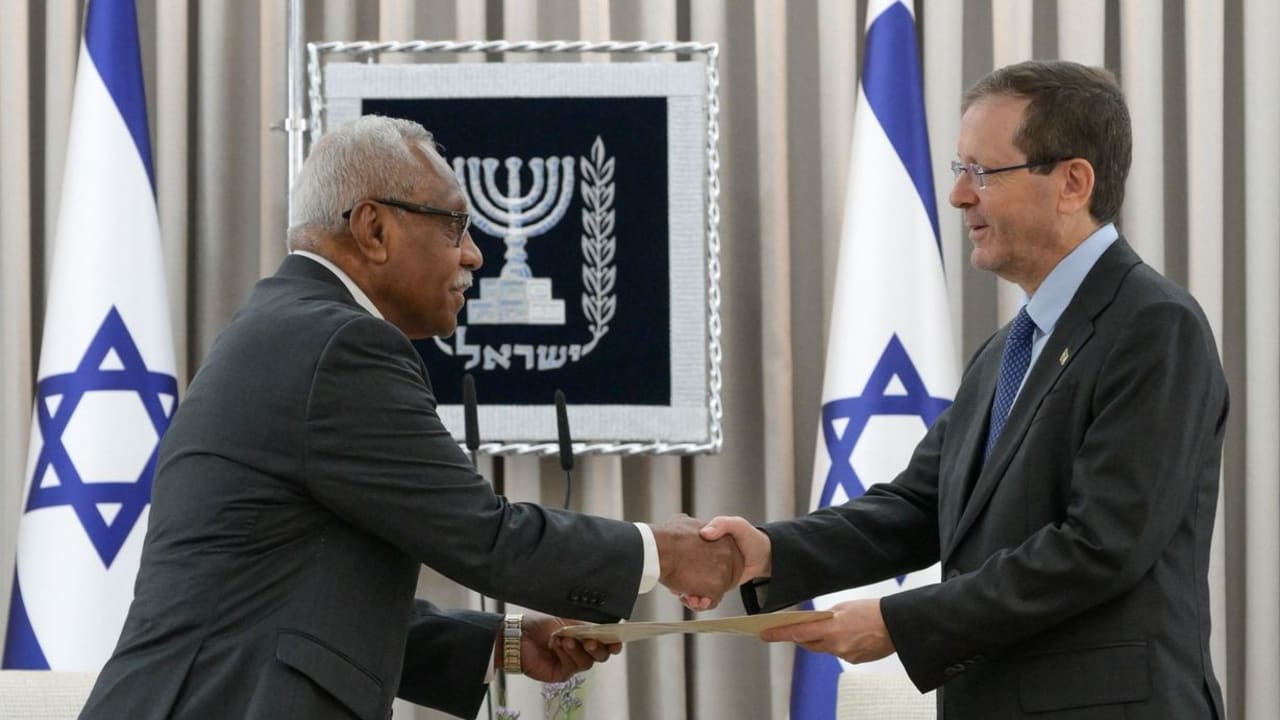
Jesoni Vitusagavulu, Fiji’s first resident ambassador to Israel, was one of two ambassadors who, on Tuesday, presented credentials to President Isaac Herzog. The other was Thai Ambassador Boonyarit Vichienpuntu, who has been in Israel for a little over four months.
The appointment of Vitusagavulu, a businessman and diplomat, was announced as recently as last month.
Initially, it was thought that Filipo Tarakinikini, Fiji’s permanent representative to the United Nations, would also serve as ambassador to Israel. Tarakinikini led a team to Israel prior to deciding on a location for the embassy.
Tarakinikini was in Israel in September 2025 when the Fijian Embassy in Jerusalem was inaugurated by Fiji’s Prime Minister Sitoveni Rabuka together with Prime Minister Benjamin Netanyahu, but both countries preferred a resident ambassador to one on a commute.
Fiji is the seventh country to open an embassy in Jerusalem. The other countries with embassies in Israel’s capital are the US, Guatemala, Honduras, Kosovo, Papua New Guinea, and Paraguay.

Ambassadors present their credentials to the President of the State in chronological order based on their arrival dates in Israel. Vichienpuntu was therefore the first to meet with President Herzog, who congratulated him on having won a prestigious award in recognition of his diplomatic service to his country.
Both the ambassador and Herzog acknowledged the good relations that have existed and flourished since the two countries entered into diplomatic relations in 1954. Even so, Herzog observed, relations can be further enhanced.
Thai nationals have enormous respect for their monarchy, and the nation went into long and deep mourning over the death of Sirikit, the queen mother, who passed away in October last year at the age of 93.
The ambassador thanked Herzog for his letter of condolence, which he said had been one of the first to arrive.
The conversation moved to bilateral trade, which totals over $1 billion per annum, with key products in technology, agriculture, and defense equipment, while Thailand’s main exports to Israel are cars and processed foods.
Thailand is an extremely popular destination for Israeli tourists, but despite locals' complaints about Israelis’ disrespect for Thai traditions and culture, Vichienpuntu wants to increase the number of Israeli tourists visiting Thailand. Herzog said that one of his sons is currently vacationing in Thailand and loves it.
Herzog suggested there was room for more cooperative ventures in climate change, fisheries, and water management. Some of the workers in these and other fields have been trained by Mashav, Israel’s Agency for International Development Cooperation, whose experts, the ambassador said, he had been happy to meet.
Vitusagavulu, a former ambassador to the US, has had a diverse career that includes studies at universities and graduate schools in the South Pacific, the UK, Australia, and Israel. He also has a diploma in airline management from Bar Ilan University.
In addition to his diplomatic background, he has worked as an investment consultant specializing in tourism, information technology, and the audiovisual industries, as a special projects manager, and as a banker.
At the time of his present appointment, he was working as a Christian Minister in the US.

Marketing is apparently in his blood, because during his meeting with Herzog, he could not resist plugging Fiji Water, a bottled product sourced from an artesian aquifer on Viti Levu. The company that owns it is American and headquartered in Los Angeles, California.
Herzog said that he would like to tour the Pacific region as his father, former president Chaim Herzog, had done 40 years ago, en route to Australia. He recalled that his father had been impressed with Fiji. The subject came up as Herzog was talking about his own upcoming visit to Australia. Unlike his father, he will miss out on Fiji.
However, he believes it is important to get to know the Pacific region because the world is becoming increasingly dependent on it.
The two also discussed trade, and the ambassador said it was more advantageous for Fiji to focus on niche products rather than commodities.
Herzog discusses International Stabilization Force with new Fiji ambassador
On a more political level, they discussed the proposed International Stabilization Force, a multinational force designed to operate in the Gaza Strip to contribute to the security of the civilian population and facilitate humanitarian aid. If such a force comes into being, Fiji is likely to participate.
Fiji has been a long-term participant in UN peacekeeping operations in the region, including UNIFIL, the Multinational Force and Observers (MFO), and UNDOF.
Due to the rain on Monday morning, the presentation of credentials ceremony did not follow the usual protocol, which includes an outdoor honor guard and an army or police band playing the national anthem of the ambassador’s country. The president waits in the main hall to receive the credentials, then he and the ambassador introduce each other’s entourages, and everyone moves into a smaller reception hall, where the president and the ambassador have a tete-a-tete. They then return to the main hall, where the ambassador signs the guest book reserved for ambassadors, and everyone walks toward the exit, stopping in the doorway while the band plays Israel’s national anthem.
It was more than a little different on Tuesday. The 20-member IDF band was positioned in the main hall. The honor guard, consisting of three soldiers (instead of three or four rows), stood against a wall facing the rear. The limousine transporting the ambassador came right up to the building, stopping beneath the pergola, whereas it usually stops at the far end, near the garden.
The president, who usually waits in the main hall,l was in the small reception hall. The band played both anthems as the ambassador entered the building. After “Hatikvah,” he was led straight into the small room, where he and the president had a brief introductory chat. His entourage was then allowed to enter, and the formal ceremony began.
At the end of it, the president and the ambassador performed the introductions to each other’s key personnel, and everyone returned to the main hall for a photo op, after which the ambassador exited to the waiting car.
Both ambassadors wore the national costumes of their respective countries – a brave move, considering the rain and the low temperature.