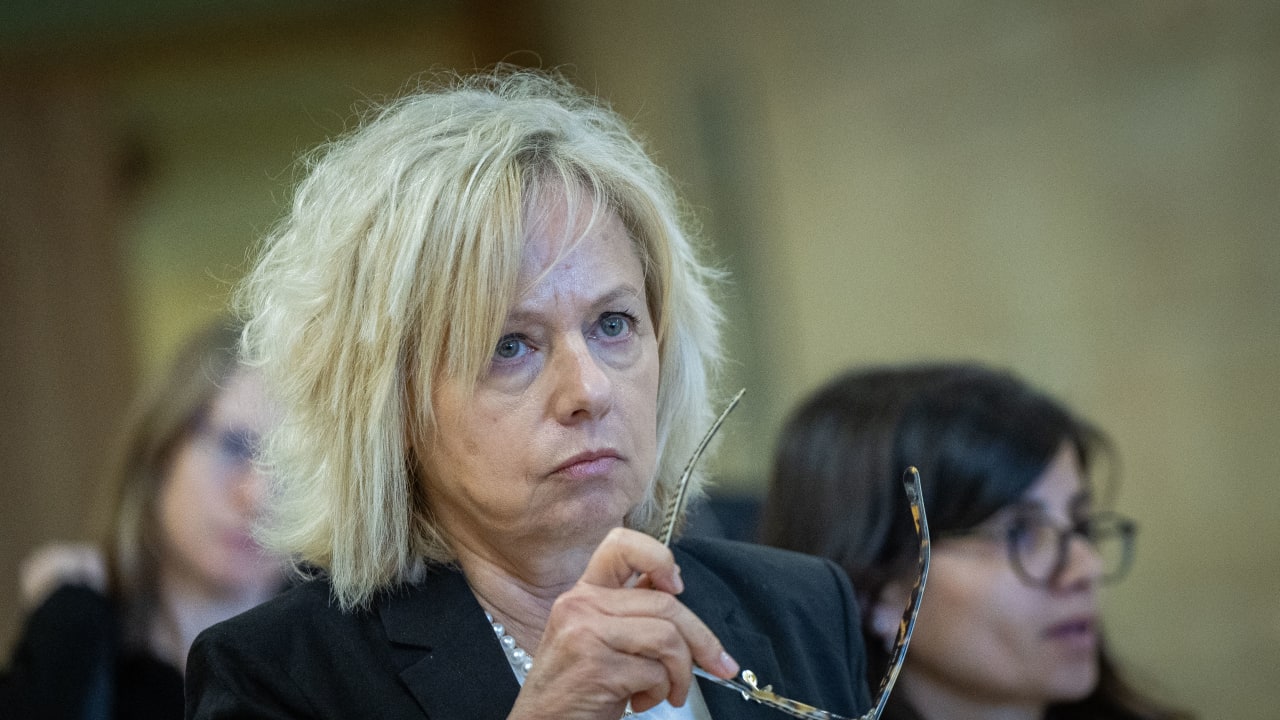
The government is set to approve on Monday a highly controversial decision to remove Attorney-General Gali Baharav-Miara from her position, marking a new stage in the government’s attempt to unburden itself of what it claims are politically motivated legal restrictions.
As per a ruling by High Court Deputy Chief Justice Noam Sohlberg in mid-July, the decision will require judicial review and thus not take effect immediately.
A number of ministers have announced, however, that following Monday’s decision they intend to ignore the A-G, and will not invite her to government meetings or heed her legal directives.
According to Israeli legal precedent, the attorney-general is the governmental organ responsible for interpreting the law for the government, and its interpretations are legally binding. The attorney-general also oversees Israel’s public prosecution apparatus and, as such, decides whether or not to prosecute a sitting MK or minister.
The Attorney-General’s Office is also responsible for representing the government in proceedings against it in the High Court of Justice, and for overseeing the legal advisers in each individual government ministry.

Baharav-Miara was appointed to the position during the previous government’s tenure. The current government has repeatedly accused her of intentionally blocking policy initiatives in order to eventually lead to the government’s downfall; using her power as chief prosecutor to launch politically-motivated “witch hunts”; and refusing to give the government its day in court by siding with petitioners in a number of court cases.
Baharav-Miara has argued in her defense that the dozens of cases in which she ruled the government’s actions “not legally viable” were negligible compared to the thousands of positive opinions her office provided; that by showing the government its legal limitations, she was fulfilling her intended role, not abusing it; that she could not defend in court actions that the government took despite her deeming them illegal; and that the accusations about “witch hunts” served as attempts by politicians to escape justifiable prosecutions.
Since the government adopted the Shamgar Commission’s report in 2000, the attorney-general was appointed via an advisory committee comprised of a retired Supreme Court justice as its chairperson; a former justice minister or attorney-general; an MK, selected by the Knesset’s Constitution, Law, and Justice Committee; a lawyer, determined by the Israel Bar Association; and a legal academic expert, chosen by the deans of the law faculties.
After attempting and failing since March to convene the committee in order to begin proceedings to fire Baharav-Miara, Justice Minister Yariv Levin proposed changing the firing process, such that, instead of an independent committee, a new advisory committee would be formed, composed of five government ministers. It was formed in a government decision on June 8, and on July 20, officially recommended firing her. Baharav-Miara refused to attend a hearing in front of the committee, arguing that its formation was illegal.
Sohlberg encouraged the government to resort to the previous firing method, but the government refused.
According to the text of the government proposal set to pass on Monday, the government argued that Baharav-Miara’s continued tenure “severely harms the functioning of the government.”
Explanatory remarks for the government’s decision to hold the meeting to fire the A-G on Monday also pointed to “accumulated incidents” against her, including “legal objections to government policy, refusal to represent the government in court (including in cases where the court sided with the government), failure to comply with government decisions not stayed by court order, delays in tasks, and [issuing] public criticism [against the government].”
Baharav-Miara has been a barrier to the government’s attempts to pass a number of measures, such as parts of its 2023 judicial reforms, an exemption for a majority of eligible haredi (ultra-Orthodox) men from IDF service, attempts to change the appointment and firing methods of senior officials, such as the Civil Service Commissioner and the Shin Bet head, and more.
The decision to fire her could lead the government to attempt to act on these issues, even if the firing is stayed by the court.
A series of organizations announced on Sunday morning that they would be holding a demonstration on Sunday evening against Baharav-Miara’s firing.
Last moment to save independence of the government's legal advisory mechanism
Attorney Eliad Shraga, chair of the Movement for Quality Government in Israel (MQG), said in a statement: “This is the last moment to save the independence of the government legal advisory mechanism and prevent irreversible damage to Israeli democracy. The government chose to disrespect the court and continue on its wrong course. Now it is the public’s turn to show that they are not giving up on the rule of law.
Democrats chairman Yair Golan posted on X/Twitter on Sunday, calling for a protest outside the government’s meeting at 1 p.m. on Monday.
“We can’t sit at home anymore,” Golan wrote. “While we all see the horrifying images of [hostage] Rom [Braslavski] and Evyatar [David] wasting away in Hamas tunnels, Netanyahu’s government is focused only on itself. The agenda for the upcoming meeting: increased security for Netanyahu and his family and the dismissal of the attorney-general.”
“That’s what they care about. They don’t care for a second about the lives of the hostages; they don’t care about the lives of the soldiers. Netanyahu, Smotrich, and Ben-Gvir watch Evyatar dig his own grave while still alive. And them? They carry on as if nothing is happening. Enough. We can’t stay silent. Tomorrow I’ll cancel everything on my schedule and go to Jerusalem to cry out against this heartless government,” Golan wrote.
He concluded by calling on fellow opposition leaders and MKs to join him and “Bring the country to a halt.”
Another controversial measure expected to pass by the governing coalition on Monday is the replacement of Knesset Foreign Affairs and Defense Chairman MK Yuli Edelstein (Likud) with Likud MK Boaz Bismuth.
Coalition whip MK Ofir Katz announced on July 21 that Edelstein would be removed following the departure of the two haredi parties, Shas and United Torah Judaism, from the government after a fallout in negotiations with Edelstein over a haredi IDF conscription law proposal.
Haredi politicians opposed Edelstein’s attempts to insert enforcement and oversight mechanisms to ensure that haredim who receive an exemption from IDF service are actually studying in yeshivot, and Edelstein refused to enable a law to pass that would de facto enable the majority of eligible haredi men to evading service.