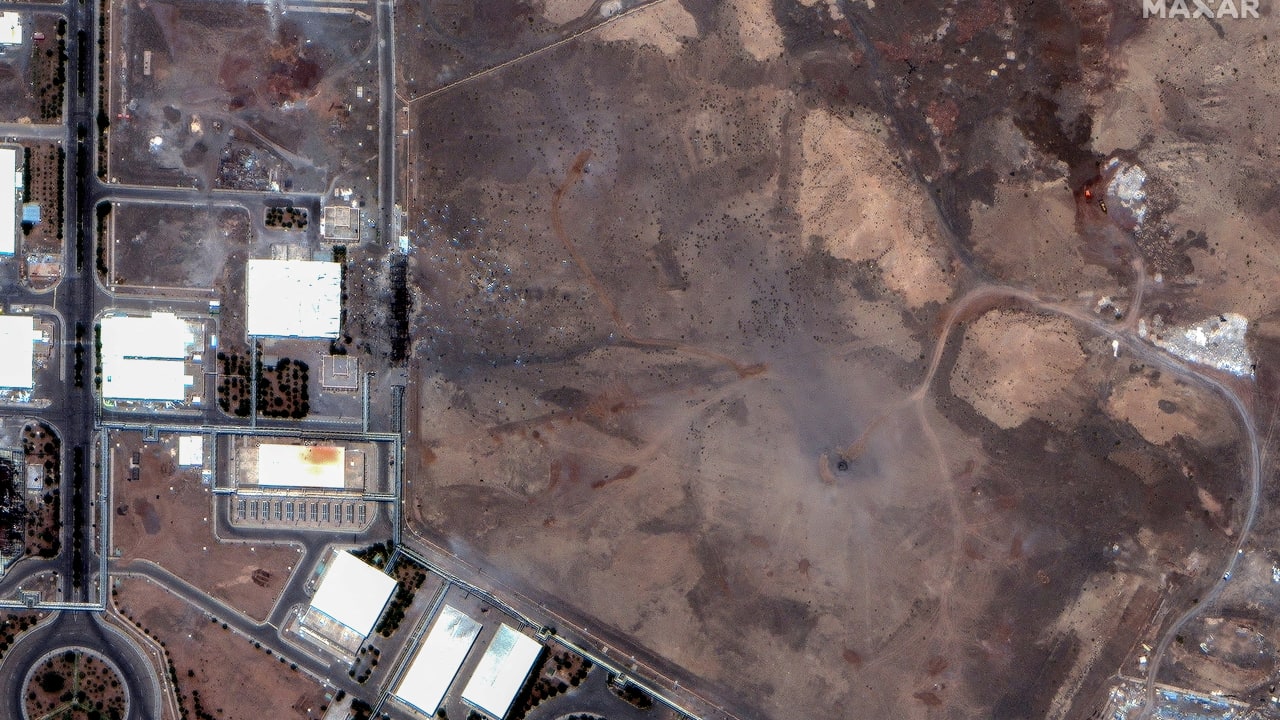
“Fordow is gone” was the simple message sent by President Donald Trump on social media in the early hours of Sunday, June 22, Israel time, putting an end to days of speculation over whether he would be willing to provide the coup de grace to Iran’s nuclear project.
Six B-2 bombers dropped a dozen “bunker buster” bombs on Fordow. Navy submarines fired 30 Tomahawk cruise missiles at two other sites, Natanz and Isfahan.
The American strikes came nine days after Israel’s surprise attack on Iran, launching a war that has changed Middle East history.
In his televised address shortly after the attack, Trump said the “nuclear enrichment facilities have been completely and totally obliterated”. However, Iranian officials said the three sites that were hit had been evacuated, and most of the highly enriched uranium had already been moved to other locations.

Urging Iran, whom he described as ‘the bully of the Middle East’, to make peace, Trump warned of the consequences if they continued the war.
“There will be either peace or there will be tragedy for Iran far greater than we have witnessed over the last eight days,” he said. “Remember, there are many targets left. Tonight was the most difficult of them all by far, and perhaps the most lethal. But if peace doesn’t come quickly, we will go to those other targets with precision, speed, and skill.”
US and Israel coordination
Prime Minister Benjamin Netanyahu said the US attack was carried out “in full coordination” with Israel and was a continuation of the Israeli military and Mossad operations in Iran against its nuclear program, which he said threatened our very existence and endangered world peace. “At the beginning of the operation, I promised you that Iran’s nuclear facilities would be destroyed one way or another. That promise has been kept,” he said. “President Trump is leading the free world with strength. He is a great friend of Israel, a friend like no other.”
Both Israel and the US were waiting for damage assessment reports from aerial surveillance and intelligence gathering following the attack.
A few hours after the attack, Iran launched some 30 ballistic missiles towards Israel, scoring direct hits in Tel Aviv and Ness Ziona, injuring some 30 people. Israel closed its airspace, delaying rescue flights bringing home Israelis who had been stranded abroad since the start of the war. The Home Front Command re-instituted strict guidelines for public gatherings, permitting only essential activity.
US forces in the region went on a heightened state of alert, bracing for Iranian retaliation. Iran’s Foreign Minister Abbas Araghchi said Tehran “reserves all options to defend its sovereignty, interests and people,” warning that the American attack will have “everlasting consequences.”
The Houthis in Yemen threatened to respond, after previously warning that a US strike would lead to a resumption of attacks on international shipping in the Red Sea.
Calling it a “dangerous escalation”, United Nations Secretary General António Guterres said there was now a “growing risk that this conflict could rapidly get out of control – with catastrophic consequences for civilians, the region, and the world.”

Khamenei's nuclear threat and Israel
Ali Khamenei has been Iran’s supreme leader since 1989. The cornerstone of Iran’s foreign policy during this period has been an unrelenting campaign aimed at Israel’s destruction, patiently building up an alliance of regional proxies, the so-called Axis of Resistance, creating a ring of fire to surround Israel and attacking Jewish targets abroad, while at the same time advancing efforts to build a nuclear bomb.
For much of his political career, Benjamin Netanyahu has made thwarting Iran’s nuclear program his top priority, raising the issue in speech after speech in apocalyptic terms, arguing that Iran will not be deterred and that an Iranian nuclear bomb will present an existential threat to Israel.
With Tehran moving dangerously close to the bomb, something had to give between the two rival regional superpowers.
The devastating Israeli strike on Iran in the early hours of Friday, June 13, marked the final showdown between these two leaders, who together have shaped much of the Middle East landscape in the modern era.
Israel had been planning an attack on Iran’s nuclear facilities for more than a decade. Events that developed since the October 7, 2023 Hamas attack created the perfect opportunity to carry out such a strike.
Iran’s air defense systems were significantly downgraded in two Israeli attacks last year in response to Iranian missile and drone strikes, leaving the country’s skies open. Additionally, Iran’s two main proxies, Hezbollah and Hamas, suffered crushing military defeats and could no longer be used by Iran to deter Israel.
Added to that was the election in November of Donald Trump as US president for a second term. One of his first acts on assuming office was to supply Israel with munitions vital for a sustained military campaign against Iran that had been held up by the Biden administration.
Israel believes that following the defeat of Hezbollah and the fall of the Assad regime in Syria last year, Tehran took a strategic decision to acquire a nuclear bomb. According to the assessment of Israeli intelligence, Tehran already had enough enriched fissile material for at least nine bombs and was potentially only months away from weaponizing the enriched uranium.
Netanyahu said the war “will continue as long as necessary,” describing the campaign as “a decisive moment in Israel’s history.”

Operation Rising Lion and Iran's retaliation
200 Israeli planes took part in the initial wave of strikes- the bulk of the Israeli air force. Dozens of nuclear installations, missile launchers, and storage facilities were attacked.
Ahead of the surprise attack, Mossad established a drone base inside Iran, smuggling in explosive-laden UAVs that were activated during the Israeli strike for precision strikes to assassinate leading regime commanders and nuclear scientists.
Iran’s ballistic missiles with warheads of half a ton or more emerged as a significant threat, killing 24 Israelis in the first 9 days of the war, injuring more than 1,200, and destroying more than 25,000 buildings, causing the evacuation of more than 8,000 people from their homes. Israelis witnessed the widespread destruction and realized that following Home Front Command orders to head for bomb shelters and safe rooms when the sirens sounded really does save lives.
Israel capitalized on its control of the skies over much of Iran to prioritize destroying the missile launchers. By the end of the first week of the war, the number of missiles launched each day had fallen dramatically, although the ever-present danger remained.
While regime change is not a declared war aim, Israel stepped up its strikes on symbols of the Islamic Republic, particularly following the direct hit on Beersheba’s Soroka hospital, which prompted Defense Minister Israel Katz to declare that Iran’s supreme leader Khamenei, “can no longer be allowed to exist”.
He also said that Israel must “bring about a widespread evacuation of the population from Tehran, in order to undermine the regime.”
Fearing he would be the target for an assassination, Khamenei reportedly named three senior clerics to succeed him in the event that he is killed.
Netanyahu's changed legacy post October 7th
The deadly Hamas attack on southern Israel on October 7, 2023, resulted in the biggest number of Jews killed in a single day since the Holocaust. Most people believed that this traumatic event would become Netanyahu’s legacy: a day of infamy he would never be able to erase.
Netanyahu now sees an opportunity to reshape that legacy once again and go down in history as the leader who, with patience and determination, saved Israel from the threat of nuclear annihilation.