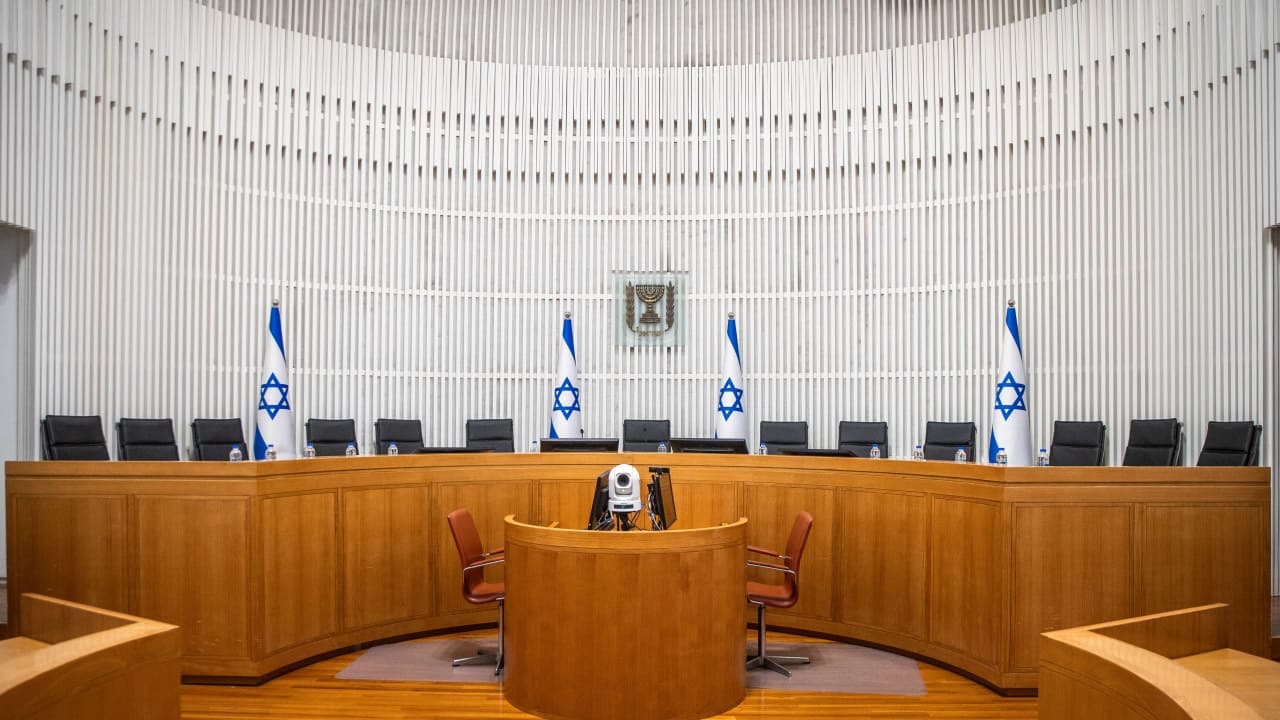
The High Court of Justice is scheduled to hear a petition on Monday filed by residents of Ras Ein al-Auja, a Palestinian herding community in the Jordan Valley.
They allege that sustained settler violence, combined with failures by the IDF and police to intervene, has led to the gradual displacement of families from the area.
In responses submitted to the court, the state has rejected the core allegations, arguing that security forces operate continuously in the area to prevent friction and maintain public order, and that several of the claims raised by petitioners are either unsubstantiated or factually inaccurate.
The petition, filed by six residents together with the Center for the Development of Peace Initiatives, describes what it characterizes as a months-long pattern of harassment, grazing takeovers, infrastructure damage, and livestock theft, centered around the establishment and expansion of nearby illegal settler outposts.
According to the petitioners, the cumulative effect of these actions amounts to a “quiet expulsion” of the community, carried out without a formal evacuation order but through constant pressure that renders daily life untenable.

Outposts escalate situation, Palestinian community says
The situation escalated significantly in late 2024 and early 2025, with the erection of new outposts in December 2024 and January 2025 in areas adjacent to Ras Ein al-Auja’s grazing lands, the petition says.
Maps and photographs attached to the petition show settler structures, animal pens, and access paths encroaching on land traditionally used by Palestinian shepherds, as well as settlers grazing flocks near water sources relied on by the community.
Settlers repeatedly entered grazing areas accompanied by large flocks, blocked access routes, and in some cases threatened residents, while law-enforcement authorities failed to provide effective protection or enforce the law against those responsible, the petition says.
One of the most serious incidents cited occurred on March 7, 2024, when about 1,500 sheep and goats belonging to Ras Ein al-Auja residents were allegedly stolen, it says.
The petition names Avishai Hurvitz, identified as the operator of a nearby outpost, as a central figure in repeated confrontations. Despite complaints filed with the police, he has not been interrogated in connection with the livestock theft or other incidents, it says. The state disputes that claim its filings.
In addition to the alleged violence, the petition raises concerns over the commencement of work on what it describes as a new “workaround road” that cuts through private Palestinian land near the community.
The road appears to be intended to facilitate settler movement between several outposts, the petitioners said, adding that they have not been presented with planning approvals or a clear explanation of its purpose or destination.
As part of the relief sought, the petition asks the court to order the military commander to declare the area surrounding the community a closed military zone to prevent Israelis from entering, to dismantle the illegal outposts and prevent their reestablishment, to provide effective protection to residents, and to enforce the law against those involved in alleged criminal acts.
In a clarification filed on January 27, the state acknowledged an inaccuracy in an earlier response concerning the displacement of residents from Ras Ein al-Auja. After additional review by the Jordan Valley and Emekim Regional Brigade, the state informed the court that while the IDF had not initially been aware of residents leaving the community following incidents on December 31, 2025, it is now known that some residents began leaving as of January 8, 2026, and that the process has continued in recent weeks.
At the same time, the state stressed that it remained unclear whether the departures are temporary or permanent, adding that residents of the area have left and returned in past incidents as well.
The state stood by other aspects of its original response, however, and said following inquiries, the IDF and police were not aware of Israelis using structures within the residential cluster itself, nor of any verified incident involving an attempted attack on children from the community on their way to school. According to the clarification, these claims were examined in real time and were not substantiated.
The state apologized to the court for the factual inaccuracy regarding the timing and scope of residents’ departures, but argued that the correction did not alter its legal position or the court’s earlier decision to deny an interim order. It maintained that security forces operate routinely in the area, respond to reports as they arise, and exercise their authority in accordance with the circumstances to protect all residents of the region.
“This mistake was costly,” said Doron Meinraht, a reserve colonel and one of the founders of Looking the Occupation in the Eye, an Israeli civil society organization that documents life under military administration in the West Bank.
“If an interim order had been issued, the eviction of the community would have been avoided,” he told The Jerusalem Post.
The state has rejected that assessment, arguing that the court’s interim decision had reflected the broader factual picture presented at the time.
In support of its position, the state submitted affidavits from a police community liaison officer in the Judea and Samaria District, a supervisor in the Civil Administration’s enforcement unit, and the commander of the Jordan Valley and Emekim Regional Brigade. The affidavits detail ongoing enforcement activity, monitoring of the area, and responses to incidents reported by residents, the state said.
The events described in Ras Ein al-Auja reflect a broader pattern documented in recent years in parts of the Jordan Valley and southern West Bank, where Palestinian herding communities have reported increasing pressure linked to the expansion of settler grazing outposts.
Israeli human-rights organizations and multiple journalistic investigations have described how repeated incidents of harassment, combined with limited enforcement, have led some communities to abandon grazing areas or leave entirely.
The state argues that such broader claims are not borne out by the specific facts of the case before the court.
The petitioners said that without judicial intervention, Ras Ein al-Auja would face the same fate.
The state maintains that it is fulfilling its obligations and that the petition presents an incomplete and, in some respects, inaccurate picture of conditions on the ground.
The High Court hearing is expected to focus on whether the state’s actions meet its legal duties under both domestic and international law, and whether further judicial oversight is warranted in light of the evidence presented