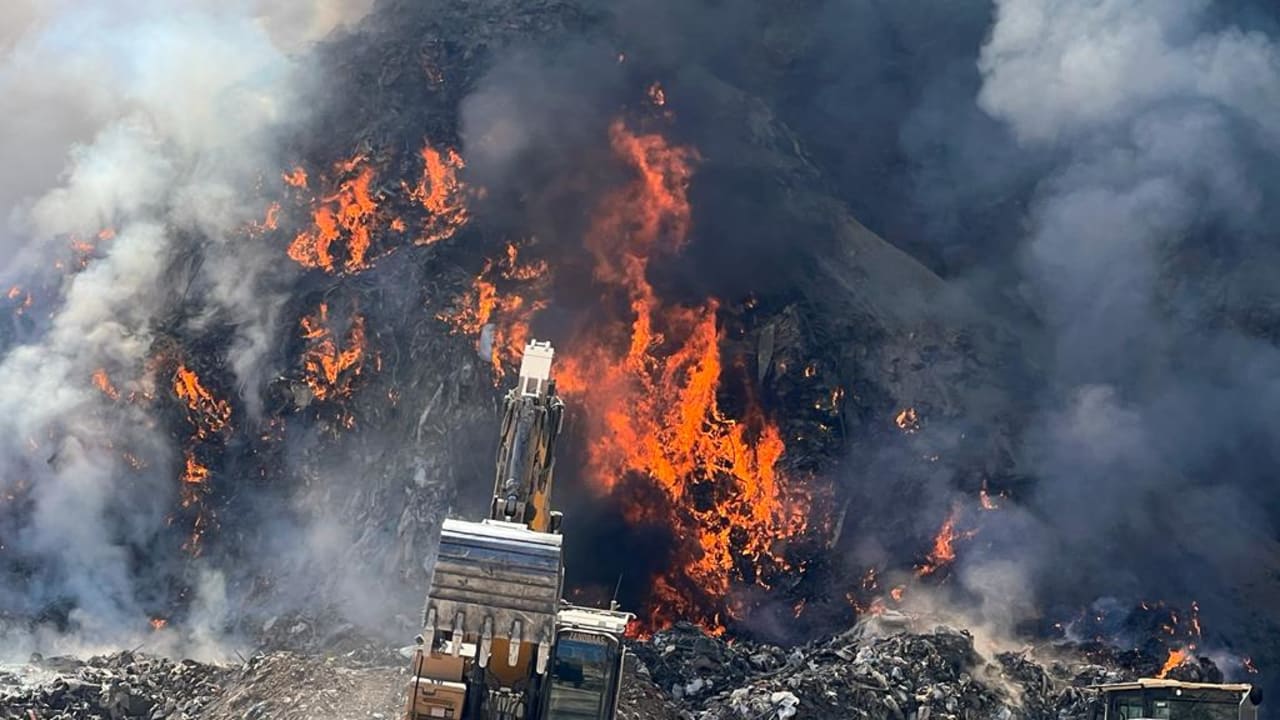
Defense Minister Israel Katz on Thursday announced the approval of new government regulations allowing the confiscation of vehicles and equipment used in mass Palestinian trash burning in the West Bank, which could potentially cause respiratory harm.
Katz said the Justice Ministry approved the new regulations after he and Finance Minister Bezalel Smotrich declared the recent phenomenon of large-scale trash burning a national security threat on December 18.
The defense minister said that IDF Central Command Chief Maj.-Gen. Avi Bluth will be signing the final application of the new rules into law in the coming days.
Reportedly, the Palestinians lack sufficient local landfill capacity, and according to an existing arrangement, they are supposed to use trucks to transport their trash to designated locations.
However, truck drivers often dispose of the trash earlier to save time and money, after which it is burned.

Following a meeting with the IDF Civil Administration head for Judea and Samaria, Brig.-Gen. Hisham Ibrahim, the Health Ministry, and numerous mayors and regional council heads from within Israel’s Green Line and in Judea and Samaria, Katz and Smotrich put forward a five-point plan to address the issue in mid-December.
The first point of the plan called for legally and conceptually declaring the trash-burning as a national security issue versus a mere nuisance.
The goal was to shift the focus and heavily increase the kind of resources that can be used to confront this issue.
Regarding the second point of the new policy – granting administrative powers to the IDF Central Command, which governs the West Bank – Katz said, “The decision we made less than a month ago…was not just a declaration.
“It was a commitment to action. Amending the Security Regulations is a direct implementation of that emergency decision.”
“It gives the relevant authorities real teeth to act against actors who are polluting, endangering, and harming the citizens of Israel,” he added.
Next, he stated, “We will harm their methods of operation, negate the economic profit, and create clear deterrence in the field.”
The defense minister said that he would “not allow a reality in which Israeli citizens breathe poison” and would continue to act “until the phenomenon is uprooted from its roots.”
Details regarding exactly how the new policy will curb the phenomenon are unclear.
An alternative outcome might involve Israel taking possession of trash-loaded trucks or possibly allowing the trash to be burned in smaller increments closer to wherever it was produced.
Even if this were allowed, the distance between many Palestinian villages and Israel is small enough, meaning that the main issue would not necessarily be addressed.
A third element of the new policy was that Israel would allocate funding – currently with no set limit – to hire heavy vehicles and private companies capable of putting out fires and removing and transferring the garbage to a landfill.
It is unclear when this new policy will be rolled out in practice.
Moreover, Katz and Smotrich promised more aggressive enforcement and penalties for those who burn trash in violation of the law.
Lastly, a website will be launched for keeping track of the trash fires, sharing information, and enhancing rapid reaction time to new incidents.
Other officials also talked about establishing new landfills in the West Bank and put the budget for the new campaign at tens of millions of shekels.
There was also talk of fining the Palestinian Authority should Israel need to step in to clear the Palestinians’ trash and of starting this campaign with the Palestinian village of Na’alin.
In October 2025 alone, the nonprofit Citizens for Clean Air hotline reportedly received 2,763 complaints nationwide about air pollution and smoke – 1,034 of them from Modi’in – accounting for roughly 37.5% of all reports.
Since then, local leaders have been trying to raise the profile of the issue nationally, but only in the past few weeks has a serious move to address the problem been made.
In November 2025, the Environmental Ministry issued a plan with many overlapping parameters.
But Katz and Smotrich have far more power and latitude to throw resources at the issue, especially given the involvement of Palestinians, than the much smaller Environmental Ministry.