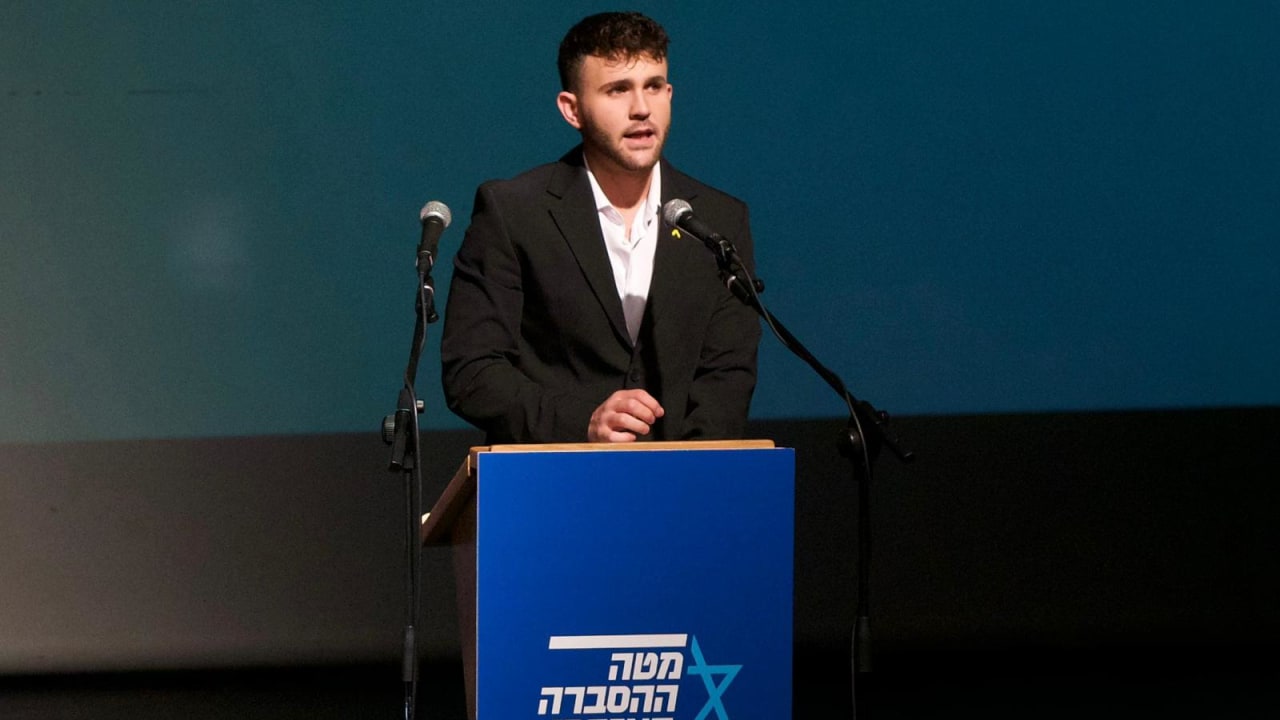
As Israel looks forward, with the trauma and consequences of two years of war, along with its diplomatic aftermath, the country must fundamentally rethink how it conducts international public diplomacy, moving from fragmented, reactive messaging to a coordinated, long-term strategy that treats global perception as a strategic arena in its own right, said Eliav Batito, head of the Civil Advocacy Center.
“The fighting on the ground may change,” Batito said in a Sunday interview with The Jerusalem Post, “but the struggle over legitimacy, influence, and international public opinion is only intensifying.”
Batito argued that Israel has yet to fully internalize the extent to which global perception shapes diplomatic space, political alliances, and long-term legitimacy.
While Israel has invested heavily in military and intelligence capabilities, he said, international messaging has remained structurally under-prioritized.
'Not a communications issue, a strategic one'
“This is not a communications issue,” he said. “It’s a strategic one.”

He framed the challenge as a sustained influence campaign rather than a series of crisis responses, arguing that pro-Palestinian movements have invested decades in shaping global narratives, while Israel has failed to articulate a coherent, long-term story of its own.
“When Israel doesn’t tell a story,” Batito said, “others do.”
Batito traced the origins of the Civil Advocacy Center to the first hours of October 7 after he saw international colleagues sharing claims online that he said were demonstrably false. What stood out to him, he said, was not hostility but the absence of an Israeli narrative in real time.
An improvised WhatsApp group created to share verified media materials quickly expanded into dozens of volunteer networks involving thousands of people, including translators, designers, lawyers, software developers, and media professionals.
Within days, the initiative formalized into an organization now active across four fields: media, education, technology, and legal advocacy.
Batito stressed that civil society is not a substitute for state diplomacy but an essential complement to it.
“There are things a state simply cannot do,” he said, pointing to the speed, flexibility, and cultural fluency required in digital spaces. Civil organizations, he argued, can operate more quickly and deploy tools, including satire and informal messaging, that official state bodies cannot.
Rather than focusing on past failures, Batito emphasized what he sees as an unresolved structural issue: the lack of a single coordinating authority for Israel’s international public diplomacy.
Responsibility for the field is currently divided among multiple bodies, including the Foreign Ministry, the Diaspora Affairs Ministry, the Prime Minister’s Office, the Government Advertising Agency, and the IDF Spokesperson’s Unit. According to Batito, this dispersion has made a sustained strategy difficult.
“When responsibility is spread across too many bodies, accountability disappears,” he said.
The challenge has been compounded by the prolonged vacancy at the top of the National Public Diplomacy Directorate, the designated responsible unit within the PMO. The directorate’s former head resigned in May 2024, and the position has remained unfilled since, despite repeated calls by the Knesset Subcommittee on Foreign Policy and Public Diplomacy to appoint a permanent successor.
Batito compared the situation to managing a military front without a commander. “It wouldn’t be accepted elsewhere,” he said. “It shouldn’t be accepted here.”
The government, several months ag,o approved an additional NIS 545 million for international public diplomacy efforts in 2025, to be administered through the Foreign Ministry as part of the political agreement assigning Foreign Minister Gideon Sa’ar responsibility for Israel’s international messaging.
Batito said the allocation reflects recognition of the challenge but argued that its impact will depend on how the funds are used. Civil society organizations are currently excluded from accessing the budget, a policy he criticized while acknowledging that this view reflects the perspective of advocacy groups themselves.
He contrasted this with cooperation from the Diaspora Affairs Ministry, which he said works closely with the Civil Advocacy Center on education and training initiatives aimed at developing future Israeli advocates abroad, though he described those efforts as limited in scale relative to the need.
Batito repeatedly returned to the need for long-term planning, insulated from political turnover. He noted that Israel has seen multiple foreign ministers during the course of the war, with policy priorities shifting accordingly.
“In influence campaigns, you don’t build a strategy for six months,” he said. “You build it for decades.”
He warned that Israel risks losing future generations of global leaders – particularly younger audiences abroad – if it does not invest now in sustained engagement and narrative-building.
Batito outlined three steps he believes are essential to strengthening Israel’s position: appointing a single senior figure to coordinate international public diplomacy, formally integrating civil society organizations into planning and execution, and developing a long-term, cross-government strategy that can withstand changes in leadership.
“These are not questions of tactics,” he said. “They are questions of structure and intent.”
He concluded that recognizing global perception as a strategic front – and organizing accordingly – is no longer optional.
“This arena isn’t going away,” Batito said. “The question is whether Israel chooses to engage in it seriously.”