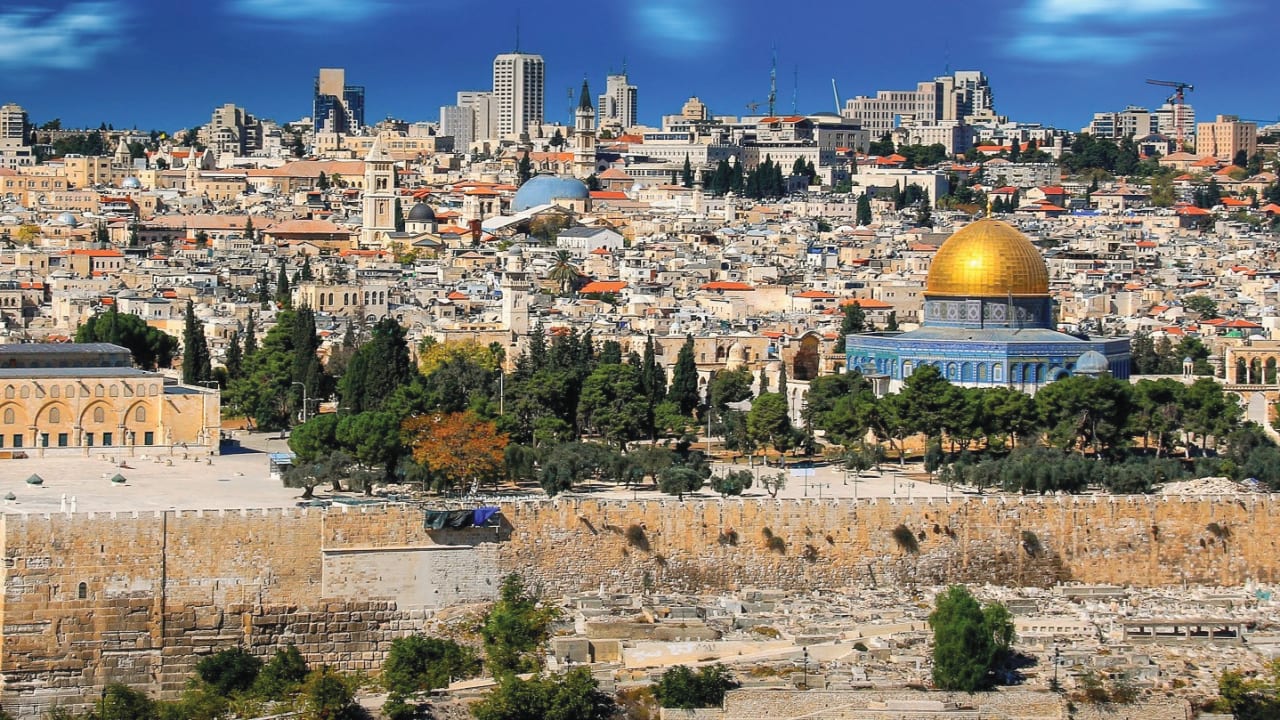

Love for a city is not unlike love for a parent. When parents are alive and want to tell us something of family history, we are often too busy and not interested, asking them to tell us later. But later seldom comes.
The same goes for a city. By frequently traveling to different parts, we think we know the city, but more often than not it’s merely surface knowledge, lacking in depth.
Jerusalem, as it once was, is quickly disappearing. Memories we might have wanted to capture have faded before we could anchor them in our minds. But not all is lost. On November 13, Yad Yitzhak Ben-Zvi is launching a lecture series and a Zoom series about Jerusalem with a focus on its people, places, neighborhoods, hidden alleyways, wide-open streets, familiar landmarks, and some new features.
KAN snafus
■ SHORTLY BEFORE US President Donald Trump and Prime Minister Benjamin Netanyahu were due to give their press conference, one of the announcers on KAN Reshet Bet said he hoped that there would not be any interference with the broadcast. He wasn’t talking about censorship but was indirectly referring to all the snafus caused by the inability of studio staff to hear reports that are being phoned in to the studio in Jerusalem.
Yet when program hosts can’t hear those phoning in, radio listeners can hear the caller perfectly. One would think that by now, especially in an AI era, KAN, the Public Broadcasting Corporation, could avoid glitches by placing an ordinary radio in some semi-isolated part of the studio so that they would know when listeners can hear the conversation and when they can’t.

It’s just unfortunate that Israel doesn’t go for simple solutions. It has to be complicated so that Israel can show off its hi-tech abilities.
Suleiman Maswada: A hardworking reporter
■ APROPOS KAN, one of its most hard-working reporters – and they all work very diligently – is Suleiman Maswada. It’s hard to believe that a little over a decade ago, he barely knew a word of Hebrew. Growing up in east Jerusalem, he lived a somewhat insular life. But now his Hebrew is flawless, with no trace of an Arabic accent. He is a top-class political reporter and updates morning, noon, and night.
He has endeared himself to his colleagues, who now call him Sulie,. While the prime minister was in the US, Maswada was constantly reporting. He is living proof that coexistence is not only possible but desirable.
New CEO of Hebrew University
■ THE HEBREW University of Jerusalem has appointed Naama Kaufman-Fass as its new CEO. Kaufman-Fass comes to her role with over two decades of executive experience across Israel’s public and private sectors. She previously served as director-general of the Agriculture Ministry, deputy and acting director-general of the Economy and Industry Ministry, and chief risk officer at the Finance Ministry.
In the private sector, she has led a company specializing in water desalination projects and served as a senior executive at a CPA firm. She has bachelor’s and master’s degrees in law, as well as an MBA with a specialization in finance.
Kaufman-Fass will succeed Yishai Fraenkel, who has served as CEO for the past eight years. Under Fraenkel’s leadership, the university initiated and advanced large-scale real estate and infrastructure projects, worth billions of shekels, designed to strengthen its research enterprise and deepen its ties with industry. He also oversaw the implementation of the university’s renewal plan in financial and human resources.
Among his achievements are the establishment of the Gav-Yam “Hebrew Campus” Park at the Safra Campus (Givat Ram), expected to generate more than 10,000 new hi-tech jobs in Jerusalem; the construction of hundreds of innovative student dormitories; advanced research facilities for computational medicine at the Ein Kerem Campus; the completion of the School of Computer Science and Engineering complex; and the inauguration of Israel’s first Nano Quantum Building.
Fraenkel also helped establish the Quantum Consortium, which brings together academia and industry to develop quantum technologies, and is spearheading, alongside other Israeli universities, the creation of a national academic center for AI that aims to position Israel as a global leader in artificial intelligence.
Outgoing President Prof. Asher Cohen also commended Fraenkel, saying he has left a lasting mark on the university, with leadership defined by strategic vision, wisdom, and commitment to academic excellence. He expressed his confidence in Kaufman-Fass’s abilities.
In response, she thanked the university’s board of directors and the president for the trust they had placed in her and said that it was an extraordinary privilege to lead such a distinguished institution – one that has educated generations of researchers and leaders who shape society.
Closings on Ahad Ha'am
■ LESS THAN six months ago, it was happily reported in this column that fashion had returned to Ahad Ha’am Street. Though the clothes were attractive, proprietor Racheli Peretz failed to attract the customers who had patronized the previous two fashion enterprises that had lasted for much longer than her tiny boutique, which closed at the end of September, after offering phenomenal bargains.
It’s not really surprising. A hotel is under construction across the road, and preparations are in progress on nearby Keren Hayesod for the construction of light rail infrastructure. One tiny store with a very limited stock is not worth being caught up in the traffic congestion that now characterizes Jerusalem.
At least the coffee shop a few doors away is still going, and hopefully, after the construction of the hotel is completed, more shops will open. The hairdressing salon, which is the most veteran of the few commercial enterprises in the street, is still going strong.
greerfc@gmail.com