We all need our remedial fix, particularly in these dire times. Some might opt for an escapism furlough, say by binging on a whole season of some riotous or dark series on Netflix, indulging in a slurp or two of some alcoholic beverage or other, or – even better – losing themselves in the serenity and beauty proffered, gratis, by Mother Nature. To borrow a groovy expression from those far-flung retrospectively seemingly carefree 1960s – whatever turns you on.
One of the phenomena that struck me, in the aftermath of October 7, 2023, is the number of people I frequently encounter who managed to find some desperately needed solace in all manner of “alternative” pursuits.
Rivka Benaim
Rivka Benaim, for one, dips into some age-old Far Eastern wisdom for her spiritual, and physical, balm. Benaim has been engaging in Chi Kung - variously spelled Qi Gong - for some 17 years, shifting styles as her expertise and awareness evolved and morphed. Long term, hard-earned benefits notwithstanding, this wasn’t a premeditated plan to achieve a practiced accumulative curative bottom line.
“I didn’t really think about where it might lead,” she explains. “I started out with [Jerusalemite Chi Kung teacher] Ayallah Greizer, who was very accommodating and supportive. I wasn’t very coordinated and I found it very frustrating, to begin with, to try to do the movements.”
But things moved along and, after a while, Benaim attained a reasonable level of proficiency with the ancient Chinese system of exercises, which comprises soft flowing movement, breathing techniques, and meditative states designed to develop and nurture the body’s vital energy. The professional term for the latter is “chi,” hence the name of the discipline through which practitioners seek to improve physical and emotional health, as well as spiritual wellbeing, by working with breath and the mind, posture, and movement. Seems a lot of folks in these parts could do with a helping or two of that.

INITIAL HURDLES duly negotiated Benaim began to make headway and, with the help of an illustrious visitor, to get more and more out of her daily exercise routine. “A Chinese master, who lives in the US, came to Israel. I went to the workshop and I felt I was taking off on a new departure from that,” Benaim recalls. “It was deeper and worked more with consciousness. That led me to healing, to a different journey.”
It soon also spawned much-needed succor at a sadly opportune time. “A couple of years ago I attended a Chi Kung retreat in Spain and about a month after I returned home October 7 happened. And then a group of us who had been on the retreat got together and almost daily, at 7 a.m. we joined a Zoom session and did Chi Kung together.”
It was, as we all well know, a matter of maintaining an emotional even keel as the extent of the bestial violence committed by the Hamas terrorists cascaded over us. “It didn’t get any of the hostages released, and it didn’t change anything in the outside world, but it helped us keep our sanity,” Benaim notes.
There’s a helluva lot to say for that these days, as our hostages continue to languish in God knows what conditions in Gaza, parents of IDF soldiers bury their children, and the violence drags on and on leaving ever more innocent bystanders struggling to survive in desperate existential circumstances.
Despite the life-affirming, and corporeally and spiritually enhancing rewards she reaps from the venerated Chinese discipline, Benaim says her Chi Kung pathway does not leave her tripping from one euphoric state to another, leaving beatitudes in her wake.
“It connects you with the beauty of life, but you don’t live in la-la land,” she says. “You don’t say that all is good. It is a sort of exercise that brings you face to face with body-soul pain too. But Chi Kung does help you to accept things – you learn to work with the aches and pains you feel. It is a journey.”

Heddy Breuer Abramowitz
OFFLOADING DISTRESS and angst through creative channels can also do wonders for a person’s welfare, while offering aesthetic, emotional, and cerebral returns for others who get to view the end result. Heddy Breuer Abramowitz is a prime example of an artist who dispenses positive vibes, both through her work and her general outlook on life.
She currently has a bunch of portraits on display at the former President Hotel on Ahad Ha’am Street in Jerusalem which, for some time now, has incorporated the Social Space Gallery. There, Oxon Hill, Maryland, USA-born Abramowitz, who made aliyah in 1979, has joined fellow Jerusalemite artists – painters Avigail Fried and Judith Appleton, and photographer Netanel Paz – in the delightfully and poignantly named A Reason to Get Up in the Morning show, which runs through October 22 under the aegis of curator Kate Finkelstein.
“Yes, I have a reason to get up in the morning,” Abramowitz chuckles. And not just by dint of her artistic efforts. “My son, who is a career officer, just got out of Gaza for a long stretch off for the first time since October 7.” That lengthy tour of duty was tough on mom, too. Thankfully, she has an outlet at her talented command. “I was a very angry person, but art keeps me much more positively disposed. As long as I’m involved in my art, I’m really okay.”
Losing herself in her creative pursuit, says Abramowitz, is the perfect antidote for the negative vibes and day-to-day challenges that abound here all too frequently. It also provides a comforting getaway from the regional violence and local dismay grind without shelling out for a plane ticket.
“You can get yourself into a different headspace [through engaging in art] and remove yourself from the current stress and delve into something in a different world,” she says. That and proffering the compelling end product to art lovers and anyone who appreciates cultural endeavor, such as the paintings that adorn the walls of the Social Space Gallery for the next few weeks.
THAT FOLLOWED on the heels of an exhibition slot at Studio Of Her Own over on November 29 Street a couple of stones’ throw away from the President Hotel. Abramowitz is clearly intent on keeping the creative ball rolling, come what may. I wondered whether her work also enabled her to dispense with any pent-up aggression, that may have accrued in the aftermath of October 7, in a gainful way. “I don’t think I get aggression out. I think I can remove myself from the daily news, which I unfortunately read too much of,” she smiles grimly. “And I can get deeper into something I really love.”
She says she can lose herself when she lays paintbrush on canvas, paper or whatever physical substratum she goes for, and immerse herself in the accompanying technicalities. “I get to feel good about myself, and I get to obsess about centimeters and millimeters, and wonder whether something is going to be positioned right, and how it’s going to be framed and things like that. It removes me, for example, from constantly thinking about the hostages.”
Abramowitz says she does not depict the hostages, per se, in her work but that they – and the situation as a whole – filters into her creative hinterland. “They don’t [visually] appear in my art, but they do in the sense that I wore one of those yellow pins but I found it was very distracting, and it was pulling me into the news all the time.”
That simply wouldn’t do, and wasn’t helping the creative process. It was a bit of a logistical headache, too. Unsurprisingly, with her grasp of aesthetics, Abramowitz settled on an intriguing mark of empathy with our compatriots still held captive in Gaza. “I got this idea from my friend [and fellow Jerusalemite artist] Ruth Schreiber,” she says as she displays her painted finger nails, eight in a fetching shade of puce with the two pinkies in yellow. “I sometimes change my shirt three or four times a day, so I had to keep moving the pin. This way I just touch up my nails whenever the color gets a bit grotty,” she laughs.
Zachi Devash
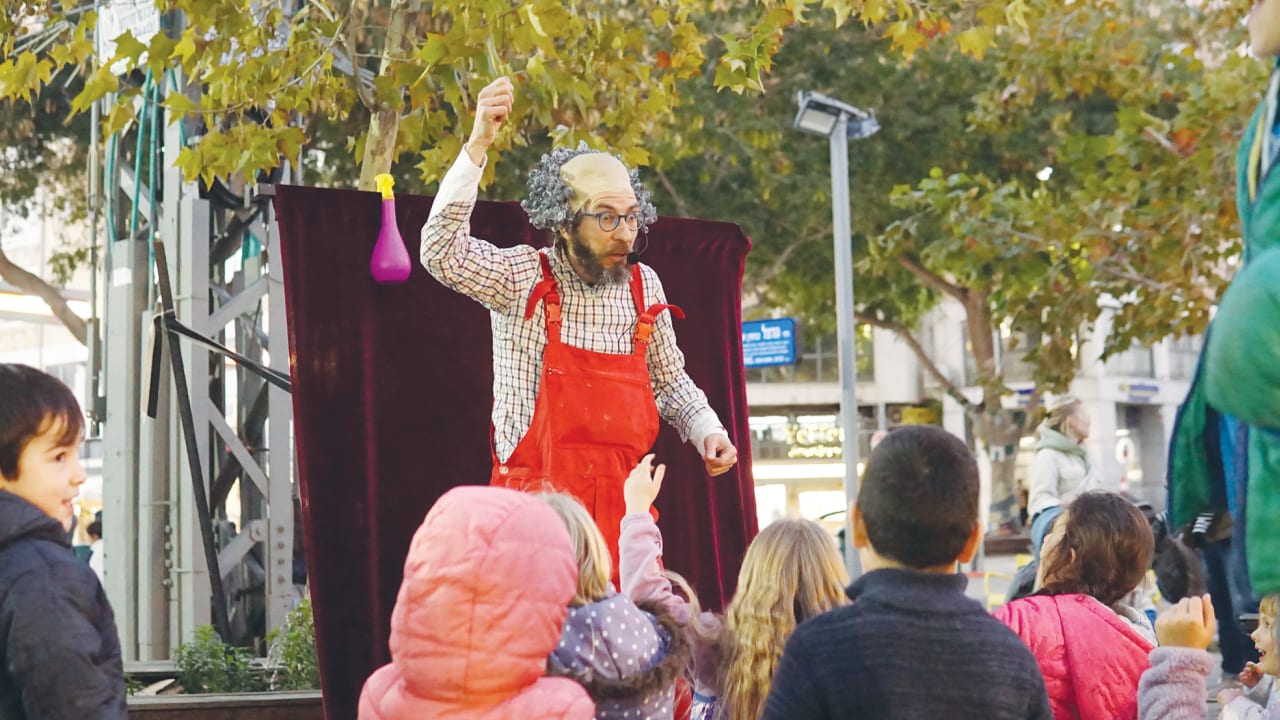
Children can also provide adults – parents – with “a reason to get up in the morning” – sometimes whether they want to or not. Zachi Devash has a couple of offspring of his own but spends plenty of time with many more representatives of the younger crowd, as part of his daytime job.
Devash calls himself a one-man street theater performer. Over the past couple of decades, he has predominantly performed for kids at all sorts of venues. He says keeping youngsters well entertained leaves him with a positive buzz, too. Mind you, over the past couple of years, keeping that cheery vibe has become increasingly difficult.
“Yes, you could say I make people happy. But, now, it is as if I have to invest more energy in order to produce the same [fun] result,” he says. “And I feel it is very important, both for the people I perform for, and for myself.” The proof of the pudding generally transpires. “I can begin a show feeling down and generally, by the end, I come out of it feeling much better.” That goes for the audience, too.
Is that, I wondered, a matter of taking the “fake it till you make it” line of thought? “I don’t think it’s quite that,” says Devash. “I don’t think I can really fake it. You have to take a moment, take a deep breath, and go for it. You don’t really have a choice.”

Meir Charash
THAT HAS been a national across-the-board sentiment these past two years. But for Meir Charash, the day-to-day challenge of keeping his spirits buoyed, and making a conscious decision to hang on to life, has been painfully palpable since well before October 7, 2023. Almost nine years ago, in December 2016, he lost his then 23-year-old son Ariel, to suicide.
US-born Charash makes a living as a fitness-cycling trainer and Thai masseur, and seeks solace through his intensive sporting activity. He arises at some unearthly hour six days a week so he can get a ride in before starting work. His relentless pedaling releases endorphins, which have been scientifically proven to enhance one’s state of mind, reduce feelings of anxiety and stress, and promote a sense of well-being.
The 67-year-old plugged straight into that as soon as he possibly could after the devastating tragedy. “The benefit of that, and the connection with the loss of my son and trauma, is [evident in] that 11 days after I lost my son, on a Friday, I got on a bike and joined the regular Friday [cycling] group,” he recalls.
Naturally, it wasn’t easy. “Someone asked me how I managed to get on the bike and smile while I was riding. It wasn’t a smile. I think I cried through the ride and for the next six months I didn’t talk. But biking became a statement for me – not just watt power [output] and cadence, which I still take seriously – it was a statement about life. You can live with loss, and even enjoy life, definitely enjoy life.”
Charash encapsulated that courageous positive mindset in a succinct motto. “Riding through has become a mantra for me. The difficulty of going up hills, the falls, the lactic acid, the tears, but then there’s the thrill of going downhill and the pure enjoyment.” His full rallying cry goes: “Embrace the loss. Ride through. Soak in the blessings.”
SITTING WITH Charash is like taking a crash course in how to do your damnedest to not only put a brave face on things, but to somehow glean actual happiness from just being alive. He is keen to spread the good, supportive word as far and as wide as he possibly can.
“Especially during the last two years – and I’m not judging anybody – just like with personal loss, you can just be sullen and depressed, and just be angry. That’s all valid. I have this expression, you can be ‘gam vegam’ – you can have both. I can be terribly concerned about the hostages, and I just had an amazing PR on Strava,” he enthuses. That references a sports-social app used primarily by cyclists and runners to share and compare Personal Records – PRs – and keep tabs on their own fitness levels.”
Therein lies yet another advantage of Charash’s chosen form of exercise. “Biking also brings a sense of community and friends,” he says.
He also uses online posts to disseminate some of his hard-earned wisdom. “Since the war, I mostly write about suicide prevention and building resilience, nothing political. There’s some divisiveness; we need unity. Not the Bibi unity, just togetherness.