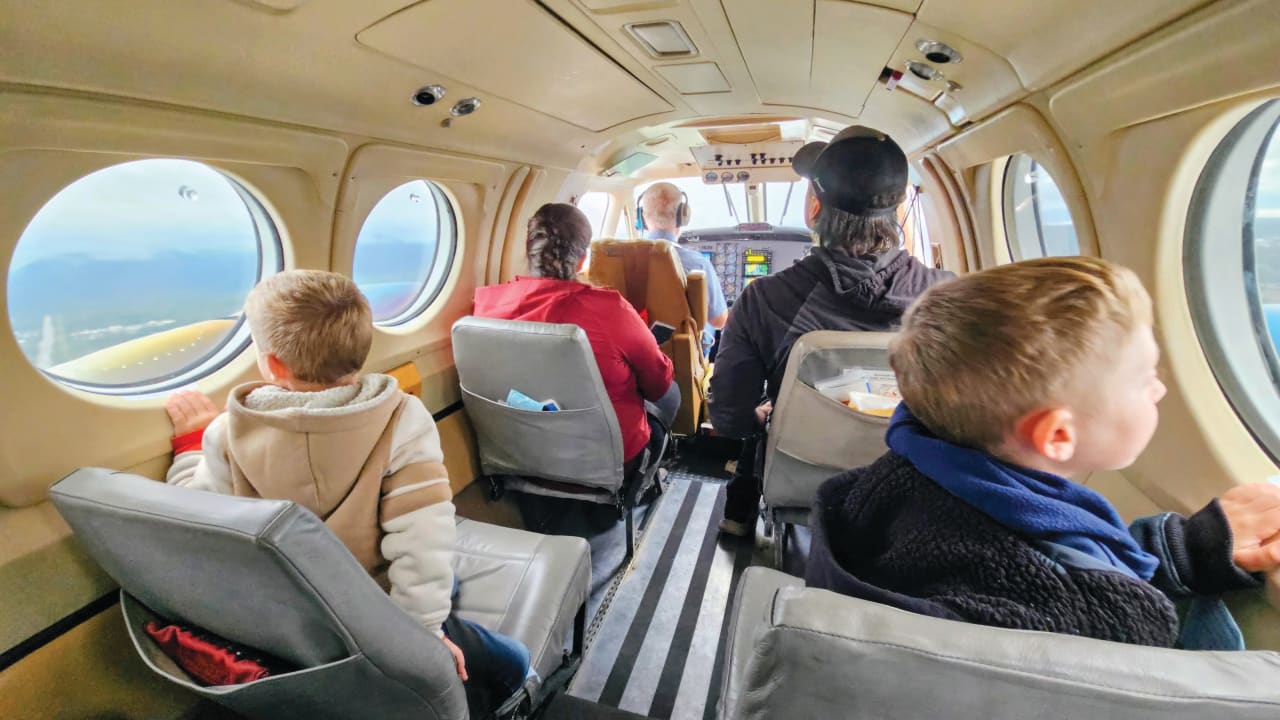
Just one week before landing in Sderot, we stood on a remote Alaskan riverbank watching nearly 20 wild grizzly bears feast on spawning salmon – raw and awe-inspiring, with no fences and no safety barriers. That primal brush with danger brought an unexpected calm and a clear perspective: The wild tests you, and in that test you discover limits and meaning.
Days later, we stepped into Israel’s fiercest heatwave in decades and into Sderot, where the threats are not predators but rockets, sirens, and the memory of sadistic terrorist invasions that shattered this town nearly two years ago. A reminder: We are still the closest city to northern Gaza, with just 15 seconds to reach safety when the siren sounds.
This town has endured tens of thousands of rockets fired toward civilians since the disengagement from Gaza exactly 20 years ago. Yet somehow, it is still standing taller than ever.
From glacial blues refracting sunlight to a city where the sun hits red against reinforced shelters, from pristine silence to the distant thud of explosions, the sensory shift was jarring and surreal. But this is home, and returning here was never meant to be easy.
My family and I spent the previous year as shluchim (emissaries) across North and Central America, staying in more than 80 homes, lodges, and healing retreats.

Those landscapes taught me to look for the architecture of recovery: How a place that seems broken can find new patterns of life, how nature restores itself, and how rituals, routines, and design help people reclaim a sense of safety. That lens is what brought us back to Sderot: not to flee the past but to investigate, document, and contribute to a living example of resilience.
Resilience has a toolkit
One of the clearest expressions of practical resilience is how the community supports its children. At the Sderot Resilience Center, our first welcome was not a brochure on sirens or shelter locations; it was a child’s resilience workbook.
Merchav Pnimi Sheli/Inner Space: My Resilience Workbook, co-authored by Dr. Naomi Baum and Tzivia Reiter, LCSW, is published and distributed by Ohel Children’s Home & Family Services. Trauma-informed and evidence-based, these tools are designed for ages five to 10 and come with teacher editions, multi-language translations, and classroom protocols. They are not simply exercises; they are scaffolding: guided stories to name fear, journals to make emotion concrete, and playful activities that teach breathing and grounding, while guiding adults through moments of panic.
Receiving the workbooks was a quiet but profound moment for our family. Here was a professional framework for the intimate, daily work of raising children in a frontline town. As a photojournalist who maps healing practices, I see these workbooks not only as tools for families but as blueprints for scalable programs. That dual quality, clinical depth, and practical usability is rare, and it makes Ohel’s work a strong candidate for wider implementation.
Mapping the world’s resilience capital
Sderot has changed dramatically since I first arrived in 2006. New neighborhoods have risen where open plots once lay, the city has nearly doubled in footprint, and the pace of construction is constant. I find myself lost in streets I once could have navigated blindfolded.
At first, the noise jarred me. After a year of evaluating wellness by the quality of silence, the constant hum of cement mixers and cranes felt invasive. But soon, I realized that each sound marks renewal: the audible proof that a community chooses to build, to expand, and to stake a claim to life.
Returning to Sderot, Adi, my wife and anchor, made the choice clear. Her drive to engage meaningfully led us back to the Gaza envelope. In recent months, she has taken on a national mission at the Israel Digital Center, managing the Digital Network for Israel Solidarity, a global community, while guiding groups throughout the Gaza envelope in commemorating Oct. 7.
Her commitment reminds me daily that our decision to return is not just about living here; it’s about shaping the narrative, supporting recovery, and making an impact far beyond our own family.
Presence over distance
Choosing to raise our sons, Lavie, 9, and Eitam, 6, here was not a sentimental whim. It was a moral decision forged in long nights of conversation.
I have witnessed the corrosive effect of prolonged threat, and I know that the instinct to protect can become a form of erasure – denying children the very landscapes and communities that make them whole.
Still, the question was unavoidable: Can I, in good conscience, bring my family back to a city that is still a frontline? Adi’s answer was resolute: Presence matters. Her determination and her new role at the Digital Center framed our return as a decision to engage in rebuilding and advocacy, not merely to endure.
Being present allows us to translate personal witness into public action. It lets our children know, in small quotidian ways, that life is worth choosing, despite risk. It lets us help shape the systems that nurture recovery: schools that teach emotional literacy, playgrounds that double as safe spaces, and community networks that connect families to clinical care when needed.
My own work has shifted as well. Years of photographing rocket fire and their aftermath altered something in me; I am no longer driven to be a war correspondent. Instead, I am compelled to document recovery, to ask what works, and to translate those answers into images and narratives that can inform policy and practice.
The Dead Sea Revival project I led for seven years and the healing retreats across the Americas taught me that recovery is rarely miraculous; it is methodical. It requires attention, resources, and the courage to live where the problem exists.
Ordinary life, extraordinary courage
Sderot’s courage is most visible in small things. Children ride bicycles down streets that once lay under rubble. Markets open early and stay open late. Parents plant gardens on apartment balconies. A playground three minutes from our door has shaded slides and a mini soccer field, with the concrete imprint of shelters nearby. Play and protection coexist here – a daily lesson in resilience.
Every siren or distant boom is counterpointed by laughter, by families spending time at the parks, and by shopkeepers cleaning counters. These acts are not a denial. They are deliberate, moral choices to affirm normalcy. They are the daily exercises of hope.
As a photojournalist, I am drawn to these moments. The frame I seek is not only the dramatic shot of destruction but the quieter photograph of repair: hands lifting a plank, neighbors painting a mural, a child writing in his resilience workbook. Those images, I believe, have the power to reframe how the world sees places like Sderot. They can change narratives from victimhood to agency, from isolation to a shared curriculum for recovery.
Our family has returned to a city that tests you and teaches you in equal measure. From grizzly rivers to red-alert towns, from the solitude of glaciers to the busy hum of construction, the arc of the last year has been about understanding how life endures and how it rebuilds. Now my work is to map that endurance, to photograph its innovations, and to share them with audiences who can learn from them.
If this is a new chapter, it is also an invitation. Sderot has lessons to teach about preparedness, trauma care, and communal creativity. It is a proving ground for ideas that could serve families and communities worldwide. As we settle in, we bring our cameras, notebooks, and a resolve to tell that story honestly and fully.
The writer is a photojournalist and founder and former director of the Sderot Media Center, who has spent over a decade reshaping global awareness of Sderot and the Gaza border communities.
The Environment and Climate Change portal is produced in cooperation with the Goldman Sonnenfeldt School of Sustainability and Climate Change at Ben-Gurion University of the Negev. The Jerusalem Post maintains all editorial decisions related to the content.