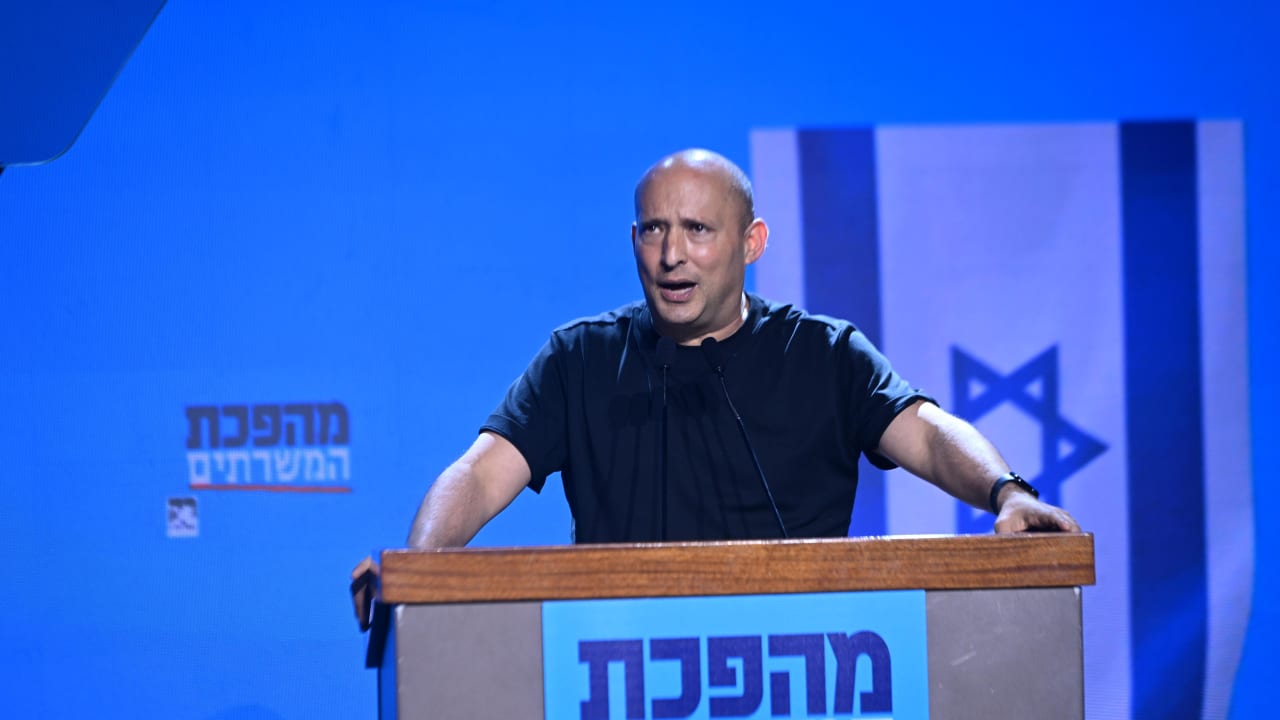
Former prime minister and B’Yachad head Naftali Bennett argued that the Eisenkot-led bloc should “threaten the haredi parties, not beg them," in closed-door conversations about negotiations to form Israel's next government, Walla learned on Sunday.
"We need to make them want to come. We need to show them how much they stand to lose if they don't come. We need to press ahead with the 'Alliance of Those Who Serve' at full force and make them come out of fear of what will happen if they don't," Bennett said.
His remarks offer a rare glimpse into the former prime minister's thinking at a time when his position on the makeup of the next government remains one of the biggest unanswered questions in the political arena.
While other party leaders in the change bloc have publicly discussed possible coalition arrangements, Bennett has kept his cards close to his chest, carefully avoiding statements that would reveal which parties he would be willing to join in government.
Bennett, whose election campaign was based largely on the "Alliance of Those Who Serve" and a pledge to change national priorities regarding those serving in the IDF, has so far avoided directly addressing the possibility of forming a government with the haredi (ultra-Orthodox) parties.

Bennett: For or against sitting with haredi parties?
He also remained silent after Yisrael Beytenu chairman Avigdor Liberman said he was willing to join a coalition with the haredi parties, despite having pledged otherwise during the election campaign.
Walla has learned that Bennett has yet to decide which political alternative he prefers: a government that relies on the support of Arab parties, or one that includes the haredi parties and would require compromises over military conscription.
Nevertheless, his private comments suggest he opposes offering the haredi parties significant concessions to secure their participation in a coalition.
Instead, Bennett believes that continuing to advance the principles at the heart of the election campaign, particularly changes to military conscription policy and benefits for those who serve, could increase pressure on the haredi parties and make joining the government more attractive than remaining in the opposition.
Bennett helping Eisenkot establish a 'Zionist gov't'
On Tuesday, ahead of the swearing-in of the Knesset, Bennett addressed the negotiations to form a government publicly for the first time, although he again avoided directly discussing a possible partnership with the haredi parties.
"I am doing everything to help [Yashar leader Gadi Eisenkot] establish a Zionist government of national renewal and bring about the revolution for those who serve," he said.
In a voice message to party activists, Bennett added that reservists need others to step in and share the burden, using the military metaphor of taking turns carrying a stretcher.
He said he was working quietly to help Eisenkot form a government as quickly as possible, while warning activists that "we have no small battles ahead of us."
"Former prime minister Bennett and the B’Yachad party are committed to the revolution for those who serve as an urgent necessity for the State of Israel and the IDF," Bennett's office stated.