
Israel should consider withdrawing from parts of its security buffer zone in Syria as a relatively low-cost step toward improving relations with the US, while pursuing diplomatic alternatives to prolonged military deployments in Lebanon and Gaza, former senior Biden administration official Ned Price said in a recent interview with The Jerusalem Post.
Price, who previously served as deputy US ambassador to the UN and held senior positions at the State Department and CIA, argued that Israel would need to show progress on several fronts to rebuild support among Democrats, but that concessions did not need to come simultaneously.
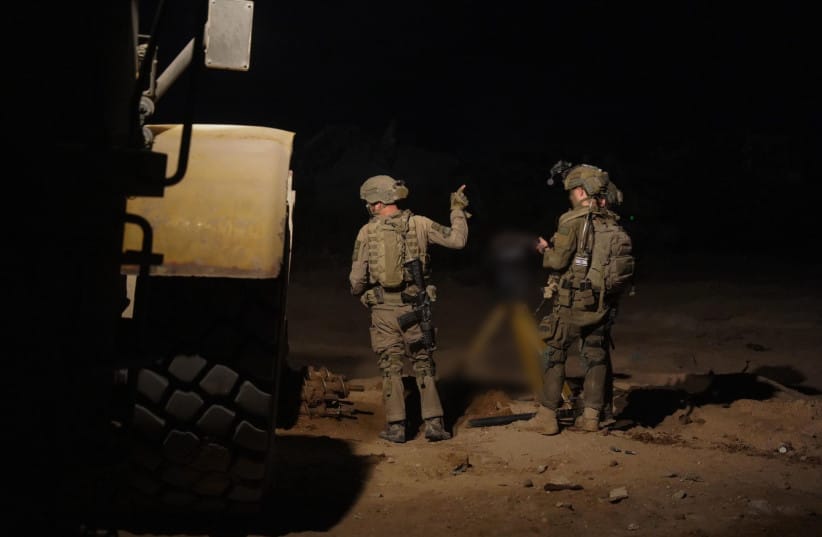
Israel's security zones in Gaza, Lebanon and Syria
Price was questioned about what order Democrats would want Israel to make any concessions in, given that Israel has three security zones, but even if Israel was able to make partial withdrawals, it could not, just in terms of practical planning and coordination, be expected to carry out even partial withdrawals simultaneously from all three.
Addressing partial withdrawals from Gaza, Lebanon or Syria, he said, "Sequencing is a good challenge to have. With enough time, there should be progress on all fronts. There will be absolutists who will say we need to see progress on all fronts on a continuous basis if there is to be progress in the relationship."
"But as a practical matter…in the US, eyes have been trained on Gaza since and after October 7. It has taken up so much oxygen in the US and in our relationship in terms of those who have long-standing experience with bilateral relations and the broader issue of Israel and Palestine," clarifying that concessions in Gaza would likely be more pressing even than in Lebanon and Syria.
Next, he added that the US, "Eyes are equally trained on the West Bank and the contours of what can and cannot be done in any negotiation of the solution of a future State of Palestine."
Price was firm that, on top of territorial issues, Jewish extremist violence and, in some cases, terrorism in the West Bank needed to be stopped rapidly under any scenario, while recognizing that Palestinian terrorism there remains a significant challenge.

Should Israel make concessions with Syria?
Referring to Syria, the Post asked whether this was "low-hanging fruit" where Israel could more easily make concessions with partial withdrawals earlier, at a lower political and security cost than a partial withdrawal from Gaza or Lebanon, which might also give Jerusalem more time on those other fronts.
Price agreed that, "There is low-hanging fruit. If I were an Israeli policymaker, I would look for the very point you [the Post] made about Syria. It was sort of an [Israeli] opportunistic move to me, a land grab in the aftermath of the Assad ouster, which was really probably unnecessary for Israeli security."
"There is potential for regular relations with the new regime in Damascus which would obviate the need for this kind of land grab. Looking at low-hanging fruit, even if no one is clamoring at the moment, making gestures however small, however relatively painless, could be a wise move," he continued.
Meanwhile, both the Israeli government and opposition leaders have been outright opposed to or concerned about withdrawing from the security buffer zone, having less faith in Syrian leader Ahmed al-Sharaa than either Trump or many Democrats.
Yet, behind the scenes, there has been greater Israeli openness to withdrawals from Syria, while holding onto the Syrian Mount Hermon site for a more indefinite period due to its unique security value and the fact that it does not enmesh Israel with too many Syrian civilians.
Lebanon

Ex-Biden official on Lebanon: Israel must put an end to 'temporal horizons'
On Lebanon, the Post noted that neither Netanyahu nor Eisenkot have signaled any near-term readiness to do more than partial withdrawals.
Price explained that Israel seeking to postpone a withdrawal from Lebanon for a period of years would not be as easily accepted as in the past.
"We need to challenge these temporal horizons – Five years is never five and 10 years is never 10. Also, five years is five too long, and it just assumes that these challenges can be wiped off the map militarily, whether overtly or something less than that, but that is not going to be the case."
Accordingly, "rather than thinking about a five or 10 year time horizon," Israeli policymakers can "invest in concerted diplomacy and dialogue – with partners in Lebanon, but also cooperation with the international community,"
"Israel does still have the opportunity to work with the US, France, and the Saudis on this rather than committing to an occupation of however long, which would be a recipe for an endless occupation – a learned lesson from the West Bank, Gaza, and Syria. I just don’t think that is the right approach," he said.
Moreover, he stated, "The default assumption is that if Hezbollah is getting too strong, then Israel needs to take care of it…for much of recent decades, there have been few other alternatives. We want to change that assumption. Institutions like the LAF (Lebanese Armed Forces) need to be strengthened so that other entities, internal entities, rather than an external state like Israel, will be responsible and capable of patrolling a non-state entity like Hezbollah."
The goal would not be to eliminate Hezbollah, which Israel has not come close to doing anyway, but to eliminate the external threat Hezbollah has posed to Israel, including preventing it from growing too strong through rearming, and the question would be how to change that, noted Price.
Pressed that all efforts to strengthen UNIFIL or the LAF have failed because Hezbollah has invariably been more powerful and had collaborators at the highest levels of the LAF, he responded, "I am not saying this is going to be easy. There are locales which may not hold all of the answers, but there are clues and parallels."
Questioned that Afghanistan and Iraq are evidence that the US and the West have not succeeded well at such projects in the region, he acknowledged, "Afghanistan is not the best in terms of parallels, but we have engaged in capacity building in Nigeria, Somalia, and other places in West Africa – there may be some lessons to be learned, even if not to emulate fully," he explained.
"This is the dynamic: multiple countries have demonstrated a willingness to be engaged in a concerted way…I don’t want to suggest this is going to be a solution for next week or this year, but this has to be the paradigm going forward, rather than the paradigm being temporal occupation," of southern Lebanon by Israel for an extended period.

Ex-Biden official slams Netanyahu for damaging bipartisan relations in US
Returning to a more general level, Price slammed Netanyahu for publicly embarrassing then-president Barack Obama with his 2015 speech to the US Congress and multiple moves since then that he said have undermined Israel as a bipartisan issue.
Moreover, Price said that better coordination and messaging to Democrats is only part of Israel's problem in the US, noting, "also [US Vice President] JD Vance and what the president [Trump] demonstrated on election day – with seemingly offhand statements, these had a seismic effect within both parties."
Mainly, Price said that Israelis need to understand that they will need to work much harder to convince Democrats and Americans in general about why the US should support Israel in a variety of areas, with both policy and messaging changes, than at any other time in recent memory.