"To be a woman in Nuremberg was a paradox: very much in the room, but unseen; critical to the story, but unrecorded," British author and historian Natalie Livingstone told The Jerusalem Post.
Livingstone has recently published a new book, The Nuremberg Women, about the untold stories of the female prosecutors, interpreters, journalists, and witnesses who shaped justice at the historic post-WWII tribunal.
Livingstone is known for her retelling of moments in history that have typically been told through a male lens. Her first book, The Mistresses of Cliveden, chronicled three centuries of powerful women who presided over England's Cliveden estate, and her second book, The Women of Rothschild, unveiled the role of women in shaping the legacy of the famous dynasty.
The new novel explores the frequently overlooked roles of eight women who held central roles during the 1945–1946 Nuremberg Trials, where Nazi leaders stood trial for crimes against peace, war crimes and crimes against humanity.
The memory of the Trials was present in Livingstone's own upbringing, as the granddaughter of Holocaust survivors. But the true seed of interest in the topic came during a visit to the Imperial War Museum, where she encountered Dame Laura Knight's painting The Nuremberg Trial (1946). Part of the museum's permanent collection, the famous oil-on-canvas depicts Nazi leaders and war criminals sitting in the dock, juxtaposed against the bombed ruins of the eponymous German city.

World-famous painting by a woman in attendance included only men
"I looked at Courtroom 600, which is where the trials took place, and I saw how the artist had depicted male defendants, male lawyers, male judges and male soldiers. I had to lean in very closely in order to see that the signature is actually that of a woman, Dame Laura Knight, who painted the scene in real life."
British artist Dame Laura Knight was an official war artist and the very first woman elected to be a full member of the Royal Academy in over a century.
It was Knight herself who had proposed to the War Artists' Advisory Committee that the Nuremberg war crimes trials be a subject. Knight then spent three months in Germany in January 1946 observing the main trial from inside the courtroom.
Knowing that the world-famous painting was made by a woman sent Livingstone into a "process of discovery and realization."
"If Laura Knight was hiding in plain sight, who else was there?" she queried. "What other stories were there? I was completely intrigued to find out other incredible protagonists who were so vital to the process."
What she uncovered, she told the Post, was "a whole ecosystem of women in Nuremberg."
"Nuremberg was this bubble. It was this moment in time. And in order to put the trial together, it required a huge array of so many different talents from writers, stenographers, translators, and prosecutors. And it transpires that almost all of those roles could be performed and inhabited by women, apart from that of judge. It opened up this world to me."
Perhaps one of the more unexpected discoveries for Livingstone was the quantity of available source material.
"So many of these women wrote diaries of their times at Nuremberg. It gave me a really, really vivid sightline about what it was like to be in Nuremberg on a day-to-day, hour-to-hour basis."
She told the Post that a lot of women also wrote "Fantastically detailed letters," which also provided details of everyday life that courtroom testimony cannot provide. Additionally to that, some women wrote memoirs.
"This whole rich world of source material was opened up to me by looking at the women's stories rather than restricting myself to the testimony from Courtroom 600 and the traditional narrative - which excluded women."
One woman traditionally excluded from the Nuremberg narrative is Harriet Zetterberg.
Zetterberg, a 1941 graduate of the University of Wisconsin Law School, was on the US prosecution team, the first woman to be formally assigned to the role. Zetterberg's job was to prepare trial briefs.
She corresponded frequently with her mother about the trials, referring to the work as "frantically busy" and with a sense "of listening to history in the making."
However, Livingstone told the Post she would have had no idea that there were any female prosecutors in the American team had she not found Zetterberg "as a literal footnote in the memoirs of chief US prosecutor Telford Taylor."
In his memoir, Taylor was recounting the the conviction of Hans Frank, a notorious Nazi war criminal known as 'the butcher of Poland.'
"Taylor was describing how the dossier which led to his conviction was assembled. There was a whole list of men. And then there was an asterisk. And I looked down at the asterisk, followed it down, and there was Harriet Zetterberg."
"She was this extraordinary, consequential legal mind, the first woman to win the Sterling Scholarship for Law at Yale University, who wanted a life in public service and lobbied to go to Nuremberg.
"As soon as she arrived in Nuremberg, she was set to work with putting together this dossier that led to the conviction of Hans Frank, working 16-hour days under really impossible conditions. Nuremberg was a ruined city. There was no real infrastructure. There wasn't heating. There were only very dim light bulbs. A lot of the machinery, like the typewriter, didn't work. But she toiled and toiled and toiled to produce this brilliant airtight case, which led to his conviction."
Livingstone noted that on the day that she was due to be presenting the evidence, she had to hand over the dossier to a man.
"And the reason for that is in 1946, in order for a woman to advocate in court, she would have had to have obtained a waiver of disability. That disability being that she was a woman."
A woman of several secrets, Zetterberg was also married and pregnant, which led her to be sent back to the US.
"The realities of being an ambitious working mother in late 1940s and 1950s America meant that there was no infrastructure for her to really pursue her career. The only jobs that she could find was very menial paralegal work; she ended up being paid a secretary's wage. So she ended up having this life of thwarted ambition."
Unlike some of her male counterparts, Zetterberg to this day has no Wikipedia page.
"She's really emblematic of the paradox of what it was to be a woman in Nuremberg. Very much in the room, but unseen. Critical to the story, but unrecorded."
French resistance fighter, Auschwitz survivor testified at Nuremberg
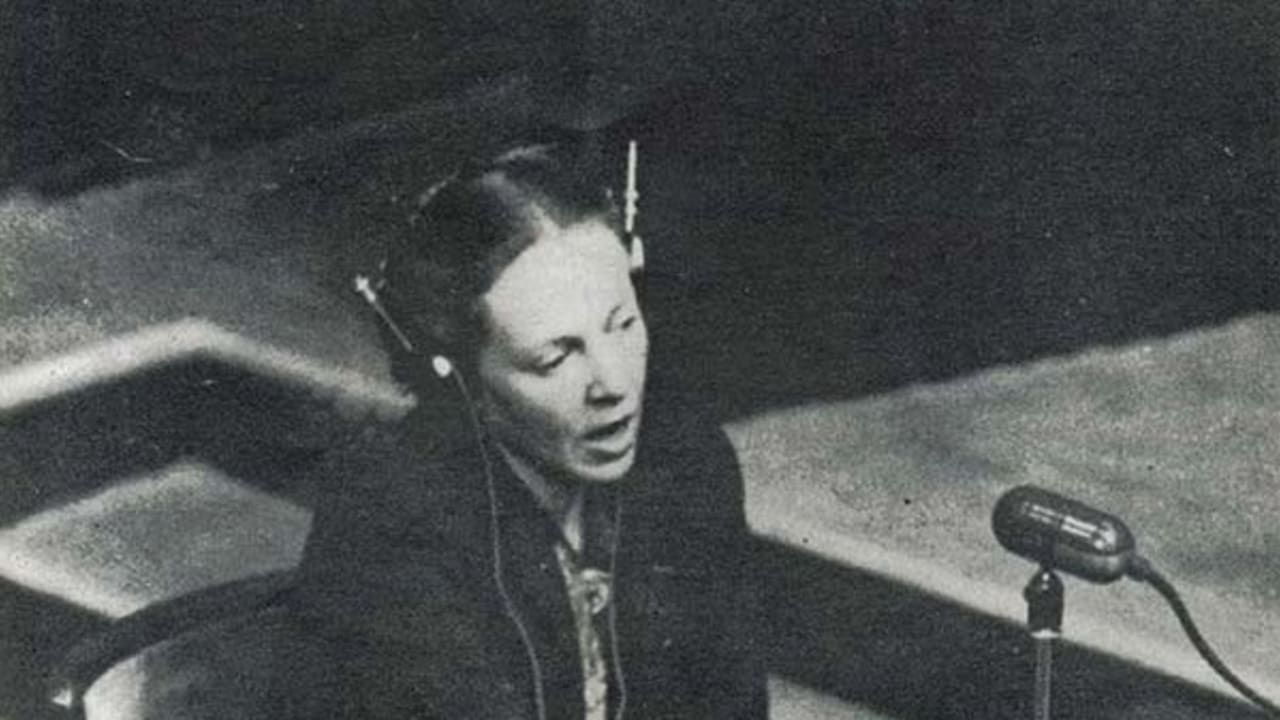
Another woman central to the Nuremberg trials was non-Jewish French resistance fighter, photojournalist, and Auschwitz survivor Marie-Claude Vaillant-Couturier.
Vaillant-Couturier was arrested alongside other Resistance activists in February 1942 and was eventually deported to Auschwitz-Birkenau in January 1943. Of the 230 female resistance members in her convoy, only 49 survived the war.
Vaillant-Couturier was in Auschwitz for 18 months, where she witnessed the genocide of the Jews, and was then transferred to the Ravensbrück concentration camp in August 1944, where she remained until the camp's liberation on 30 April 1945 by the Red Army.
She was then asked to testify at the Nuremberg Trials. She later reflected: "By telling of the sufferings of those who could not speak any more, I had the feeling that, through my voice, those whom they had tortured and exterminated accused their torturers."
"Marie-Claude is the heart and soul of Nuremberg and the heart and soul of the book," said Livingstone.
"She was a passionate and fearless French resistance fighter. Even when Ravensbrück was liberated, she opted to stay a further three months in order to look after those who were too sick and infirm to travel back by themselves. And then on the 28th January, 1946, she took to the stand, the first female eyewitness at Nuremberg."
In a two-hour foundational testimony, Vaillant-Couturier told the courtroom and the world the true horrors of the Holocaust. According to Livingstone, she laid out in "unflinching details the deaths due to starvation, due to cold, the sexual brutality against women, the murders of children, of babies."
"She painstakingly restored names to those who had just been reduced to numbers. And she left the courtroom in no doubt about the systematic attempt of the Nazis to liquidate and eradicate the Jews."
"It opened the eyes of the courtroom and the eyes of the world to this astonishing, horrendous, singular, catastrophic phenomenon, which became known as the Holocaust."
Vaillant-Couturier then spent the rest of her life fighting Holocaust denial.
These are just two women explored in the book. There are also journalists Erike Mann, Ursula von Kardorff and Rebecca West, guesthouse owner Countess Ingeborg Kálnoky, young Soviet interpreter Tatiana Stupnikova, and of course, Dame Laura Knight.
"These stories are so human, and they're so rich in emotion. Finding these eight extraordinary, fascinating technicolor personalities was just so rewarding. Each woman in her own way was so dynamic, so new, such an untapped virgin source: it's a historian's dream to be able to uncover such incredibly powerful figures in history who haven't been heard before," Livingstone mused.
There is also a wider significance to the book, in terms of the relevance of the Nuremberg trials 80 years on in a time of increasing distortion of truth.
"Nuremberg is about truth. Nuremberg is about the facts. Nuremberg is about evidence. Nuremberg is about human voices. All of those things have been diluted or weaponized or distorted in this world that we're living in, particularly in the realms of social media."
"These notions of conspiracy theories and misinformation and hatred thrive in the echo chamber of modern life. So Nuremberg reminds us, it takes us back to the roots of civilization: that is, the willingness to distinguish between lies and the truth and evidence and incitement and hatred and humanity."
Livingstone also said the Nuremberg reminds us that this kind of hatred did not begin in Auschwitz.
"It began with language. It began with dehumanization. And it began with a gradual and slow proliferation of prejudice. Nuremberg reminds us that these nefarious forces can be countered."
And nowhere can you see this more, she concluded, than in the stories of these eight women who displayed "such resilience, hope and desire to live despite seeing the very worst of humanity."