
Three speeches at this year’s UN General Assembly last month by India, Pakistan, and Sri Lanka offer a useful window into a broader transformation across South Asia and the Indian Ocean. Their significance for Israel lies not simply in what each country said about Gaza, terrorism, or Israel itself. More importantly, they reveal three different ways states are trying to protect their interests and preserve strategic room for maneuver in an increasingly fragmented international system.
India’s position is the most ambitious of the three nations.
External Affairs Minister S. Jaishankar described a world in which everything is being weaponized, from finance and market access to technology and supply chains. His response was not withdrawal from globalization, but diversification, de-risking and greater national capacity.
He also placed this transformation within a larger shift toward multipolarity and argued that the international order created after 1945 must adjust to new realities. This reflects an important evolution in India’s understanding of strategic autonomy. Autonomy is increasingly less about maintaining distance from rival blocs and more about acquiring the capabilities, partnerships, and alternatives necessary to prevent dependence from becoming vulnerable.
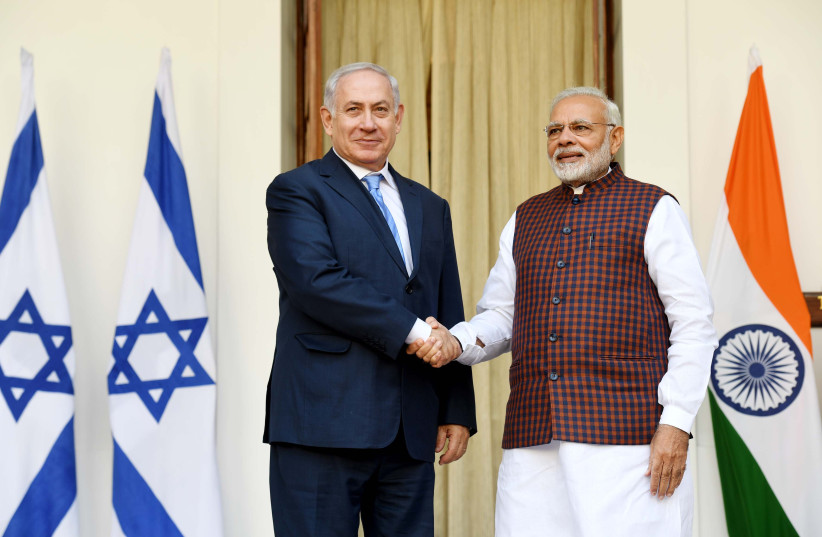
That distinction matters for Israel. India can deepen defense, technological, and economic cooperation with Israel while continuing to support a two-state solution, maintain important relationships across the Arab world and Iran, and resist expectations of automatic diplomatic alignment. This is not necessarily a contradiction in Indian foreign policy. It is largely the point of strategic autonomy.
Jaishankar’s treatment of the Middle East illustrates this approach. He called for restraint, de-escalation and protection of civilians, but also emphasized uninterrupted energy and commercial flows and the security of shipping and seafarers. Ukraine, too, was addressed through the need to end an increasingly costly war. The underlying concern is therefore broader than individual conflicts: instability increasingly travels through energy markets, maritime routes, supply chains and trade.
Pakistan’s speech reflected a different strategic position. Prime Minister Shehbaz Sharif spoke repeatedly about peace and dialogue, yet much of his security narrative remained organized around India. Kashmir remained central, while India’s decision to hold the Indus Waters Treaty in abeyance was presented not merely as a bilateral dispute but as an existential security issue. Sharif warned that attempts to stop or divert Pakistan’s share of the waters would be treated as an “act of war.”
The juxtaposition is revealing. Pakistan presented itself simultaneously as an advocate of dialogue and as a state prepared to articulate explicit redlines. It also situated itself within several overlapping strategic relationships: its partnership with China and the China-Pakistan Economic Corridor, its relations with the Gulf, and its continuing engagement with Washington. Sharif even credited President Donald Trump with helping prevent a wider India-Pakistan war.
Regarding Israel, however, the language was markedly different. Gaza and the Palestinians occupied substantial space, and Sharif employed exceptionally harsh accusations against Israel, including the claim that Israeli policy in the West Bank reflected a “genocidal agenda.” For Israeli policymakers, Pakistan therefore remains a very different political case from India. Yet its foreign policy cannot be understood through its position on Israel alone; it is embedded in a wider effort to manage relations with China, Washington, the Gulf and an adversarial India.
Sri Lanka offers a third model and perhaps the most interesting from a small-state strategy perspective.
Foreign Minister Vijitha Herath described Sri Lanka as being at the “crossroads of the Indian Ocean,” yet did not mention India or the United States; China appeared only in connection with regional flooding. Instead of framing the Indian Ocean primarily through great-power rivalry, Colombo emphasized international law, neutrality and peaceful maritime cooperation.
For a small state in a strategically contested location, this is not necessarily idealism. It can be understood as a strategy for managing asymmetry. Sri Lanka cannot compete militarily with the major powers operating around it. Its room for maneuver therefore depends partly on avoiding exclusive alignment, maintaining multiple relationships, and strengthening the rules and institutions that constrain, however imperfectly, the exercise of power.
Its recent economic experience adds another dimension. The speech connected Sri Lanka’s recovery from the 2022 crisis with continuing vulnerability to debt and external shocks. In this conception, economic resilience is itself a component of strategic autonomy.
Taken together, the three speeches challenge another convenient category frequently used in Israel: The Global South. No single Global South foreign policy exists. India increasingly speaks as a power that wants to help shape the international order. Pakistan approaches that order through a security environment still heavily structured by its rivalry with India and its dependence on multiple external partnerships. Sri Lanka seeks to preserve autonomy from a position of much greater material vulnerability.
This distinction has practical implications for Israel. Support for Palestinian statehood does not necessarily indicate strategic distance from Israel, just as strong bilateral defense cooperation does not produce automatic diplomatic alignment. States increasingly separate relationships by domain security, technology, energy, connectivity, diplomacy and cooperate where interests converge while disagreeing elsewhere.
For Israel, therefore, the important question is not simply which South Asian states support Israel. It is where Israel fits into their respective strategies for managing a changing international order.
That is a more demanding question. But in an Indian Ocean increasingly connected to Israel through trade routes, energy flows, Gulf partnerships and emerging connectivity projects, it is also the more important one.