Mars
Japan launches uncrewed space mission to become first to gather samples from Mars' moon Phobos
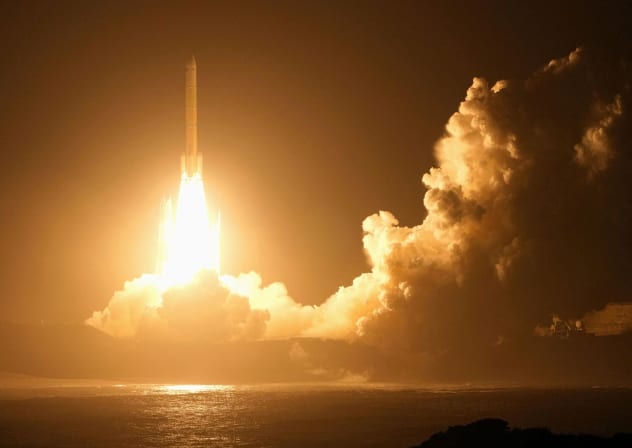
The Japan Aerospace Exploration Agency's Martian Moons eXploration spacecraft lifted off aboard an H3 rocket before dawn from the Tanegashima Space Center in southwestern Japan.

Jordan joins Artemis Accords, int'l principles for exploring Moon, Mars, space, NASA says
Water on Mars? Scientists discover 'bathtub ring' which may reveal contours of ancient ocean

Artemis II astronauts return to Earth after historic crewed mission to the Moon
UAE, NASA missions find 'patchy' auroras in Mars atmosphere
The new type of aurora is formed with the solar wind hitting Mars' dayside upper atmosphere and emits ultraviolet light as it slows down.

Why did rocks from the Mars Perseverance rover surprise scientists?
Rocks collected by the Mars rover could help scientists figure out if Mars could support life and, if so, when.

This Israeli firm helped NASA study Mars, will help study Jupiter's moon
Ricor Cryogenic Systems, located on Kibbutz Ein Harod in northern Israel, built a cooling system for NASA’s Curiosity rover and will do the same for the Europa Clipper mission.

How can crops be grown on Mars? These plants are the key - study
Researchers found that it is possible to grow food crops on Mars using an alfalfa based-fertilizer.

Earth averted Mars-like fate with inner core restoring magnetic field - study
The magnetosphere, meaning Earth's magnetic field, is essential in allowing Earth to remain habitable. This is because it acts as a shield, protecting the planet from cosmic radiation.

Volcanic eruption on Mars produced a rare mineral - study
Rice University's scientists teamed with NASA and the California Institute of Technology to solve the mystery that stunned them on their Mars research.

What can a Martian meteorite teach us about Earth’s origins?
The chemistry of the meteorite indicates that Mars had volcanic activity similar to that on Earth, recording the first stage of Mars’ geological evolution.

NASA experiment searches for amino acids in investigation into possible life on Mars
A discovery of amino acids on the planet could indicate signs of past Martian life that is now extinct.
NASA calls on public to help it study the clouds of Mars
NASA has 16 years' worth of data on Mars's atmosphere, but clouds can best be seen with the naked eye. So they need your help to find them in order to understand the atmosphere better.
Five planets align perfectly, visible until end of June
Mercury, Venus, Mars, Jupiter and Saturn will be visible every morning until the end of June in an alignment not seen since 1864.
