Fossil
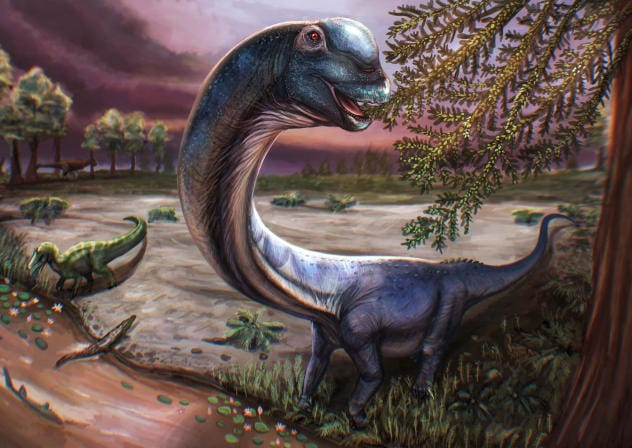
Scientists unearth fossil of Southeast Asia's largest dinosaur in Thailand
Nagatitan lived at a time when Earth's atmospheric carbon dioxide levels were rising, coinciding with high global temperatures.
Newly discovered fossil challenges idea of ape origins in east Africa - study

Stone handaxes found in Galilee show early humans valued aesthetics of their tools - study

Fossils of a new species of huge dinosaur Spinosaurus unearthed in Niger
Lost world found: Fossils beneath Madura Strait rewrite human history
Two skull fragments provide unique insights into how and where this ancient human lived.

New pterosaur species Nipponopterus mifunensis identified from Japanese fossil
Expected to provide important clues on pterosaur evolution, the fossil is the first known member of a new genus.

Nature study: Newly analyzed fossil reveals earliest feathered flight
"Archaeopteryx is not the first dinosaur with feathers, nor is it the first dinosaur with wings. However, we think it is the earliest known dinosaur that could use its feathers for flying."

Footprints found in Australia are the oldest evidence of clawed animals ever found
'A single track-bearing slab calls into question everything we thought we knew about when modern tetrapods evolved.'

Rare fossilized butterfly identified as new extinct species Tacola kamitanii
It is the first butterfly fossil from the Early Pleistocene epoch, dating to 2.6 to 1.8 million years ago.

Did T. rex's 'grandparents' migrate over the Bering Land Bridge?
Tyrannosaurus rex evolved in North America, specifically in Laramidia, the western half of the continent.

New fossils suggest land bridges brought apex crocodiles to the Caribbean
Fossils date to 5 to 7 million years ago, extending sebecids' existence by 5 million years.

Oldest-known ant preserved in 113 million-year-old Brazilian fossil
The species, called Vulcanidris cratensis, is part of a lineage called hell ants - named for their demonic-looking jaws.

Massive dinosaur fossil found at Big Bend National Park
Student expedition leads to discovery of a large vertebra belonging to an Alamosaurus.

A curled up paw: 5.5-million-year-old fossil bridging foxes and wolves found in Italy
The most complete specimen of Eucyon ever found in Europe, was discovered in the province of Cuneo, Italy.
