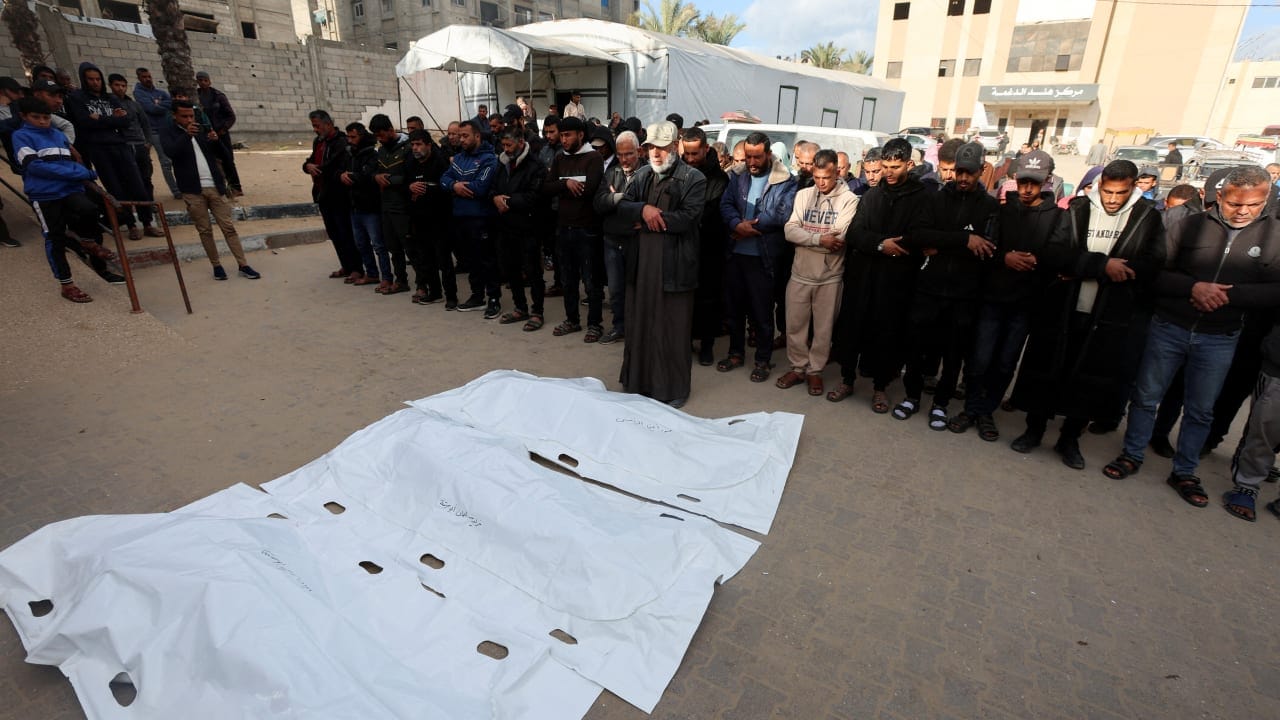
Since the beginning of the Israel-Hamas War in October 2023, few issues have been as contentious or as professionally corrosive for those tasked with defending Israel’s case internationally as the casualty toll in the Gaza Strip.
For over two years, Israel has faced relentless accusations of genocide, disproportionate force, and war crimes, driven largely by a single claim: the number of people reportedly killed in Gaza.
That figure, issued by the Hamas-led health ministry, has been cited repeatedly by governments, international organizations, and global media outlets, often without qualification or scrutiny.
The two authors of this article have spent much of the past two-and-a-half years trying to explain Israel’s war on television panels, in closed door briefings, and in lectures halls – often undergoing hostile questioning, ticking studio clocks, and the quiet knowledge that a single unchallenged statistic can undo an entire argument.
We have had to convey how modern urban warfare is conducted, why casualty figures in active conflict zones are unreliable, and how, even if Hamas’s numbers had been accurate, they still failed to tell the real story of the war.

That story is about Hamas’s deliberate embedding of its military infrastructure within civilian areas; about its systematic use of human shields; and about a terrorist organization that benefits strategically from civilian deaths.
What Israel has done in Gaza, we often argued, is not unique. It is what any military does when fighting a barbaric terrorist enemy entrenched inside a civilian population.
A central talking point throughout the war was that Hamas’s casualty figures – now claiming some 70,000 dead – should be scrutinized, that the figures were never substantiated and lacked credibility. No media, we regularly argued, would seriously quote casualty numbers issued by the ISIS or al-Qaeda health ministry. Yet when Hamas publishes figures, the world accepts them reflexively.
Israel entered the information war unarmed
About 18 months ago, one of us approached the IDF and the Foreign Ministry with a simple question: What is Israel’s own accounting of the casualty toll in Gaza?
The answer was hard to believe: No one collects that information. For anyone on the frontlines of Israel’s communication battlefield, this situation is the equivalent to sending F-35s to bomb Iran’s nuclear installations without ammunition.
In other words, while Hamas was flooding the world with unverified figures, Israel made no systematic effort to challenge them.
Whether this was a mistake is debatable. That it was negligent is not.
That negligence exploded into full view last week, in a “background” briefing to Israeli military correspondents, where a senior officer told reporters that Israel “accepts” the casualty figures issued by Hamas.
He did not say Israel has reservations about Hamas’s numbers.
He did not say the figures are being examined or disputed.
He didn’t even say that this number includes the estimated 25,000 terrorists killed in battle or targeted strikes.
He said Israel “accepts” them, clearing failing to realize how his words would be interpreted.
The impact was immediate. Israeli media reported the statement, international outlets translated and amplified it.
Mehdi Hasan, one of Israel’s most virulent critics, seized on it as proof that Israeli officials had been lying all along.
Piers Morgan, who has attempted to host balanced discussions about the war, concluded that the debate was effectively over: Even the IDF, he said, now accepts Hamas’s numbers.
Whether knowingly or not, one IDF officer caused the country incredible damage. Nevertheless, none of this should come as a surprise.
For two years, Israel has operated without a head of the National Information Directorate – the body created after the 2006 Second Lebanon War to coordinate government messaging and public diplomacy during crises. The position was simply left vacant.
This is not an accident. It is the result of a deliberate decision by Prime Minister Benjamin Netanyahu, who has consistently preferred chaos and fragmentation in Israel’s messaging over coherence and accountability, treating strategic communication as an accessory rather than an operational necessity of modern warfare.
Putting politics aside, the damage is undeniable. Israel has fought a multi-front war while effectively abandoning the information battlefield. No amount of Instagram influencers, clever one-liners by politicians, or media hits can compensate for the absence of a serious, coordinated public diplomacy effort.
What is truly astonishing is that something as basic as responding credibly to genocide allegations and casualty claims has been neglected entirely.
If the IDF can locate a missile launcher in the middle of an Iranian desert, or recover the body of a hostage from a mass grave in Gaza, it can certainly assign a multi-disciplinary team of analysts to examine open-source intelligence, social media data, and battlefield reports to create a database of its own on the casualties and attempt to distinguish between civilians and combatants killed in Gaza.
Private researchers and think tanks have attempted to do this work. The fact that the Israeli military never launched a systematic effort of its own speaks volumes. No budget – not even the hundreds of millions of shekels that the Foreign Ministry now touts for public diplomacy in 2026 – can retroactively repair what every spokesperson knows instinctively: Credibility is built in real time, and once lost, it’s almost impossible to buy back. The damage is already done.
There is only one phrase that fits this situation, and that is gross negligence.
So while it may be tempting to blame CNN, The New York Times, The Guardian, or Le Monde, the real address for complaint is much closer to home.
It is the government in Jerusalem and the IDF headquarters in Tel Aviv that dropped the ball. They are the ones who failed to do their job. And they are the ones who will carry this stain long after the war ends.
A country at war cannot afford to treat its information front as an afterthought. Those of us who have stood in front of cameras and hostile panels did not ask for slogans. We asked for facts. We asked for systems. We asked for a state that understood that in the 21st century.
Credibility is a strategic asset, which, when squandered, becomes a national liability.
Yaakov Katz is a co-founder of the MEAD policy forum, a senior fellow at JPPI, and a former editor-in-chief of The Jerusalem Post. His newest book is While Israel Slept. Lt.-Col. (ret.) Peter Lerner is the director-general of International Relations of the Histadrut; he served for 25 years in the IDF as a spokesperson and liaison officer to international organizations.