
In Israeli politics, two numbers that matter most on election night. Because Israel is a parliamentary system, winning the most seats does not always mean victory. What ultimately matters is which bloc can form a government – and who receives the mandate to do so.
That distinction is not theoretical. In 2009, Tzipi Livni’s Kadima won one more seat than Likud. But it was Benjamin Netanyahu who received the mandate to form a government, because his bloc was larger. The presidency followed political reality, not just numbers.
There is a second number that also matters: who is the largest party? When the gap is narrow, as it was in 2009, bloc arithmetic prevails. When the gap is wide, however, the dynamics change. A decisive victory by a single party creates momentum – political inertia that can outweigh bloc math, even if the winning side does not immediately reach 61 seats.
Perception becomes power. The sense of victory itself reshapes the post-election coalition negotiations, recommendations, and ultimately the formation of the new government.
This is a lesson the opposition should learn ahead of the next election, which by law must be held by October. If they really want to replace the current government, the opposition’s best path is unity and merging into a single list and running together.
Current polls show the opposition bloc – Naftali Bennett’s new party, Yair Lapid’s Yesh Atid, Avigdor Lieberman’s Yisrael Beytenu, Gadi Eisenkot’s Yashar, and Yair Golan’s Democrats – hovering between 56 and 58 seats. Netanyahu’s bloc is smaller, at around 52 to 54. And yet Likud remains, by a wide margin, the largest single party, in some polls enjoying a double-digit lead over its nearest rival.
Is it possible that President Isaac Herzog would still give the mandate to an opposition leader if all those parties were to unite behind one recommendation?
Yes. It is possible.
It is also possible that when one party emerges as the clear winner, far larger than any other, the mandate will follow that result – even if the bloc numbers are tight. Presidents, like politicians, read political reality. And political reality is shaped not just by math but by decisiveness.
Centrist parties should unite against Netanyahu
That is precisely why it makes sense for the centrist opposition parties – Bennett, Lapid, Benny Gantz, and Lieberman – to unite. Polls suggest that such a merger could produce a party approaching 50 seats. Together with Golan’s Democrats, that could be enough to form a coalition.
Even if it falls just short of 61, a lead of nearly 20 seats over Likud would leave little doubt about who won the election. It would be obvious who should receive the mandate – and who would ultimately form the government. With close to 50 seats, the leader of that united party would carry a clear mandate from the Israeli public. That would be as decisive a victory as Israel has seen in years.
In such a scenario, there would also be no logical reason for Likud to remain in opposition. Netanyahu, because of his criminal trial, would not be able to serve as a minister. But what justification would Likud have for refusing to join a broadly supported government formed by the clear winner of the election? The public will have spoken unmistakably.
There are additional benefits to unity, beyond electoral math. After October 7 and two years of war, the country is exhausted. Israelis want – and need – unity. Politicians like to describe themselves as leaders, but leadership is not only about standing at the head of a party. It is about showing the public a path forward and modeling the behavior the country needs to emulate to heal.
Whenever party members are asked why their leaders do not unite, the answer is always the same: who will be number one. After what Israel has been through, this is not a legitimate excuse. Not now. It is time for Bennett, Lapid, Lieberman, Gantz, and Eisenkot to set aside their egos and do what the moment demands.
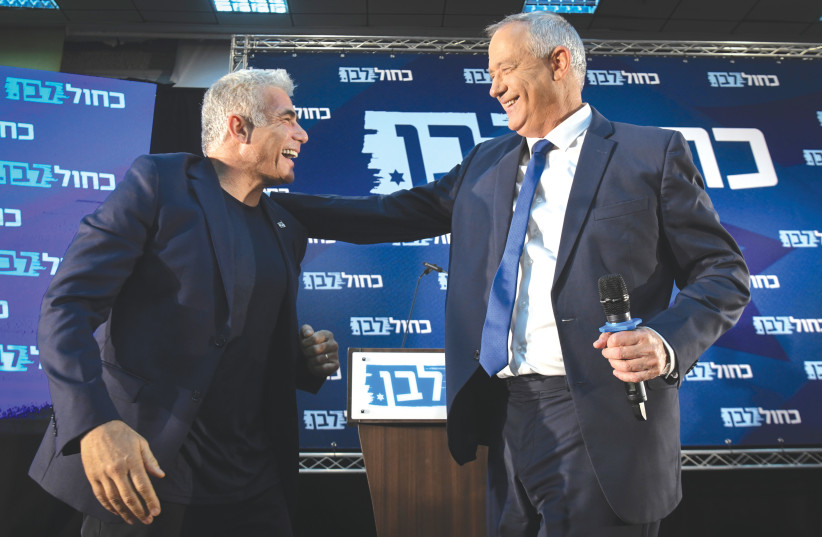
Lapid, knows how to do this. He is the only major Israeli politician who has twice stepped aside for the sake of political necessity. In 2019, he gave Gantz the top spot in Blue and White.
In 2021, he allowed Bennett to become prime minister even though Yesh Atid had more than twice as many seats. It was a display of something rarely seen in politics and an understanding that leadership sometimes means yielding.
Choosing who should lead a united opposition party will not be easy. But here is one straightforward solution: primaries. Announce an open leadership race. Give candidates two or three months to campaign. Then let the public decide.
Yes, safeguards will be needed. Voters will need to join the party and register. They will need to pay membership fees and there will need to be in-person voting. All of this screening is important to prevent sabotage by rival camps. These are technical challenges, not conceptual ones – and they can be managed.
Beyond increasing its chances of replacing the government, if the opposition chooses unity it will prove that Israeli politics are still capable of responsibility. It will prove that leadership means more than survival, more than branding, and more than personal ambition.
Unity cannot remain a slogan imposed on the public while leaders cling to their own corners. It must begin at the top.
The writer is a co-founder of the MEAD policy forum, a senior fellow at JPPI, and a former editor-in-chief of The Jerusalem Post. His newest book is While Israel Slept.