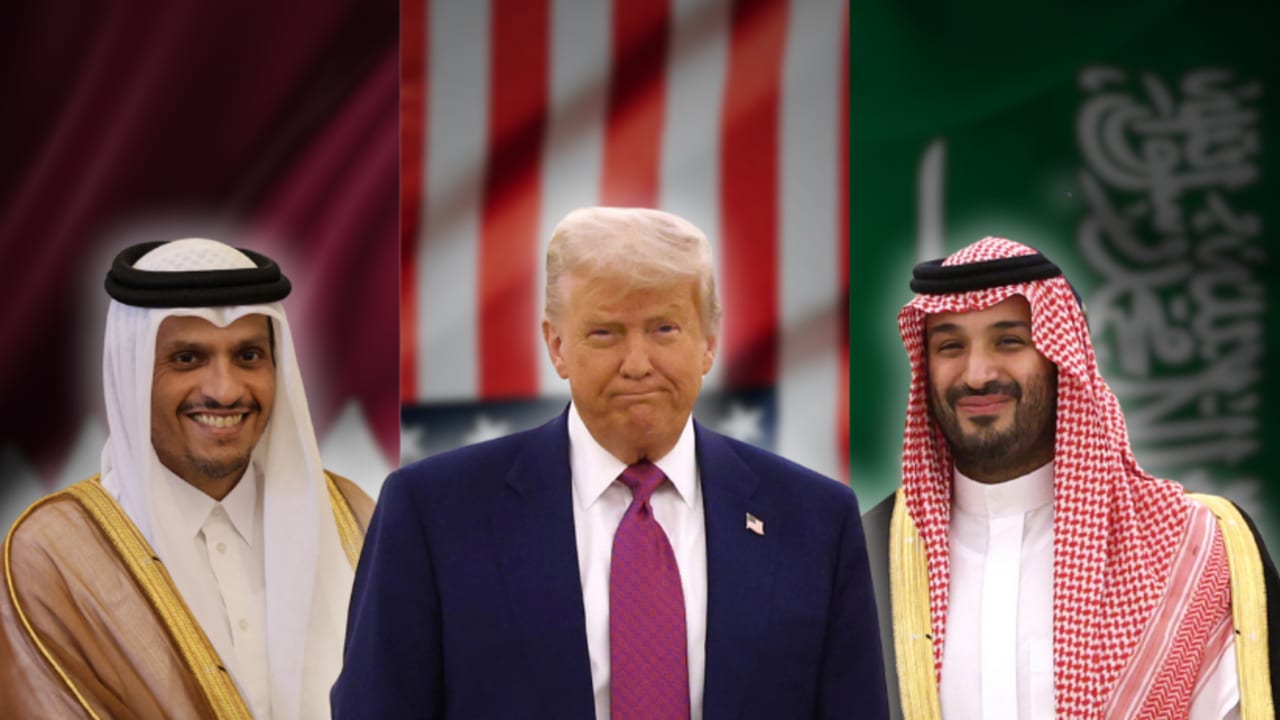
United States President Donald Trump has reportedly accepted points in the Gaza peace plan which seemed unthinkable a few months ago. It would appear that through smart, transactional diplomacy, Saudi Arabia, Egypt, the UAE, and Qatar are exploiting leverage over Trump.
Much of the American media has been suggesting that Trump alone achieved the ceasefire and hostage release. Some reportedly have said that even the January 2025 ceasefire agreement under Biden was Trump’s work.
However, the Gaza plan appears to have been a team effort with significant, sustained input from Qatar, Egypt, Saudi Arabia, the UAE, and Turkey – as well as Tony Blair and Jonathan Powell from the UK.
The Gaza plan will lead to serious negotiations over the future of Gaza and "Palestine." If it is implemented, “The conditions may finally be in place for a credible pathway to Palestinian self-determination and statehood.”
This differs from March 2025, when President Trump was proposing that the United States should own Gaza; he never suggested Palestinian statehood was a worthy objective.

Trump’s main allies
Saudi Arabia, the UAE, and Qatar are unquestionably Trump’s main allies and business partners in the Middle East. Trump’s May 2025 visit to the area secured billions of dollars of future projects in the United States, particularly in AI-related data centers and energy.
Reportedly, Trump and US Envoy Steve Witkoff’s relationship with Saudi Arabia, UAE, and Qatar includes these countries’ investment in Trump Towers, golf resorts – and his and Witkoff’s sons’ crypto business, World Liberty Financial. Additionally, US advisor Jared Kushner’s business Affinity Partners exists with the help of Saudi, UAE, and Qatari investment funds, and Kushner has clearly been an important player in the Gaza negotiation.
It would be inconceivable now for Trump to back any plan for the region without the approval of Kushner and the Saudis. The Abraham Accords that Kushner negotiated in 2020 with UAE and others made little reference to “Palestine” – only a vague “continuing their efforts to achieve a just, comprehensive, realistic and enduring solution to the Israeli-Palestinian conflict.”
'Palestine' as a state
Even though “Palestine” was largely ignored, Trump had said that they would bring “real peace in the Middle East for the first time.”
In February 2024, Kushner said that the two-state solution for Israel and “Palestine” was “a super bad idea” and that it was essentially “a real estate problem.” That has all changed now due to Saudi and Qatari pressure.
Now the Trump administration has apparently bought into the Saudi vision of the new Middle East, and it does not include an acceptance of Israeli expansion of interest in the wider region.
Before the agreement
Before the ceasefire agreement, the UAE had summoned Israel’s ambassador over its attack on Hamas terrorists hosted in Doha. It also threatened to pull out of the Abraham Accords over the wishes of some in the Israeli cabinet members to annex the West Bank (Judea and Samaria). Trump immediately stepped in to assuage his allies. Qatar forced an apology from Netanyahu, which Trump announced before Israel had a chance to deny it.
Saudi Arabia has insisted on no annexation, even of Israeli settlements, though Trump had supported it in his Peace to Prosperity plan. The president, of course, also readily accepted Israel’s wish to move the US embassy to Jerusalem in his first term – and recognized the annexation of the Golan Heights, which met with strong Saudi disapproval.
Another part of the Saudi and Qatari smart diplomacy is insisting that Trump put his own name to the Gaza plan, so that Trump serves as chair of the “Board of Peace” and the economic development plan. For the next three years, at least, Trump will be personally responsible for how key parts of the deal unfold.
What remains to be seen
It remains to be seen whether Saudi Arabia and Qatar cooperate with Trump’s vision of more countries joining the Abraham Accords with Israel.
Since Prime Minister Netanyahu has repeatedly insisted that there will be no state of “Palestine” – and he did not attend the Sharm el-Sheikh summit due to the holiday of Simchat Torah – the gap between him and the Saudis and Qataris appears unbridgeable.
Saudi Arabia and France have spearheaded the strong international push to ensure eventual global recognition of Palestinian statehood. The Saudis and the Gulf states have, through skillful diplomacy, ensured that Trump owes them multiple favors.
It seems unlikely that Trump can do an additional Abraham Accords deal without a recognition of eventual Palestinian statehood.
Let us hope that talk of the 2026 Nobel Peace Prize doesn’t dominate US policy in implementing this plan.
So far, the work toward achieving peace has been a commendable team effort, and any prize related to it should, in my view, be awarded to all the leaders of the key states, not just the United States, who brought it this far.
The writer is a former UK diplomat and a nuclear non-proliferation specialist. He currently lectures on international relations at the Pardee School of Global Studies, Boston University.