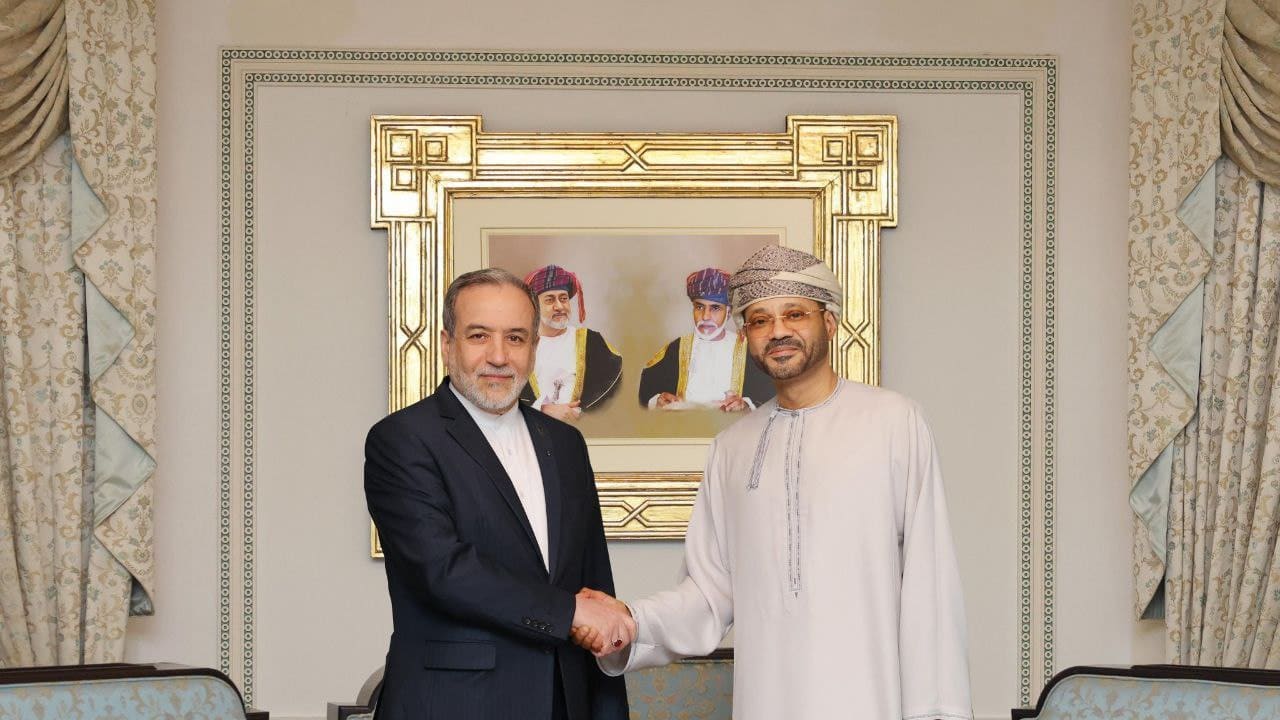
Iran and the United States started high-stakes negotiations via Omani mediation on Friday to try to overcome sharp differences over Tehran's nuclear program, while a dispute over widening the agenda risked derailing diplomacy and setting off another Middle East war.
According to a regional diplomat briefed by Tehran, Iran has rejected US calls to halt uranium enrichment, but said it was willing to discuss the “level and purity” of enrichment or a regional consortium.
Oman's Foreign Minister Badr bin Hamad al-Busaidi held separate meetings with Iranian Foreign Minister Abbas Araghchi and the Trump administration's special envoy Steve Witkoff, who was accompanied by special advisor Jared Kushner. Previous Iran‑US talks have used a shuttle-diplomacy approach.
"Very serious talks mediating between Iran and the US in Muscat today," said Busaidi after confirming the ending of the talks, and added, "It was useful to clarify both Iranian and American thinking and identify areas for possible progress. We aim to reconvene in due course, with the results to be considered carefully in Tehran and Washington."
"The consultations focused on preparing the appropriate conditions for resuming diplomatic and technical negotiations, while emphasising their importance, in light of the parties’ determination to ensure their success in achieving sustainable security and stability," Oman's Foreign Ministry stated.
An Iranian official told Reuters the direct talks had not officially started, and that Iran’s demands had been conveyed to the US via Oman. The official said indirect negotiations "possibly" would begin after a meeting between the top US negotiator and Oman’s foreign minister.

Iran, although it is in a position of weakness due to the US and Israel having destroyed its enrichment equipment during the war in June, said it was only willing to discuss its nuclear program, according to a report by the Wall Street Journal.
Additionally, protests earlier this year have posed the greatest challenge the regime has seen in its half-century of power, leaving its economy weakened and its currency at an all-time low.
Iran’s leaders showed little readiness to compromise on the core issue of uranium enrichment, threatening to trigger another war in the event of a US attack, according to the WSJ report. However, both sides showed willingness to continue working towards a diplomatic solution.
Araghchi claims Iran entering US talks 'with open eyes, memory of 2025 talks'
These updates come after Iranian FM Abbas Araghchi commenting on X/Twitter that Iran "enters diplomacy with open eyes."
Yet, the Islamic Republic has "a steady memory of the past year," he noted, likely referring to how the last round of negotiations was disrupted by Israeli and American strikes on Iran in June.
"We engage in good faith and stand firm on our rights," Araghchi claimed.
"Commitments need to be honored. Equal standing, mutual respect, and mutual interest are not rhetoric - they are a must and the pillars of a durable agreement," the foreign minister affirmed.
Meanwhile, Ali Shamkhani, political advisor to Iran's Supreme Leader Ayatollah Ali Khamenei, who participated in the 2025 talks and is likely participating in the renewed talks this weekend, commented that Araghchi is a "skilled, strategic and trustworthy negotiator at the highest levels of decision-making and military intelligence," in a post on his own X page.
Iranian soldiers "will safeguard the nation's interests" acting under Khamenei's orders, Shamkhani added.
Notably, Shamkhani previously served as the naval chief of Iran's military and of the Islamic Revolutionary Guard Corps.
His comments were posted in six languages: Farsi, Arabic, English, Hebrew, Russian, and Chinese.
Only acceptable negotiation result is Islamic Regime's surrender to Iranian people, Crown Prince Pahlavi says
Additionally, Iranian Crown Prince Reza Pahlavi reacted to the renewed talks on Friday, commenting that the "only acceptable deal" is a deal where the "Islamic Republic surrenders to the people of Iran" in a post on his official X account.
"We are ready for such a deal, and it will bring peace to the region and the world," Pahlavi affirmed, writing in both Farsi and English.
Araghchi denounces Germany's Merz, E3 pressure on Iranian nuclear sanctions, Merz's support for Israeli strikes last June
In a separate post, Araghchi reacted to Germany's Chancellor Friedrich Merz, who called for an end to violence in Iran and noted that Berlin is prepared to increase pressure, engaging in talks aimed at bringing Iran's nuclear program "to a swift end."
Araghchi denounced Germany as an "engine of regression" that has fallen from its history as the "engine of Europe's progress."
He noted that the E3 (Germany, Britain, and France) pushed to reimpose UN sanctions on Iran, which the foreign minister believes "put an end to [E3s] role in nuclear negotiations," alleging that Merz is now "begging" to be allowed to resume negotiations.
"We Iranians have unfortunately been faced with several other examples of Merz's political naivety and distasteful character," he accused.
He also commented that Merz "expressed exuberance" when Israel conducted airstrikes on Iran in June, and has "publicly daydreamed about Iran supposedly being weeks away from collapse."
"Iran has always welcomed strong relations with Germany. It is, therefore, doubly regrettable that an individual such as Mr. Merz now represents Germany on the world stage. We hope that more mature and honourable political leadership will return to Germany," Araghchi concluded.
Amichai Stein and Tobias Holcman contributed to this report.