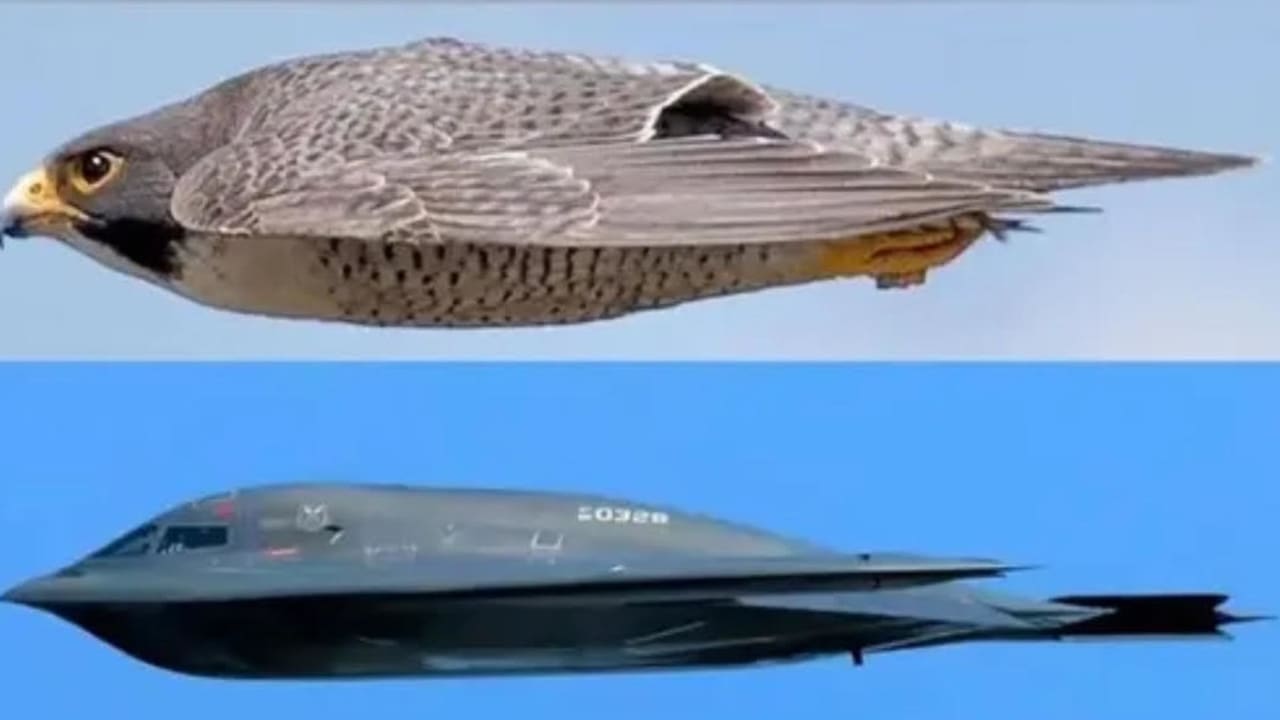
The B-2 Spirit stealth bomber that struck Iran’s nuclear sites was born from a close study of the natural world, most notably the peregrine falcon, which also inhabits Israeli skies. Its unique shape allows for quiet, fast, and fuel-efficient flight, making it the most expensive aircraft in history.
This week, much was said about the B-2 Spirit—a US stealth bomber that flew nonstop for 18 hours from American soil to Iran’s nuclear installations, dropped its payload, and returned without landing. But few know that the design of the $2.1 billion aircraft was inspired by a relatively small yet extraordinary bird of prey: the peregrine falcon.
The falcon’s Latin name—Falco peregrinus—combines falco, meaning “sickle” or “scythe,” a nod to its sharply curved, outstretched wings in flight, and peregrinus, meaning “wanderer,” reflecting its near-global distribution. The peregrine falcon is native to Israel, and in the Persian Gulf region, it is trained by falconers for hunting, even serving as the national bird of the United Arab Emirates.
During Operation Midnight Hammer, seven B-2s participated, releasing 14 Massive Ordnance Penetrator (MOP) bombs on Fordow and two on Natanz. A third facility at Isfahan was hit by Tomahawk missiles launched from US submarines.
A single glance at the B-2’s unusual form—a tailless, flying-wing structure with no distinct fuselage—reveals its avian inspiration. Just as the peregrine falcon dives silently on its prey, the B-2’s smooth, aerodynamic profile enables it to slip through the sky with minimal drag, enhanced speed, and improved fuel economy.

Radar signature as small as a bird
Thanks to biomimicry—the imitation of nature—the B-2 can almost vanish from radar screens. Its shape, combined with whisper-quiet gliding, stealthy altitude adjustments, and precise spatial control borrowed from the falcon’s own aerial agility, grants it perfect camouflage and an exceptional unrefueled range of up to 11,000 km. Aerial refueling can more than double that range, allowing the bomber to strike Iran and return without landing.
The B-2’s outer skin is made of radar-absorbing materials, and its rounded structure prevents sharp radar echoes. The result is a radar signature as small as that of a bird.
Unlike conventional jets, the B-2’s four General Electric engines are buried within its body, cutting noise and masking thermal emissions, making infrared detection extremely difficult. It's smooth “flying wing” without a tail delivers uniform airflow, similar to a raptor gliding slowly, but requires millisecond digital adjustments, much like a bird’s nervous system during sudden maneuvers.
So, next time you spot a bird of prey soaring overhead, remember: even the world’s most advanced military technology can trace its origins back to the wisdom of nature.