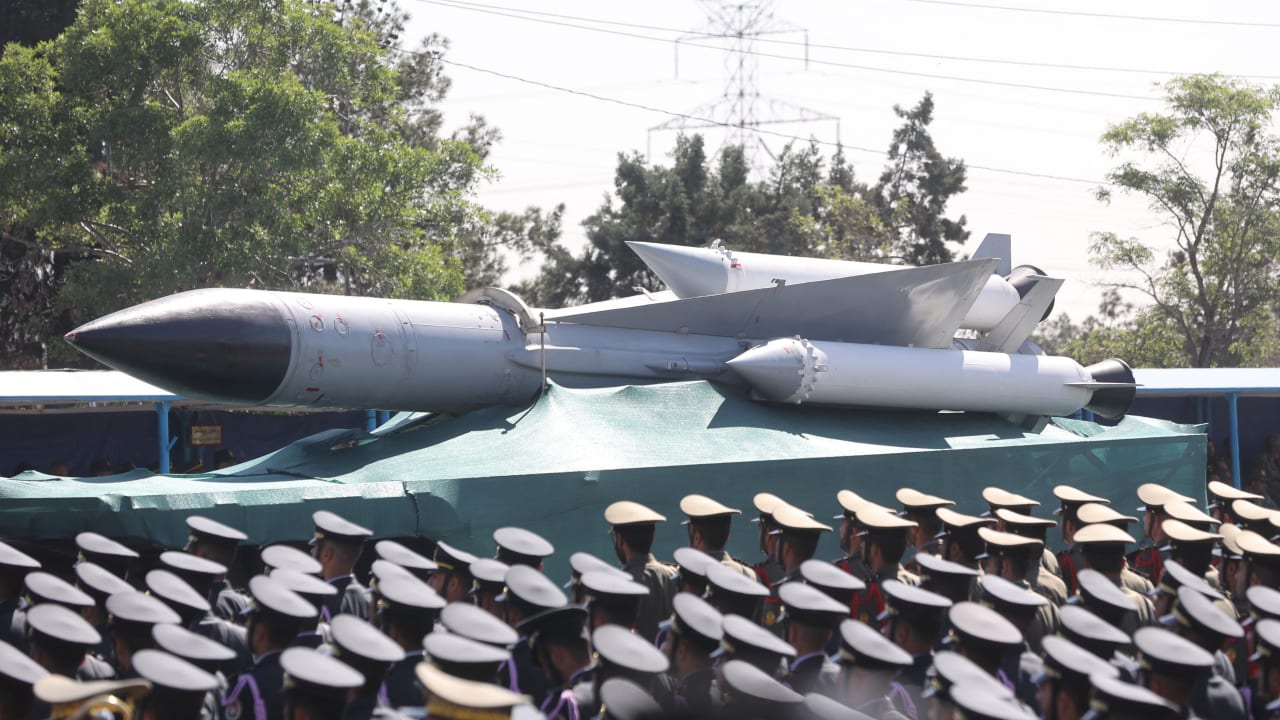
Israel’s wars in the Middle East changed forever in the predawn hours of January 18, 1991. That’s when Iraqi dictator Saddam Hussein responded to George H.W. Bush’s invasion of Iraq by firing eight Scud missiles at Israel.
By the end of the war, Iraq had fired 39 missiles, and everything changed.
How? Because it shattered the old paradigm of Israel’s wars – where Israel fought conventional battles, tank against tank, in the Sinai or on the Golan Heights – and replaced it with a new one: their missiles against the Jewish state’s population centers; their rockets against Israel’s kindergartens.
The threat was no longer confined to the front lines. Suddenly, Tel Aviv and Haifa were in the crosshairs. For a country long focused on its air force and armored corps, this required a dramatic shift – not only in military strategy but in how the home front was protected.
And Israel, one of the most adaptive states on earth – a key to its survival – did just that. It adapted.

Saddam’s Scuds served as the catalyst for Israel’s development of a multilayered missile-defense system: the Arrow, designed to intercept long-range ballistic missiles like those launched from Iran; David’s Sling, built to stop medium-range missiles from Lebanon or Syria; and Iron Dome for short-range threats from Gaza.
While the conceptual groundwork for missile defense was laid earlier – with Israel signing a memorandum of understanding with the US in 1985 to jointly develop the Arrow as part of then-president Ronald Reagan’s “Star Wars” program – it was the Gulf War that turned this from a theoretical project into a national priority.
When Hussein’s Scuds began falling on Tel Aviv and Ramat Gan, Israeli citizens huddled in sealed rooms, windows taped with plastic and doors sealed with masking tape, unsure if the missiles were laced with chemical weapons. The Arrow program, once seen as speculative and costly, began to look like an existential necessity to many.
That war marked a watershed moment – the first time Israel was subjected to sustained ballistic-missile fire from a country with which it did not share a border.
The psychological impact was immense. Missiles were raining down, and Israel – under intense American pressure not to retaliate – could do little in response. The sense of helplessness was profound.
It convinced even skeptical members of the security establishment and government – as well as a traumatized public – of the urgent need for a comprehensive defense shield. The Patriots the US deployed to knock out the Scuds failed to do the job.
Before the Gulf War, missile defense faced heavy opposition in both the political and military echelons.
Critics argued it was prohibitively expensive, technologically uncertain, and diverted resources from the IAF and preemptive deterrence. Ballistic missiles at the time were also seen more as theoretical threats than immediate ones.
That changed almost overnight. In 1991, shortly after the Gulf War, the Israel Missile Defense Organization (IMDO) was established. What followed was the steady development of Israel’s three-tiered defense array: the Arrow, Iron Dome, David’s Sling, and more recently, the Iron Beam laser system. What was once a controversial investment became a strategic cornerstone.
Why the shift? Because Israelis had felt defenseless.
Iraq was launching missiles, and the country didn’t know if – as Saddam had done to the Iranians in their war – he would resort to chemical weapons. And if he did, what stood between Israeli civilians and disaster were plastic sheets, masking tape, gas masks, and special protective bassinets for infants.
What caused the shift?
THE GULF WAR exposed the country’s vulnerability to long-range missile fire and, more broadly, the emerging reality that future wars would target civilians as much as soldiers. That understanding gave rise not only to a new missile-defense doctrine but also to a new approach to civil defense.
Some critics argued that no country can be hermetically sealed – that a missile will always get through. And that’s true. But as recent days have shown, there’s a monumental difference between one or two or even three missiles penetrating the defense shield – and 60 ballistic missiles, as were fired from Iran on Saturday night – striking unimpeded.
The Gulf War didn’t just change Israel’s thinking about interception; it also transformed its civil protection standards. In the 1990s, the government began mandating the construction of reinforced safe rooms (mamadim) in all new homes. It expanded the network of bomb shelters and invested heavily in early warning systems and public readiness.
Civil protection isn’t universal. But it’s vastly more developed than it was in 1991, when the best many people could do was take shelter in a taped-up room and wait for the all-clear.
Back then, Israel had no effective way to stop a missile. Today, it does. It has also demonstrated a very effective and precise way of striking back.
Iran has many times the number of missiles that Saddam had, and their precision is greater. But Israel now has the ability not only to intercept many of those missiles; it has also won mastery over the Iranian skies, enabling it to respond in ways it never did during the first Gulf War.
In 1991, the IDF’s instructions to the public were to go into the safe room and – as IDF spokesman Nachman Shai famously advised – “drink water” to stay calm. Today, while the anxiety and the need to drink water remain, there is a much more robust civil and military infrastructure to fall back on.
Another contrast is in the role of Benjamin Netanyahu.
During the 1991 Gulf War, Netanyahu was a deputy minister in Yitzhak Shamir’s government. Fluent in English and telegenic, he emerged as Israel’s principal spokesman to the world – particularly on CNN, which broadcast live updates from Tel Aviv to a global audience.
His appearances, including one memorable interview while wearing a gas mask, helped shape Israel’s image during that war as a responsible actor exercising tremendous self-restraint under fire. His messaging was disciplined; his tone resolute.
Those broadcasts put Netanyahu squarely on the world’s stage. He was the calm, confident face of Israel under siege.
Today, he no longer stands before the cameras describing Israel’s response; he sits at the center of the war cabinet deciding it.
Netanyahu’s journey over the last nearly 35 years mirrors Israel’s own evolution: from a country absorbing missile strikes with masking tape and plastic sheeting to one intercepting them with multilayered defenses and striking back with jaw-dropping precision.
The challenges have grown enormously, but so, too, has Israel’s ability to deal with them.