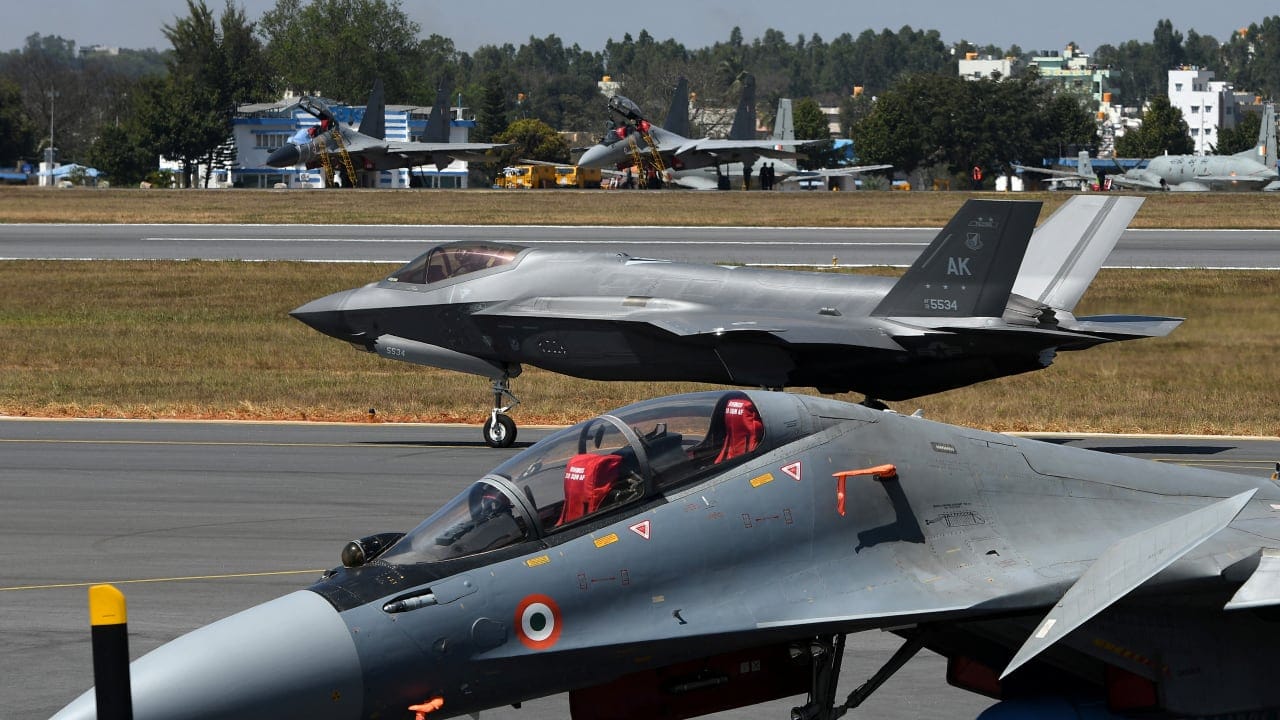
On Monday, US President Donald Trump implied that the United States could sell F-35s to the Kingdom of Saudi Arabia. As Riyadh may seek to become one of the small fraternity of users of the F-35, it is worth taking stock of some key details about the advanced fifth-generation warplane.
The F-35 first flew in 2006 after a decade in development.
A “joint strike fighter,” it was supposed to eventually replace older American warplanes that had dominated during the Cold War. Lockheed Martin, which led its development, has said in the past, “The F-35 plays a crucial role in 21st-century security by deterring threats and disrupting adversaries’ plans. By its very presence, the F-35 enhances the safety of nations operating it and protects freedom around the world.”
When Romania became the 20th country to acquire the warplane in 2024, Mara Motherway, vice president of strategy and business development at Lockheed Martin, said, “The F-35’s growing presence across Europe demonstrates alliance-based deterrence and is setting the foundation for NATO and allied nations’ next-generation air power capability.”
Israel first signed a multi-billion-dollar deal to acquire the warplane in 2010. Israel initially acquired 20 of the planes, then 17 more in 2017, and it has continued to buy more since.
US alliance system bolstered by F-35 warplane sales
The first F-35s were delivered to Israel in 2016. Those warplanes were supposed to define the Israel Air Force into the future, much as the advanced platform was supposed to define the US Air Force for decades to come. For Israel, one issue that has been important is maintaining the country’s qualitative military edge, meaning that Jerusalem should be able to confront and counter conventional military threats in the region.
The F-35 program, including development and manufacturing components, used to include Turkey, a NATO ally of the US.
However, Ankara left the program after it acquired the Russian S-400 system. Countries that have F-35s should be US allies and not own military technology from adversary states, such as China or Russia.
Over time, the F-35 program has become wildly successful. According to a Lockheed Martin fact sheet on the program from September 2025, a total of 1,230 aircraft have been delivered. The F-35 program has more than a million flight hours worldwide, and over 3,095 pilots have been trained.
Twenty countries have now acquired or are in the process of acquiring the aircraft. These include the core US and European allies who were part of the program, namely the US, UK, Italy, Netherlands, Canada, Australia, Denmark, and Norway, as well as foreign military sales to Israel, Japan, South Korea, Belgium, Poland, Singapore, Finland, Switzerland, Germany, the Czech Republic, Greece, and Romania.
The partners in the program include four out of five of the “Five Eyes” countries: the US, UK, Australia, and Canada. New Zealand has not acquired the aircraft. The US military has acquired or ordered the most aircraft, with 1,763 for the US Air Force, 420 for the Marines, and 273 for the Navy.
The US Air Force recently welcomed its 500th F-35, meaning it is waiting for many more to be delivered. Meanwhile, the UK has acquired 138 of the aircraft, and Australia has acquired 100. British F-35s also operated from a Japanese ship for the first time, the Lockheed Martin September fact sheet noted.
Israel is a major user of the F-35, utilizing it in combat for the first time in 2018. While Israel is acquiring 75 of the warplanes, many countries have acquired or ordered fewer. For instance, Greece is a new participant in the program and has an initial order for 20 F-35s. The first of these are expected to be delivered around 2028. What this shows is that even countries that join the program must still wait years to receive their first jets. This is a long-term investment and a symbol of the US alliance system.
Because the F-35 is a fifth-generation fighter with all the latest technology, it acts as a kind of data hub and sponge, and it means that militaries using the platform can easily work together in joint operations. For Israel, this is a good thing in its work with the US Central Command and also in partnerships with Greece in the Eastern Mediterranean.
Jerusalem is also in the Middle East in terms of countries with the F-35. If Saudi Arabia joins the program, ostensibly, that could mean joint drills one day, if the countries normalize ties. Even without normalization, cooperation with CENTCOM could still see joint drills. Meanwhile, Israel has other partners with F-35s, such as Italy and further European countries.
According to the Lockheed Martin fact sheet, there are now 16 armed services currently flying the jet around the world. Ten countries operate it on their home soil, and it is flown out of 38 bases and from 12 ships. In the future, it is expected to be flown from 58 bases worldwide and up to 24 ships, meaning aircraft carriers.
The F-35 has already had more than 669,000 sorties.