Seth J. Frantzman

Seth J. Frantzman is the senior Middle East Correspondent and analyst at The Jerusalem Post . He has covered the war against Islamic State, several Gaza wars, the conflict in Ukraine, refugee crises in Eastern Europe, and also reported from Iraq, Turkey, Jordan, Egypt, Senegal, the UAE, Ukraine, and Russia since 2011. He is the author of three books: The October 7 War: Israel's Battle for Security in Gaza (2024), Drone Wars: Pioneers, Killing Machines, Artificial Intelligence, and the Battle for the Future (2021), and After ISIS: America, Iran and the Struggle for the Middle East (2019). He is an adjunct fellow at The Foundation for Defense of Democracies (FDD). Born in Maine, he received his Ph.D from the Hebrew University of Jerusalem in 2010. He previously served as a research associate at the Rubin Center for Research in International Affairs at the Interdisciplinary Center, Herzliya and a lecturer in American Studies at Al-Quds University. He is Executive Director of The Middle East Center for Reporting and Analysis and was a Ginsburg/Milstein Writing Fellow at the Middle East Forum. Frantzman has conducted research and worked for the JDC, The Shalem Center, the Jerusalem Institute for Market Studies, and as a Post-Doctoral at the Hebrew University of Jerusalem. He was a Congressional intern for Congressman Jim Kolbe while studying at The University of Arizona. He is a public speaker and frequent guest on various media as well as a contributor to Defense News , The Hill , The Spectator , and The National Interest, among other publications. His current interests include regional security and geopolitics.

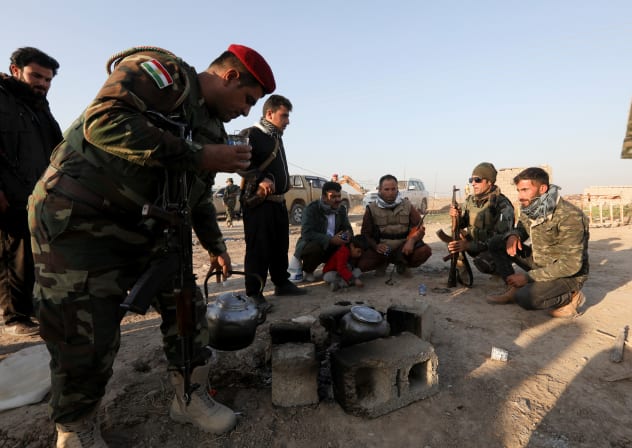
A fighter from the Iranian Kurdistan Freedom Party (PAK) takes part in a training exercise at a base near Erbil, Iraq, in February.

Kurdistan Region of Iraq hopes ceasefire brings end to drone, missile attacks

A resident listens on a mobile phone to an address to the nation by Pakistan's Prime Minister Shehbaz Sharif about the ongoing US-Israel conflict with Iran, in Islamabad on March 9, 2026.

Pakistan takes on role of peacemaker, but it comes with risks - analysis

U.S. Secretary of War Pete Hegseth (L) looks to Chairman of the Joint Chiefs of Staff Gen. Dan Caine as he speaks during a press briefing at the Pentagon on April 08, 2026 in Arlington, Virginia.

Five things to watch amid the ceasefire with Iran


Iranian-linked drone attack kills Kurdish couple in northern Iraq

It is the latest attack by Iran and Iranian-backed militias using drones and missiles on the Kurdistan region. Iranian-backed militias have launched more than 500 attacks since February 28.

Smoke rises from an oil warehouse on the outskirts of Erbil, the capital of Iraq's Kurdistan Region, following a suspected drone strike on April 1, 2026; illustrative.

Zelensky’s Syria visit symbolizes new future for Middle East diplomacy - analysis

Ukrainian President Zelensky’s visit to Syria marks a symbolic step toward a peaceful future, fostering cooperation between Syria, Turkey, and Ukraine despite regional conflicts.

Ukrainian President Volodymyr Zelensky (L) with Syrian President Ahmed al-Sharaa (R) in Damascus, April 5, 2026.

Kurdish Iranian groups deny receiving guns from US following Fox report

Reports about Kurdish Iranian groups tend to be sensitive because the groups fear an Iranian regime crackdown, and the groups have already been targeted by hundreds of Iranian drones and missiles.

A Kurdish fighter in Iraq.

Are Iraqi militias crossing into Iran to support Iran's war effort? - analysis

The militia forces could bolster the Islamic Revolutionary Guard Corps in Iran. They could also be used by Iran to enforce order and carry out suppression in some areas on its periphery.

 Members of an Iraqi Shi'ite armed group sit in a vehicle after an attack by a drone strike on an Iran-backed militia headquarters in Baghdad, Iraq January 4, 2024.

Syria condemns UAE embassy attack, Gulf nations voice outrage over protests

Protests targeting the UAE Embassy in Damascus spark regional condemnation, with Gulf nations criticizing the attack as a violation of international law, while Syria seeks to restore UAE ties.

Men walk past the UAE Embassy in Damascus on December 12, 2024; illustrative.

Gulf countries continue to face Iran attacks as criticial energy infrastructure at risk

UAE, Bahrain, Kuwait, and Saudi Arabia continue to face Iranian missile and drone attacks, targeting energy and infrastructure sites despite growing defenses.

Damage to the Kuwait-flagged Al-Salmi crude oil tanker, following a reported Iranian strike, March 31, 2026; illustrative.

Hezbollah sees potential win as Israel backs down from disarmament goal - analysis

Hezbollah views Israel’s shift away from disarming the group as a strategic win, believing that the Israeli climbdown will benefit its survival and influence in Lebanon.

IDF soldiers and a tank operate in southern Lebanon on March 21, 2026.

Turkey’s intel chief lays out country’s vision for Middle East, world - analysis

In the Middle East, Turkey seeks to play a key role if and when the Iran conflict winds down. Ankara will seek to grow its influence as Iran’s influence declines.

Turkey's President Recep Tayyip Erdogan speaks during a join press conference with Ethiopia's Prime minister during his official visit at the National Palace in Addis Ababa on February 17, 2026.

Jordan seeks calm as Iran war rattles the region - analysis

Jordan had said it “strongly condemned today the Iranian attack on its territory involving ballistic missiles" when the US and Israel launched strikes on Iran.

An Iranian missile has fallen on a home on February 28, 2026 in Amman, Jordan.

Lebanon’s internal strength tested as Iranian ambassador refuses to leave - analysis

Iran's ambassador to Lebanon, Mohammad Reza Sheibani, was expelled in mid-March for meddling in Lebanon’s internal affairs.

Then-Iran’s ambassador-designate to Lebanon Mohammad Reza Sheibani Iranian Foreign Minister Abbas Araghchi.