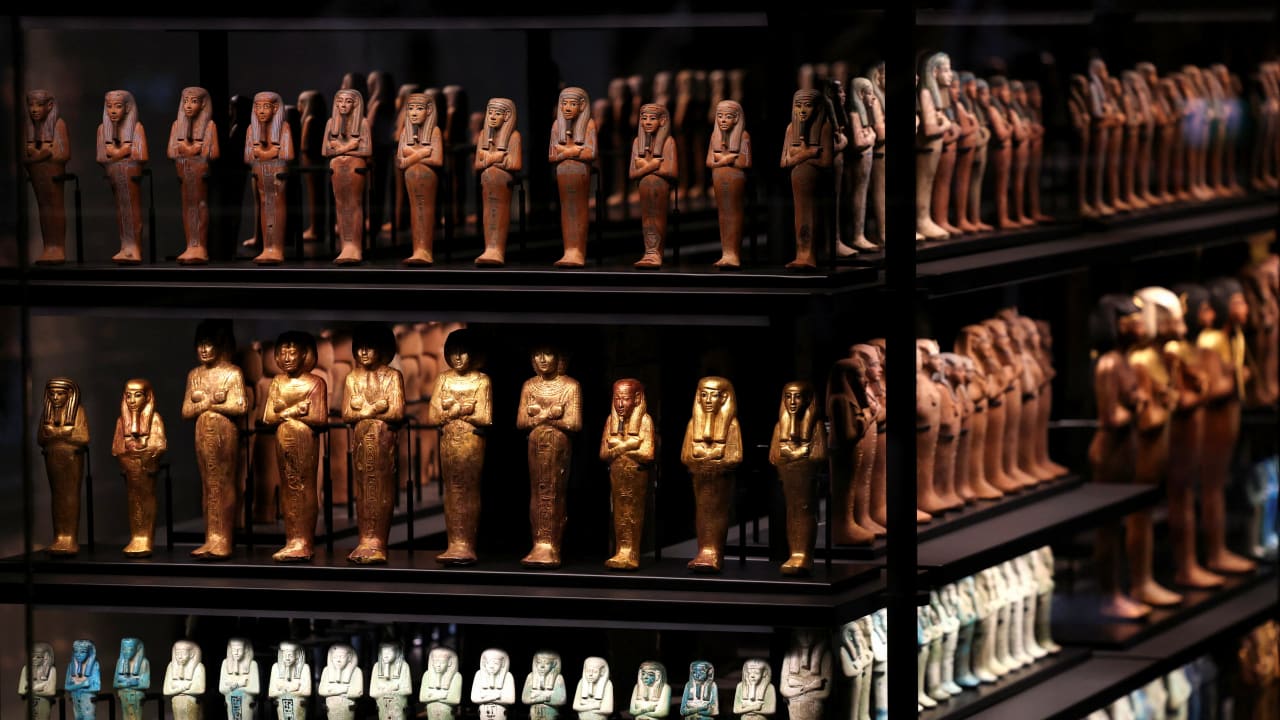
The Grand Egyptian Museum
Al-Ahram, Egypt, November 8
For more stories from The Media Line go to themedialine.org
It is not my habit to comment on events at their most celebrated or most tragic, yet a week has now passed since one of the most significant moments in modern Egyptian history: the grand opening of the Grand Egyptian Museum, known worldwide as the GEM – a true treasure, a resplendent diamond crowning Egypt’s cultural heritage, a radiant masterpiece that transcends time. It stands as a monument to endurance and beauty, its very form captivating the eye and stirring the soul.
My late uncle, the artist Abdul Badi Abdul Rahman, once said before leaving for the US that living in Cairo was only possible by the Nile or beside the pyramids. Since he chose to live near the latter, I did the same. Now, the “Gawhara,” the Golden Jewel, lies not far from where I reside, and each morning the tips of the Great Pyramids rise into view. The opening night of the GEM was nothing short of breathtaking: a vibrant spectacle of color and light, transforming the night into a living canvas of brilliance. What stood out most, however, was the palpable excitement of the Egyptian people, especially their children, who embraced this modern marvel rooted in ancient history. Such collective joy is a rarity in Egyptian life, and it was both profound and creative, radiating outward from a deep sense of national pride and cultural identity.
The following morning, after hours spent delving into the museum’s history, its treasures, and the stories of those who envisioned, designed, and built it, I awoke early, uncertain whether the broadcast I had been invited to join would proceed smoothly. The television channel, mindful of potential delays, prepared for every contingency.
Yet, as if by blessing, everything went seamlessly. The broadcast aired on time and carried an exuberant tone – a welcome departure from the somber rhythm of months spent discussing the devastation of Gaza and its grim aftermath. That day was one of unadulterated joy, a celebration not merely of architecture but of civilization itself.
Like a finely cut gem, the museum now gleams with all its facets polished, ready to gift the world a luminous reminder of Egypt’s eternal legacy. In my 77th year, I felt a joy both rare and long-awaited – a moment of collective triumph and personal fulfillment that will remain etched in memory as a radiant chapter in Egypt’s enduring story. – Abdel Moneim Saeed

Did you write about Mamdani today?!
Al-Masry Al-Youm, Egypt, November 7
Zohran Kwame Mamdani (born October 18, 1991) is an American politician and socialist activist of Indian and Muslim heritage who was elected mayor of New York City on November 4, 2025. A perceptive friend suddenly asked me, “Did you write about Mamdani today?!”
The abrupt question struck me like a charge of betrayal on the day of battle – especially since a wide array of Egyptian and Arab writers rushed to be the first to celebrate Mamdani’s victory in New York, writing at length about the supposed significance of this triumph, as though he had just reconquered Andalusia.
Some of them, whether affiliated with the Muslim Brotherhood or those who have adopted its ideological echoes later in life, went so far as to describe the event as a “conquest of New York,” punctuated by cries of “Allahu akbar.”
One could almost imagine the next step being the proclamation of New York as a province of some imagined Islamic caliphate; a delusion that continues to haunt certain minds. I fear they may soon start calling for it from pulpits in Syria.
My apologies, my friend, for the delay in writing about Zohran Mamdani. Please forgive me 70 times over. I simply hesitated to determine whether such writing was even necessary – until I saw the photograph of Zohran standing with Jewish rabbis and his open support for American LGBTQ+ groups. I also revisited the slogans of his campaign to “conquer” New York and defeat President Donald Trump, who had directed his characteristic sharp tongue at Zohran during the race.
The zeal of Arab and Egyptian commentators mirrors their fascination with everything Western – especially American – just as it reflects a yearning for transformative change. They have recast Zohran, through their own imaginations, as the herald of a long-awaited new era, the embodiment of the globalist dreams of renewal for the Arab and Islamic worlds.
Some have even competed in crafting elaborate theories to explain the supposed triumph of the Left over the entrenched American Right, hailing the “Zohranian” victory as proof of an ideological shift toward an imagined universal change. It was as though a caravan of fantasy swept them away, their imaginations soaring to the point of wondering how Zohran could be replicated in the Arab world. In a display of opportunistic showmanship, TV channels sought to transplant the “Zohran model” into the Egyptian context, hoping to fill the political vacuum in which they flounder.
But Zohran Kwame Mamdani is an American product – an exportable brand like Coca-Cola: consumed eagerly and followed by self-satisfied applause. He is not the prophet of awaited change, nor a visionary reformer with a universal philosophy, nor the revolutionary thinker that the late poet Ahmed Fouad Negm might have imagined. He never vowed to liberate Acre, nor did he take a stand against Jews. On the contrary, he expressed empathy for the victims of the Israeli bombardment of Gaza without crossing the line into antisemitism. He explicitly rejects any violation of Jewish identity and upholds its sanctity. The aspirations of Arabs and Muslims are not, and have never been, part of his political agenda.
Zohran is, in essence, a mayor – a governor in the classic sense – responsible for civic management, infrastructure, and municipal affairs. An American citizen who benefited from a charged political climate and the growing backlash against the Trumpian movement, he rose to prominence by standing against Trump in a context that favored him.
The winds of change blew in his direction. Zohran is the youthful face of American weariness with the tired dichotomy of donkey and elephant, Democrat and Republican.
His victory represents a local protest against Trump’s policies, not an intellectual rebellion against the ideas that underpin American dominance. His political imagination remains confined within the borders of New York; he has not yet glimpsed Andalusia, let alone conquered it. American exports to the world – including to the Arab world – are often laden with intellectual calories, delicious but heavy, raising the level of political cholesterol. Yet Arab minds consume them eagerly, intoxicated and oblivious to the deeper dynamics shaping their own societies. Zohran Kwame Mamdani, then, is merely a fleeting episode of political euphoria – an imported sensation destined to fade as quickly as it arrived. – Hamdy Rizk

Gaza: A forbidden zone in history
Asharq Al-Awsat, London, November 8
Today, Gaza finds itself in a liminal state – neither engulfed in full-scale war nor basking in genuine peace. The same can be said of the West Bank, caught between two unrelenting forces, suspended in a grim equilibrium. Lebanon, too, drifts in a historical gray zone, belonging neither to open war nor to stable peace.
This suspended reality has turned Gaza, home to more than two million people, into a tragic emblem of frozen conflict and fading hope. Under siege, divided, and repeatedly destroyed, it stands as a symbol of human rights violations and a draining battlefield that exhausts Palestinians, Arabs, and global powers alike. When politics offer no exit, people become hostages to geography, and regions such as Gaza, the West Bank, and southern Lebanon remain trapped, unable to progress or break free.
Since 1948, the Palestinian territories have been perpetual victims of geography – hemmed in by Israel, which treats them as a security buffer; by a PA paralyzed by its own stagnation; by an Arab world torn between sympathy and confusion; and by regional actors exploiting the crisis for their own ends. It is a vivid example of what historians describe as a “deadly political vacuum,” a moment when history itself halts, rendering solutions impossible and societies immobile, left only to wait for deliverance from beyond the realm of politics.
This is not unprecedented: The Korean peninsula has remained frozen since the 1953 armistice, its borders tense, its people still waiting for a peace that may never arrive. Berlin once stood divided by a wall of fear and suspicion; its people imprisoned in competing ideologies until the Soviet Union’s fall opened a way out. Kashmir, too, has long been locked in a deadly stalemate between India and Pakistan, where periodic violence shatters lives and stifles progress.
Gaza today mirrors all these examples – sealed borders, a crippled economy, deep internal fractures, and a population suffering in silence. The internationalization of the conflict has stripped it of its human and national essence, leaving Palestinians torn between a self-preserving Palestinian Authority and a Hamas leadership trapped in its own past.
Amid this paralysis, Gazans survive between poverty, isolation, and dependence. Education and health systems have collapsed, an entire generation deprived of opportunity. They know only destruction and blockade, their days filled with unemployment and displacement. Palestinian ingenuity has turned inward – from building a nation to simply enduring its ruins. The middle class, once the stabilizing core, has eroded, and the concept of the state has crumbled into factional control.
The Palestinian national project itself risks shrinking into a fragment of land, a wounded memory, and a collection of sacrifices. Gaza’s tragedy has spilled across the Arab world, politically and emotionally. Arabs across the region debate its meaning, divide over “resistance” and “normalization,” and quarrel in capitals and cafés alike. This discord has weakened the Palestinian cause, turning it from a unifying symbol of liberation into a catalyst for fragmentation. Some Arab states, weary of endless turmoil, now prioritize their own security, while regional powers manipulate the conflict to serve their ambitions.
The result is fatigue in Western capitals – from Washington to London to Paris – where policymakers manage the crisis but no longer seek to solve it. The international momentum once pushing for peace has vanished, and even global sympathy, once rekindled by recent tragedies, has cooled. The stalemate has hardened into permanence.
Yet the gravest danger lies not in Gaza’s physical ruin but in the decay of meaning itself. A Palestinian child grows up knowing only the whine of drones and the crash of bombs, learning that peace is an illusion and justice an empty word. Over time, despair turns to rage, and human lives are reduced to weapons. Gaza transforms from a cause into a curse, from a struggle of resistance into an enduring tragedy.
What Gaza needs is not pity or another conference, but a courageous, unified vision to break this historical impasse. The lessons of Berlin, Korea, and Kashmir teach us that a state of neither war nor peace is deadlier than war itself – it kills by suffocation. Breaking free demands that Arabs reclaim their role, not as passive spectators but as builders of renewal, urging Palestinian factions: Enough division – unite! Only then can the Palestinian people recover their dignity and restart history’s halted march. In the end, neither war has been salvation nor peace a fulfilled promise.
Only a unified Palestinian will can forge a new meaning for life amid the ashes. – Mohammed Al Rumaihi

<strong>What will be the fate of Gaza?</strong><br><em></em>
Al-Ittihad, UAE, November 8
Amid the continuing developments in the Gaza Strip, efforts to stabilize the fragile ceasefire, and mounting pressure on Israel to halt its violations and unprecedented assaults, a critical question emerges: Has Gaza become primarily an Arab concern, or has it evolved into an international issue now shaped by the US and European powers alongside certain Arab states?
The reality suggests that the Strip’s affairs were internationalized the moment the ceasefire was declared and swift diplomatic action – particularly by Washington – took center stage. The establishment of a US-Israeli coordination center operating on the outskirts of Gaza, in partnership with several European nations, highlights that Gaza’s future is now an international concern.
The active involvement of countries like France and Britain reinforces the notion that whatever unfolds next will not be decided by local actors alone, but within a global framework led by major powers. Developments point toward the Strip being placed under a form of international trusteeship, possibly through a multinational force authorized by a UN resolution that defines the scope of intervention.
Israel, for its part, seeks to shape this resolution to ensure it serves its long-term political and security objectives – allowing it freedom of action in response to any future movement by Palestinian factions and aligning with its plan to divide the enclave into two zones of control. After consolidating its security presence over more than half of Gaza, Israel appears determined to maintain the situation under an international umbrella involving the US, Britain, France, and select Islamic countries. This reinforces the understanding that Gaza’s destiny now lies in the hands of external powers that will manage it within regional and global parameters.
In this context, Arab involvement may be confined to funding reconstruction projects that remain impossible as long as Hamas retains control. While it is hoped that Arab states will contribute financially, questions persist: How, where, and under whose supervision will this reconstruction occur amid such fluid circumstances?
These uncertainties highlight the limitations of Arab influence, particularly as Egypt prepares to host a reconstruction conference later this month within an Arab, Islamic, and international framework. Yet Europe is already planning a separate reconstruction model, potentially implemented in areas under Israeli control as a first phase – an approach that could deepen international intervention in Gaza.
The overlapping agendas and conflicting objectives among all parties make any consensus elusive. While all publicly claim to seek a ceasefire, beneath the surface lies a web of competing interests and contradictions. The American position remains aligned with Israel’s core priorities; differences between them are tactical, not fundamental. Israel continues to steer US policy to fit its own interests, while Washington, aware of this dynamic, increases its pressure on Tel Aviv within limits.
The establishment of the US-Israeli coordination center represents not only tighter collaboration but also Washington’s acknowledgment that security dominates all other considerations. Reconstruction, collective security arrangements, and the deployment of an international force are thus postponed indefinitely – effectively freezing the Strip’s situation in place.
Meanwhile, tensions between Hamas, other Palestinian factions, and the PA remain unresolved. The PLO’s insistence on administrative control in Gaza complicates any Egyptian-led efforts to reach a broader agreement, as cooperation between the PA and the factions seems improbable under current conditions.
The Gaza crisis is now moving in multiple, often conflicting directions, each shaped by distinct calculations. All sides publicly stress the need for a ceasefire, fearing that renewed war could ignite a wider regional confrontation. This fear drives international actors to prioritize de-escalation, containment, and incremental stabilization while maintaining the uneasy status quo.
Hamas remains armed, reconstruction has not begun, and political commitments remain unfulfilled. The situation drifts toward stagnation, with each player recalibrating its options. For now, the prevailing approach centers on managing rather than resolving the crisis – maintaining the current state of controlled instability. Israel continues its unilateral security measures with American military backing, while Washington insists on de-escalation despite Israeli breaches of its plans. Until the broader vision becomes clear, Gaza – and its ripple effects across the Middle East – will remain an issue governed by international dynamics rather than Arab agency. – Tarek Fahmy
Translated by Asaf Zilberfarb. All assertions, opinions, facts, and information presented in these articles are the sole responsibility of their respective authors and are not necessarily those of The Media Line, which assumes no responsibility for their content.