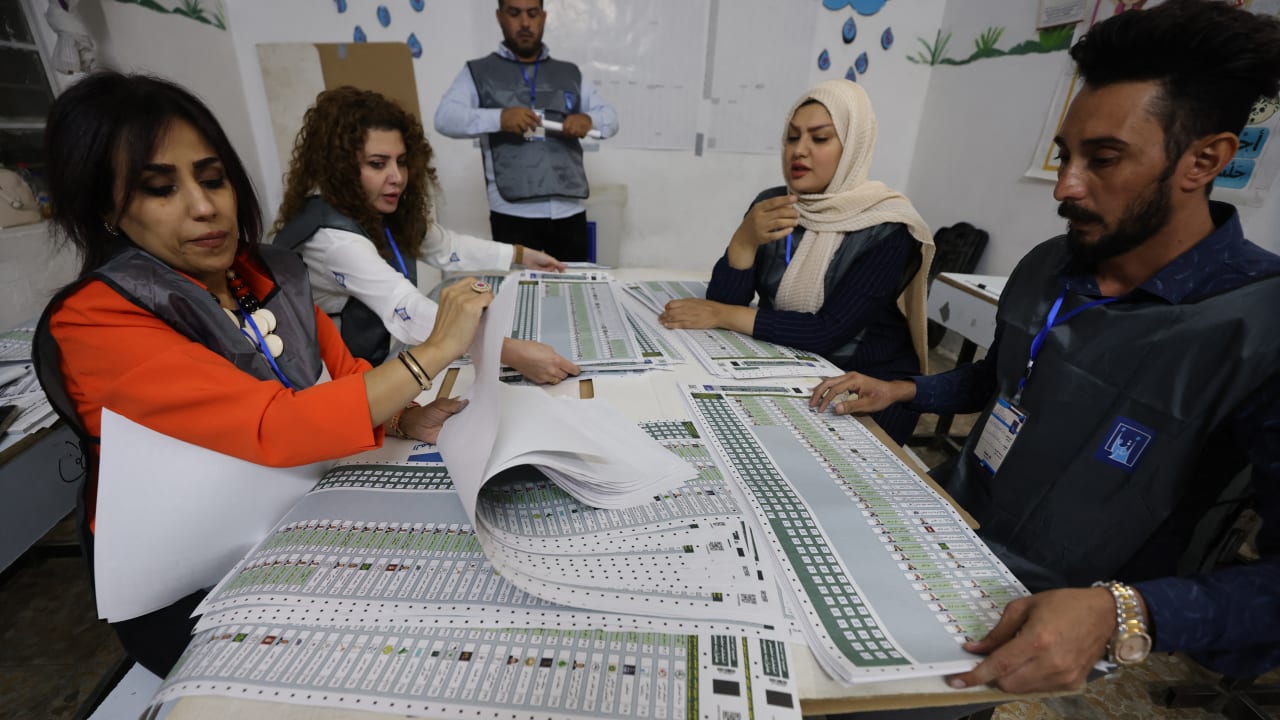
Some 55% of more than 20 million registered Iraqis voted on Tuesday in the country’s elections – the sixth elections since the US invasion of Iraq in 2006 – in an important moment for the country.
A total of 329 seats were up for election, and more than 7,000 candidates ran in the elections. The elections were mostly conducted along sectarian lines. There were several Shi’ite parties, including the party of Prime Minister Shia al-Sudani, and one led by former prime minister Nouri al-Maliki. There were also parties affiliated to Iranian-backed Shi’ite militias, such as Badr, Kataib Hezbollah, and Asaib Ahl al-Haq.
For Sunni Iraqis, there was a party led by the speaker of parliament as well as several other small parties. Kurds also had many choices, such as the leading Kurdish party, the KDP, and the second-largest Kurdish party, the PUK.
Preliminary projections showed that Kurdish parties performed well, with the KDP getting more than a million votes in northern Iraq, where there is an autonomous Kurdistan region. Kurdish parties also did well in Nineveh plains, where Mosul is located, and in Kirkuk and Diyala.
Iraq remains a divided country, but it is also struggling to find its place in the region. Iraq wants to wind down the US role in the country. US forces had left Iraq in 2011 but deployed to the country again to help fight ISIS in 2014. Now the government wants a new arrangement.

Meanwhile, the US-led coalition against ISIS now has a new partner in the Syrian government. US forces today in Iraq are primarily deployed in the Kurdistan region. With Syria joining the coalition, the US could pivot to Syria.
This would be a change from the first Trump administration, when the White House had a vision of the US leaving Syria and “watching” Iran from Iraq. Times change. Iraq has changed.
Iraq's balancing act: US, Iran influence, and militia power
Meanwhile, there are important questions for the Kurdistan region. With oil exports now flowing again to Turkey, the region continues to be a secure area of Iraq with a strong economy. The government of Nechirvan Barzani has invested heavily in infrastructure. The region is impressive. US Secretary of State Marco Rubio recently sent Barzani a letter.
The US has close ties to the Kurdistan region, with both sides benefiting from this relationship. With the apparent decision by the PKK to end its conflict with Turkey, there are opportunities to also wind down Ankara’s role in northern Iraq. If the PKK cadres come down from the mountains and lay down their arms, then parts of northern Iraq may have peace. Many villages near the Turkish border were depopulated due to the Turkey-PKK war.
There are many other issues facing Iraq. The role of the Iranian-backed militias in Iraq is a problem. Groups such as Asaib Ahl al Haq, Kataib Hezbollah, and Badr loom large over Iraq. These militias are well armed.
Kataib Hezbollah, for instance, kidnapped Princeton researcher Elizabeth Tsurkov in 2023 and only released her in September. Tsurkov holds Israeli citizenship, and she has spoken about being tortured by the militia. Kataib Hezbollah is part of the Popular Mobilization Forces, an official paramilitary unit of Iraq.
Therefore, Iraq plays both sides. It wants ties with the US but also Iran. Iran also appears to want to use Iraq, either to traffic weapons, to steal its resources, or to oppose the US.