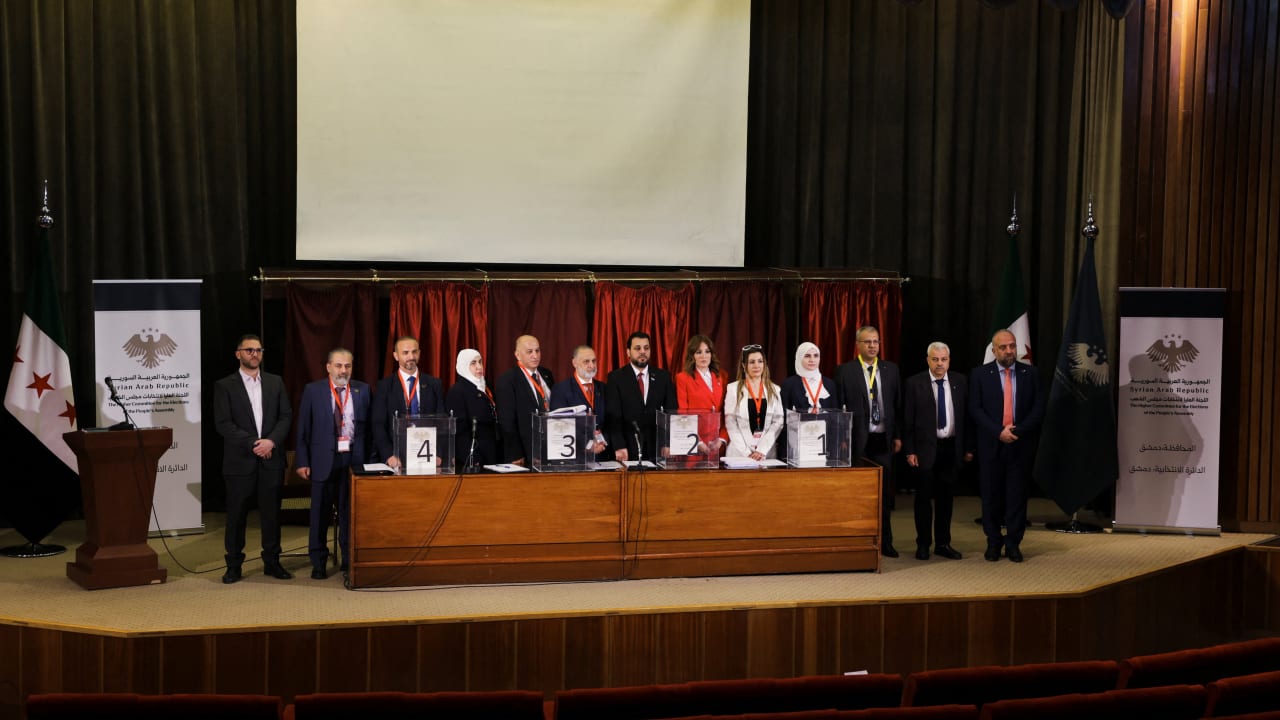
Syria held its first parliamentary elections on Sunday since the fall of the Assad regime. And while it’s an important step for Damascus, there are still many hurdles to becoming a fully-fledged democratic state.
The country’s transitional government does not control all of Syria, making it difficult to hold elections in some areas. This leaves parts of the Druze region of Sweida and the Kurdish areas of eastern Syria without elected representatives.
“A later date will be scheduled for voting in certain areas of the Raqqa and Hasakah provinces (Ma’adan, Ras al-Ayn, and Tell Abyad),” SANA reported. “Seats in the remaining districts of these provinces, as well as all districts in the Sweida province, will remain vacant until conditions allow.”
Also, the election process is complex.
“There will be no direct vote for the People’s Assembly, which will be responsible for legislation during a transitional period. Instead, ‘electoral colleges’ will select representatives for two-thirds of the 210 seats. Interim President Ahmed al-Sharaa will appoint the rest,” the BBC reported.
Syria’s state media detailed the electoral process. “The voting process, which will mark the formation of the first Syrian People’s Assembly since the fall of the defunct regime, will take place at designated electoral district centers across most provinces, as set by the Higher Committee for Parliamentary Elections.”

'Eligible voters are members of the accredited electoral bodies'
Polls opened at 9 a.m., and, for the most part, closed on time around 5 p.m., with complete results expected by late Sunday night.
“Eligible voters are members of the accredited electoral bodies,” SANA said. “After voting concludes, the ballot boxes will be opened publicly in the presence of the media, and the counting of votes will begin. Preliminary results will be announced immediately through national media outlets.”
Per SANA, “In the lead-up to the elections, extensive preparations took place across the provinces. The nomination period for membership in the People’s Assembly closed on September 28, covering 50 electoral districts nationwide, with a total of 1,578 candidates, of whom 14% were women.”
One of the candidates highlighted by Syrian media was “Syrian American Rabbi Henry Hamra,” who, according to SANA, “announced his candidacy for the People’s Council representing Damascus, becoming the first Jewish candidate since 1967.
“His platform focuses on supporting reconstruction, economic development, and efforts to lift the Caesar Act sanctions,” it reported. “Hamra emphasized his belief in a united and tolerant Syria, and pledged to work with the Syrian community in the US to achieve these goals.”
There was a short campaigning period – only several days. It is difficult to estimate whether millions of people can truly learn enough about the candidates in just three days of campaigning.
Concurrently, these elections are occurring amid tensions near Aleppo between the transitional government forces and members of the US-backed Syrian Democratic Forces.
The SDF operates in eastern Syria and has been fighting ISIS for 10 years. It is made up of Kurds, Arabs, and Christians. The SDF is supposed to integrate into the Damascus-backed new Syrian military. However, this integration has not happened yet.
As such, elections are not being held in SDF areas, nor are they being held in the Turkish-occupied region of Tell Abyad either.
Turkey’s Foreign Minister Hakan Fidan praised the elections. “He stressed the need to exclude elements that threaten the security and unity of the Syrian people, such as the PYD,” the Syrian News Channel (Al-Ikhbariya) reported.
The PYD is a key Kurdish political group in eastern Syria, which Ankara views as being on the far Left and linked to the Kurdistan Workers’ Party, which has been designated as a terrorist group by the Turkish government.
Syria’s Interior Ministry spokesperson Noureddine Baba said the elections were the most important ones in the past 60 years. The Assad regime ran Syria for 50 years, and the country was a dictatorship or suffered coups prior to that.
The Interior Ministry said a central operations room was in place to coordinate and supervise the polling. “Strict security measures have been put in place to safeguard the electoral process.”
All in all, the election took place in 50 of Syria’s 60 districts because areas including Sweida, Raqqa, and Hasakah have been omitted. Syria’s 2010 census data is being used to apportion seats.
During the civil war, at least half of the country was displaced by fighting, and millions of Syrians sought refuge abroad. It should be assumed that a lot has changed since 2010. However, no other trustworthy data exists to rely on.