
Mid-September is a season of diplomatic anniversaries.
September 17 marks 47 years to the day when Menachem Begin, Anwar Sadat, and Jimmy Carter signed “A Framework for Peace in the Middle East” and “A Framework for the Conclusion of a Peace Treaty between Egypt and Israel” at Camp David, from which these agreements took their name: the Camp David Accords.
September 15 marks five years to the date when Prime Minister Benjamin Netanyahu and the foreign ministers of Bahrain and the United Arab Emirates signed the Abraham Accords as US President Donald Trump, who brokered the accords, looked on.
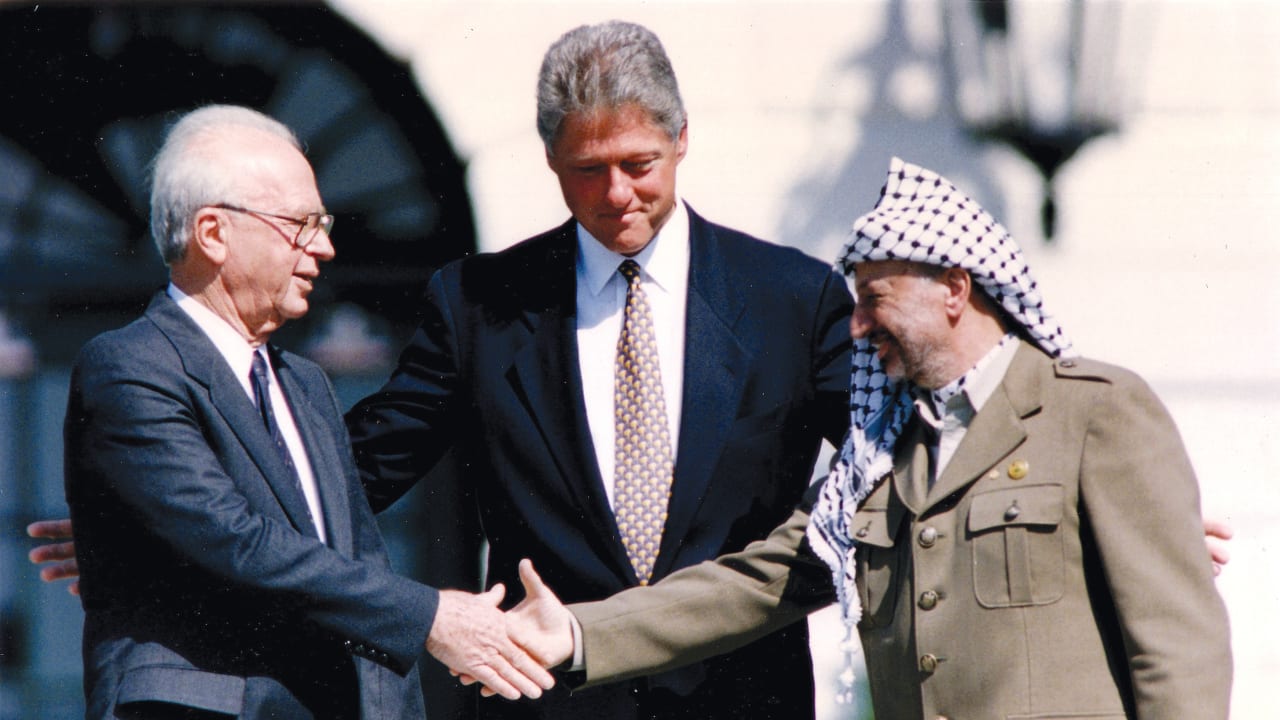
And September 13 marked 32 years since the signing on the White House lawn of the Declaration of Principles on Interim Self-Government Arrangements — otherwise known as the Oslo I Accord. There, under the watchful eye of Bill Clinton, Yitzhak Rabin and Yasser Arafat shook hands and signed the document that became known as the Oslo process.
Three anniversaries, three distinct diplomatic moments
One of them, the Egyptian–Israeli peace treaty, has stood the test of time. One, Oslo, has not. And the third, the Abraham Accords, looks resilient, even as it is facing perhaps its most difficult test yet: Israel’s strike against Hamas leaders in Qatar and warnings from Jerusalem that it could extend sovereignty to parts of Judea and Samaria if key Western countries move this month at the UN to recognize a Palestinian state.

The Camp David Accords
The Camp David Accords of 1978 spawned a peace treaty that was signed six months later in Washington. Nearly half a century on, the Egypt–Israel peace has survived Sadat’s assassination, wars in Lebanon and Gaza, and leadership changes in both countries.
The peace treaty with Egypt has rarely been warm, but it has been steady, and its anniversary is generally acknowledged. Camp David demonstrates what happens when interests overlap in ways both sides consider critical: Egypt got Sinai back, Israel got a peaceful border with the Arab world’s most populous state and, at the time, its most powerful army. That was a deal worth defending.
That durability set a benchmark. Even if no one speaks romantically of a “warm peace” with Egypt — because such a “warm peace” does not exist — everyone acknowledges that Camp David delivered what it promised: no more wars with Cairo.
The Oslo Accords
The same cannot be said of Oslo. Thirty-two years on, its anniversary is met with silence.
Israelis recall Oslo as ushering in bus bombings, suicide attacks, and the Second Intifada. Oslo is remembered as the process that brought terrorists from abroad within shooting distance of Tel Aviv and Jerusalem — and gave them arms to boot. For the Israeli Right, Oslo is synonymous with naïveté and danger, with leftist “messianism.” Even the political center largely views it as a failed experiment.
And governments do not celebrate failures. Israeli leaders since the early 2000s have shunned Oslo anniversaries lest they be seen as honoring what much of the electorate blames for bloodshed.
When Shimon Peres, one of Oslo’s architects, was still alive, Oslo’s anniversary was at least noted. Today, it hardly merits a mention. How many people knew that Saturday was the anniversary of the signing of the first Oslo Accords? Oslo’s legacy is so toxic that the iconic picture of Rabin and Arafat shaking hands on the White House lawn, with Clinton’s arms benevolently stretched to both sides, once a symbol of hope, now conveys futility.
Friday’s United Nations General Assembly vote highlighted that point. By a margin of 143 to 10, the UN General Assembly endorsed a declaration demanding “tangible, time-bound and irreversible steps” toward a Palestinian state. In Oslo’s framework, Palestinian statehood was to come at the end of negotiations, not as a foregone conclusion.
The UN vote has signaled that the international community has forsaken that sequencing. Oslo is not just forgotten — it is bypassed. The international community now speaks a different language: timelines, deadlines, imposed outcomes. The process born in Washington 32 years ago is seen as irrelevant, overtaken by events and rendered obsolete by disillusion.
The Abraham Accords
The Abraham Accords, signed five years ago tomorrow, tell a different story. They were not utopian, not messianic, but utilitarian. They played off shared threats — namely, Iran — and produced embassies, direct flights, billion-dollar trade volumes, and security cooperation.
In the five years since the signing, the accords have weathered an extraordinary storm: October 7, a grinding war in Gaza, a direct clash between Israel and Iran, and rising regional anger at the Jewish state.
Any one of these could have shattered a fragile agreement. None has. Now comes the test of whether the agreement can withstand the strike in Doha and the Arab solidarity in its wake. On Saturday, Qatar announced it would host an Arab and Muslim summit on Monday, the very day of the anniversary of the Abraham Accords, to denounce Israel’s “cowardly aggression” and demonstrate support for Doha.
Even before the Doha strike, however, the anniversary was being marked more modestly this year: an AJC conference in Washington with members of Congress from both parties, some think tank seminars, and a visit by Deputy Foreign Minister Sharren Haskel to Abu Dhabi. This is understandable. A region in flames does not lend itself to celebrations.
However, a clear lesson emerges when comparing Oslo at its 32nd anniversary with the Abraham Accords at its fifth. Oslo attempted to address the core Palestinian-Israel conflict head-on, relying on goodwill and mutual recognition. But when the goodwill evaporated, replaced by terrorism and the Second Intifada, the framework collapsed.
The Abraham Accords flipped the script, showing that peace with Arab states based on converging interests could advance even without a deal with the Palestinians. Those interests have kept the accords afloat even when atmospherics soured.
At five years, Oslo was already embattled, derided as dangerous by many Israelis. At five years, the Abraham Accords are embedded — no longer headline-grabbing, but quietly functioning.
This does not mean the Abraham Accords are beyond risk. Their resilience should not be confused with immunity. If annexation becomes policy, or if Gaza burns indefinitely, Arab leaders may calculate that formal ties with Israel are no longer sustainable.
Diplomatic anniversaries reveal how agreements are remembered. Camp David’s anniversary is acknowledged because the treaty it produced has stood for nearly 50 years. Oslo’s is ignored because it symbolizes broken promises and bitter divides. And the Abraham Accords are marked cautiously, because while the ties do endure, the region is in no mood for celebration.
The convergence of all three anniversaries within a week helps put them in perspective: Camp David delivered a treaty that lasts; Oslo delivered funerals and disillusionment; the Abraham Accords have delivered embassies, investments, and partnerships — fragile, but real. Forty-seven years on, Camp David remains the benchmark. Five years on, the Abraham Accords are alive but under strain. And Thirty-two years later, Oslo stands empty.