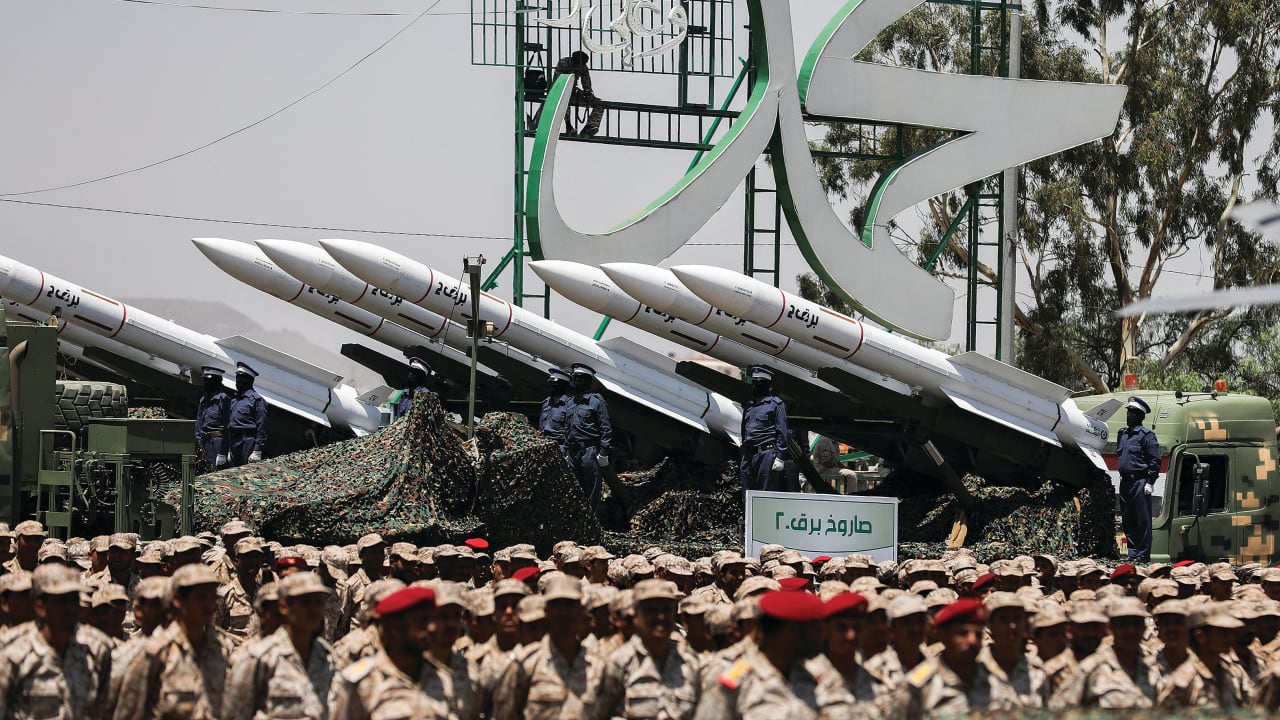
It now appears that a Houthi ballistic missile launched against Israel on Friday contained cluster munitions. This also appears to be the first time the Iranian-backed Houthis have used this type of missile against Israel. Iran has long utilized the Houthis to test new missile and drone technology.
This could be another example of Iran using the Houthis, or the Houthis developing more missile types locally, based on a similar Iranian missile that uses cluster munitions.
The Houthis appeared to confirm that they are attempting to use new missiles in a statement broadcast by their military spokesperson, Brig.-Gen. Yahya Saree, who announced a “qualitative military operation targeting Lod Airport in the occupied Jaffa area with a hypersonic ballistic missile of the Palestine-2 type.” He claimed that the missile “successfully hit its target after penetrating the Israeli defense systems.”
UAE’s Al-Ain News noted, “Media reports in Israel indicated that authorities suspect the Houthis used a fragmentation missile previously used by Iran in the 12-day war.” This was later confirmed by the IDF on Sunday.
Israel retaliated for the attack on Sunday, one of more than half a dozen long-range raids Israel has carried out against the Houthis in the past year.

The Houthis have launched several dozen ballistic missiles at Israel since the Hamas attack on Israel on October 7, 2023. The reports about possible cluster munitions in the recent missile attack have been circulating for two days.
Al-Masirah, a Houthi-owned outlet based in Beirut, claimed on Sunday that Israel carried out several airstrikes against an oil company station on al-Satin Street in Sanaa, along with attacks on the Haziz power station in the south of the city. The Saudi al-Hadath channel also reported from its sources that Israel attacked the capital’s secretariat building in Tahrir Square in central Sanaa.
The Houthis claim that the Israeli attacks will not deter them and they will continue targeting Israel. The Houthi Political Bureau Member Mohammed al-Bukhaiti said, “the Israeli aggression on Yemen will not deter us from continuing to support Gaza, no matter the sacrifices,” according to al-Akhbar media in Lebanon.
The Houthis claim their Friday attack “caused major confusion among Israeli forces, forcing millions of settlers into shelters and suspending airport operations.” They asserted that they also targeted Ashkelon and Tel Aviv using drones.
Al-Masirah claimed that Houthis’s “increasing use of ballistic and hypersonic missiles, along with advanced drones, has shifted the balance of power in regional waters, creating serious concern within US and Israeli defense establishments. Analysts now describe the conflict as one of the most significant maritime confrontations since World War II, with implications far beyond the Red Sea.”
Houthis claim 'major strategic and symbolic victory' over US Navy in Red Sea
The Houthis also believe they have scored a “major strategic and symbolic victory” over the United States in the Red Sea.
The Houthis have claimed to use new missile technology in the past.
Last week, a separate report by al-Masirah noted, “Recent Yemeni strikes deep inside Israeli-occupied territories using hypersonic missiles have raised alarm among Israeli and US defense experts, exposing vulnerabilities in multi-layered defense systems long promoted as a protective shield.”
The Houthis claimed that hypersonic missile technology “marks a turning point, moving the threat from a theoretical concern to an operational reality. Missiles traveling at speeds exceeding Mach 13 and executing advanced maneuvers have reportedly outpaced interception systems such as Arrow 2, Arrow 3, David’s Sling, and US-made THAAD, SM-3, and SM-6.”
The Houthis also believe that US and Israeli air defense systems “failed” to intercept these types of missiles during the 12-day war with Iran.
Iran called that conflict True Promise 3.
The Houthis claim that Iran “highlighted gaps in radar detection and interception capabilities. Israeli officials have since announced plans to accelerate the development of new systems, including Arrow-4 and advanced radar technologies in cooperation with US firms.”
This bragging by the Houthis is typical. Their media frequently claims they have “pierced” Israeli air defenses. However, there is not much evidence for their claims. This is why the use of a cluster munition warhead would be important.
Ynet reported on Saturday that “Shortly after Friday’s launch, senior Houthi official Nasruddin Amer released a video – the authenticity of which could not be confirmed – purporting to show the missile breaking apart in midair. He claimed the footage demonstrated the weapon “splitting into several missiles over Israeli skies.”
In a follow-up post, Amer said the clips “clearly show the missile reaching its target, disproving enemy claims of interception,” and called the incident a failure of Israel’s layered missile defense system.”
Iran's use of cluster munitions in June's Israel-Iran war
In June, Reuters noted that “Iran launched a missile at Israel on Thursday that scattered small bombs with the aim of increasing civilian casualties, the Israeli military and its Washington embassy said, the first reported use of cluster munitions in the seven-day-old war.”
Iran is believed to have used at least three missiles with cluster munitions out of the 500 it launched in the 12-day war. Human Rights Watch said Iran’s usage of these types of missiles is a violation of humanitarian law.
For nearly a decade, Iran has used Yemen as a live-fire laboratory, honing its drone and missile capabilities via its Houthi allies. What began as ideological support for the Houthi insurgency evolved into a full-scale weapons testing program – with real-world consequences for regional stability.
Iran’s involvement in Yemen is not just about empowering proxies; it’s about refining weapons platforms under battlefield conditions. From the Qasef-series drones to the long-range Shahed 136 UAVs that first appeared in Yemen in 2020 and precision-guided cruise missiles, many of these systems were first seen in the hands of the Houthis before appearing elsewhere. Iran exported Shahed 136s to Ukraine after sending them to Yemen.
The Houthi-controlled territory in Yemen offers Iran a launching pad.
Here, weapons have been tested against targets such as cargo ships in the Red Sea, radar systems in Saudi Arabia, or US Navy vessels. Each strike likely helps refine Houthi guidance systems, adjust payloads, and stress-test command-and-control links.
The information is then sent back to Iran. This test-bed strategy has ripple effects. It allows Iran to field test its arsenal without direct confrontation, and the Houthis gain new weapons.