
Macron’s promise and Great Britain’s historical burden
Al-Masry Al-Youm, Egypt, August 2
For more stories from The Media Line go to themedialine.org
French President Emmanuel Macron’s pledge to recognize a Palestinian state evokes the memory of the 1917 Balfour Declaration, issued by the British government more than a century ago. That historic document, delivered by British Foreign Secretary Arthur James Balfour to Lord Lionel Walter Rothschild, a leading figure in the Zionist movement, expressed support for establishing a “national home for the Jewish people” in Palestine.
This fateful declaration marked the beginning of the Israeli implantation in the region, culminating in the formal emergence of Israel in 1948. Yet from the outset, Israel was never content with the borders loosely outlined in that declaration, which, at least on paper, stipulated that the rights of the non-Jewish Arab inhabitants of Palestine would not be infringed upon.
Instead, it expanded relentlessly, consuming land far beyond the initial mandate, swallowing Palestinian territories and encroaching on neighboring countries in what many describe as a cancerous spread.
Seventy-seven years on, Macron’s promise rekindles a faint hope that the long and brutal ordeal of the Palestinian people – marked by displacement, suffering, starvation, and even acts described as genocide – might finally yield a sovereign Palestinian state. The importance of this French gesture lies not only in its potential to disrupt Europe’s otherwise unwavering support for Israel but also in the symbolic weight it carries for Britain.
British Foreign Secretary David Lammy has publicly admitted that his government intends to follow suit in recognizing Palestine this September, while acknowledging Britain’s historic culpability in the crisis.

As Lammy noted, the Balfour Declaration bestowed a homeland on a people to whom Palestine did not belong, at a time when Jews made up no more than 5% of the population and lived peacefully as Arab Jews among their neighbors.
There was no record of systematic persecution of Jews in Palestine or other Arab countries; the atrocities committed against Jews were overwhelmingly European in origin, from Nazi Germany’s horrors to lesser-known persecutions elsewhere on the continent. Yet Palestine bore the weight of Europe’s sins, paying the price for crimes it never committed, forced to absorb the creation of a Jewish state on its lands without historical justification.
Today, Israel inflicts upon Palestinians atrocities that echo, and in many ways surpass, the injustices Jews once endured in Europe. Entire communities are starved, deprived of water, medicine, and basic human needs, subjected to what many describe as a modern-day genocide, executed with chilling precision and brutality.
Macron’s announcement, echoed soon after by British Prime Minister Keir Starmer, spurred Canada and Australia to consider similar moves, joining a wave of European nations – including Spain, Norway, Ireland, Sweden, Slovenia, and others – that have already recognized Palestine.
This cascading recognition has breathed new life into the long-dormant two-state solution, a vision recently reaffirmed at a high-profile conference co-hosted by Saudi Arabia and France.
The question that now looms over global diplomacy is whether the US will, at long last, heed the call of reason and moral responsibility, as Britain has belatedly done, and take a decisive step toward restoring genuine and enduring peace to a region that has known little but turmoil for over a century. – Abdel-Mohsen Salama

A sweeping wave of support for Palestine
An-Nahar, Lebanon, August 1
Following France’s pledge to recognize a Palestinian state at the upcoming UN General Assembly meeting in September – and with both the UK prime minister and foreign secretary confirming that London is moving in the same direction – it has become increasingly clear that international political pressure, led by France and Saudi Arabia, will in the next two months focus on supporting the Palestinians’ right to establish a state in the West Bank and Gaza.
This would be part of a broader settlement aimed at ending Israel’s ongoing war of extermination against the Palestinians, particularly in Gaza, opening the path to wider Arab-Israeli normalization, and reforming the Palestinian Authority. This represents a political shift of major significance for the Palestinians, despite their devastating circumstances and the relentless campaign Israel has waged against them for nearly two years.
Four permanent members of the UN Security Council – China, Russia, France, and Britain – are now expected to back the establishment of a Palestinian state. The US stands alone, so far, in resisting this shift, and it remains uncertain how Washington will respond to this unprecedented move by two of its closest Western allies.
The US faces two choices: Exercise its veto in the Security Council to block any resolution, or abstain and allow it to pass. The latter option is not inconceivable, given the relatively flexible tone recently struck by US President Donald Trump on this issue. It is worth recalling that the US supported UN Resolution 1397 in 2002, under president George W. Bush, which affirmed the Palestinian right to statehood.
A distinction must be made, however, between a UN General Assembly resolution recognizing this right – which already exists, with 145 countries acknowledging Palestine as an observer state – and a binding UN Security Council resolution. The latter has repeatedly failed due to US opposition and the use of its veto.
In previous General Assembly votes on Palestinian statehood, more than two-thirds of UN members supported the resolution, while only nine countries – including the US, Israel, Hungary, and a handful of Pacific island nations – voted against it, and 25 abstained.
The current push for recognition is fueled by a combination of global sympathy for the Palestinian people, mounting outrage over Israel’s devastating war in Gaza, and growing willingness to expose Israel as a colonial, racist, and religiously exclusive state.
In many ways, it is a direct consequence of the policies pursued by the Netanyahu-Smotrich-Ben-Gvir government, which seeks to erase Palestinians from the political map, enforce peace by brute force, and normalize relations with Arab states while offering no concessions.
Yet all these declarations and diplomatic moves hinge on a crucial factor: an American decision to either support the resolution or refrain from vetoing it. And even with political recognition, the Palestinians cannot exercise their rights without concrete changes on the ground.
First, Israel must be pressured to halt the war in Gaza, allow full-scale reconstruction, and permit unimpeded humanitarian aid into the Strip. Second, settlement expansion in the West Bank and Jerusalem must cease, and a lasting solution must be found to deal with the growing problem of armed settler militias terrorizing Palestinians.
Third, Palestinians must be allowed to govern themselves freely and invest in their own resources. At the same time, the Palestinian leadership must do its part by rehabilitating the political structures represented by the Palestinian Authority and restoring its legitimacy, as this will be critical in countering Israel’s occupation policies and engaging with international efforts.
Yet Palestinians must also recognize that the state now being promised to them will fall far short of the one they have long envisioned or dreamed of. The realities of power heavily favor Israel, global circumstances remain largely unfavorable, and internal Palestinian divisions and institutional weakness limit their ability to shape the future state they seek. – Majed Kayali
A country rich in resources, yet impoverished in sovereignty
Al Mada, Iraq, August 1
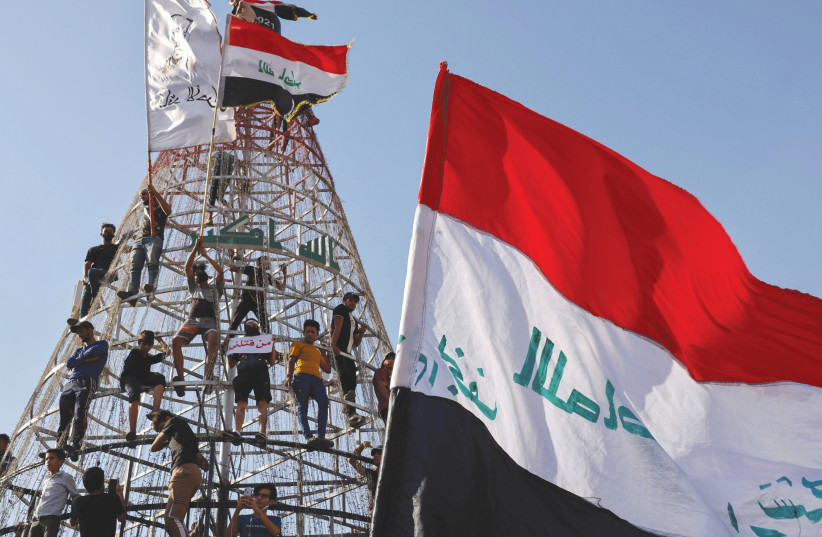
In international relations, power is not measured by the wealth a nation possesses but by its ability and will to manage it. In economics, numbers are meaningless when the keys to decision-making are held by others. This is the tragedy of modern Iraq: a country rich in resources yet impoverished in sovereignty.
Despite its abundant oil reserves, fertile land, and vast human capital, Iraq remains a stark example of a state brimming with potential yet suspended in will and stripped of control over its destiny. When sovereignty is compromised, the economy is always the first victim.
In Iraq, recovery plans falter not simply because of financial constraints but because the state long ago forfeited its right to decide. A nation that loses its decision-making power no longer shapes its own future; it reacts instead to the dictates of foreign powers, to formulas crafted by neighboring states, and to designs drawn up in the offices of international institutions.
Today, Iraq does not think economically; it merely complies. It is not poverty that binds it, but a suffocating restriction of will. It pumps oil, yet cannot freely control its flow or revenues. It is home to two of the region’s greatest rivers, yet it suffers from drought and thirst. It holds vast cash reserves yet cannot use them without external approval. It boasts thousands of brilliant economic minds, but political authority resides elsewhere, subject to pressures from above.
Since 2003, Iraq has been trapped in a fragile equation: a weak political authority, a crippled rentier economy, and layers of external dominance. Even during the oil boom years, wealth never translated into strength or influence; it became instead a tool for blackmail, a burden managed beyond state control.
The US, for instance, imposes sanctions on Iran but turns a blind eye to its oil sales to China, while tightening the screws on Iraq if it dares import electricity from Iran or pursue independent negotiations. Washington directly restricts Iraqi monetary policy, dictates terms for dollar sales, curbs foreign transfers, and treats the Central Bank as if it were an annex of the US Treasury.
This is no longer just about safeguarding against corruption – it is a veiled guardianship that denies Iraq free use of its financial instruments.
The dollar, meant to be a neutral medium of exchange, has become a weapon of political control. Blacklists, frozen accounts, punitive measures against traders – all are deployed, while the global system that entrenched this dependency goes unquestioned.
Why? Because China defends its interests with power, while Iraq is managed from abroad and undermined from within.
Electricity tells a similar story. Past governments chose to connect the national grid to imported gas – mostly from Iran – without building a domestic gas industry. This was not a technical oversight; it was a political calculation. As a result, Iraq’s energy lifeline, the foundation of modern economic activity, became hostage to its neighbors. Power outages are no accident; they are the outcome of deliberate choices designed to keep Iraq reliant.
Turkey plays its cards just as ruthlessly, throttling Iraq’s water share at will, occupying territory with little resistance, halting oil flows through Ceyhan, and setting terms for their resumption. Ankara acts out of self-interest, as any nation would; the real failure is Baghdad’s inability, or unwillingness, to respond.
None of these foreign interventions would succeed without Iraq’s own internal failings. Successive governments have chosen patronage over policy, handing out positions and wealth on partisan and sectarian lines, treating the state not as a sovereign entity but as spoils to be divided. The result is an economy stripped of production, imports without alternatives, and dependency worn without shame.
Sovereignty is not a slogan; it is a strategy. States earn respect not by pleading for it but by asserting it. Iraq today does not negotiate as a sovereign economic power; it survives as a client state dependent on others for its basic needs – its electricity from Iran, its water from Turkey, its dollars from Washington.
The Italian thinker Antonio Gramsci once observed: “A crisis occurs when the old dies and the new cannot be born.” This is Iraq in essence. The old state has collapsed, yet a modern, independent state has not risen in its place. Into this vacuum, external powers intrude, carving up decision-making just as they carve up reconstruction contracts and economic concessions.
Iraq does not lack wealth or potential; it lacks a system of governance free from foreign guardianship and narrow domestic interests. As economist John Kenneth Galbraith noted, “The economy is an extension of politics, not in its moral sense, but as a system of control.”
When politics is captive, the economy is captive, and the state itself is diminished – no matter how high oil prices climb or how swollen the national budget becomes.
Until Iraq restores true decision-making power, it will remain mired in economic subjugation and cyclical crisis, unable to step out of dependency’s shadow and claim its rightful sovereignty. – Suham Youssef Ali
Is Israel the region’s new policeman?
Asharq Al-Awsat, London, August 1
Seven years ago, I wrote about “Israel’s regional rise.” Today, its presence looms even larger, shaping the massive geopolitical shifts that followed Hamas’s attacks of Oct. 7. In the aftermath, a pressing question emerges: How does Israel view itself now?
It seems unlikely that Israel will remain content with its old role as a defensive actor confined to its disputed borders. Instead, it appears poised to pursue political ambitions that mirror its military strength.
For half a century, Tel Aviv’s strategy centered on survival, on defending its existence and its long-held territories while countering threats from powers like Iran and navigating the hostilities of regimes such as Saddam Hussein’s Iraq and Hafez Assad’s Syria.
But that era is over. The neighboring powers that once challenged Israel have been weakened or dismantled. For the first time in its modern history, Israel faces no regional force capable of posing an existential threat. Even Iran, long its most formidable adversary, lacks the offensive capacity to challenge Israel today. While this balance could shift if Tehran rebuilds its power, such a reversal appears distant and uncertain.
As circumstances evolve, Israel’s strategy shifts with them. It is no longer merely a border guard; it seeks to become an assertive player in the regional arena. The Middle East today is fragmented, alliances blurred, and many actors are waiting for a resolution to conflicts that have left the so-called Tehran axis greatly diminished.
Two paths lie before Israel. The first is to cast itself as a stabilizing force, one that preserves a fragile new order and engages its neighbors in pursuit of peaceful coexistence. This would mean moving past the decades of war and boycotts, normalizing relations with more Arab states, and consolidating its geopolitical position by neutralizing any remaining hostile groups.
The second path is more disruptive: Israel could wield its superior power to reshape the region to suit its political vision and interests, raising the specter of fresh confrontations. Regional states have long harbored concerns about such ambitions. Past regimes, from Saddam’s Iraq to revolutionary Iran, viewed Israel as a rival standing in the way of their own expansionist dreams, cloaking their hostilities in the language of Palestinian solidarity.
Hamas’s Oct. 7 attacks propelled Israel further into the regional equation, positioning it not just as a reactive actor but as a force with wider ambitions.
Does Israel envision itself as a partner in coexistence, or as a regional powerbroker? Is it becoming the Middle East’s self-appointed policeman? Recent actions suggest Israel seeks a central role in the region’s political and military contests – whether as a direct combatant, a power broker, or even a leader of new alliances. It has already moved to block Iraqi involvement in Syria and curb Turkish influence.
Meanwhile, the Netanyahu government’s appetite for continued conflict has reignited fears of a “Greater Israel” agenda and dreams of territorial expansion. Yet these notions are largely stoked by Israel’s adversaries – Iran, Syria, the Muslim Brotherhood, and leftist groups – who warn of expansionist plots to rally opposition.
In reality, Israel’s small size and its preoccupation with absorbing the territories it seized in 1967 limit such ambitions. For decades, it has poured resources into entrenching its hold on these areas, fending off efforts to establish a Palestinian state or return lands to Jordanian or Egyptian control.
Geography is not Israel’s greatest challenge – demography is. The state is committed to preserving its Jewish identity, yet 20% of its citizens are Palestinian. Annexing the occupied territories would push Palestinians to half the population, threatening the state’s defining character.
This demographic reality makes expansion unlikely but raises fears that extremists might exploit chaos, as they did in the aftermath of Oct. 7, when Hamas’s attacks were used as a pretext for mass expulsions in the West Bank and Gaza. Such actions, while possible, remain politically fraught.
Talk of a “Greater Israel,” illustrated by speculative maps and ideological manifestos, feels closer to myth than policy – a counterpart to the nostalgic Arab and Islamic longing for lost Andalusia. Israel seeks dominance, but it dreads the inevitable demographic fusion that would follow annexation, a fear unlike that of most Middle Eastern states that absorbed multiple ethnic groups in their formation.
Politically, Israel’s future course remains undefined. Fresh from its recent military successes, it is still shaping its long-term strategy. Whether it chooses to become a peaceful state open to Arab neighbors or a regional enforcer perpetually engaged in battles, one truth persists: The Middle East is too complex, too driven by competing forces and ambitions, for any single power to fully dominate it. – Abdulrahman Al-Rashed
Translated by Asaf Zilberfarb. All assertions, opinions, facts, and information presented in these articles are the sole responsibility of their respective authors and are not necessarily those of The Media Line, which assumes no responsibility for their content.