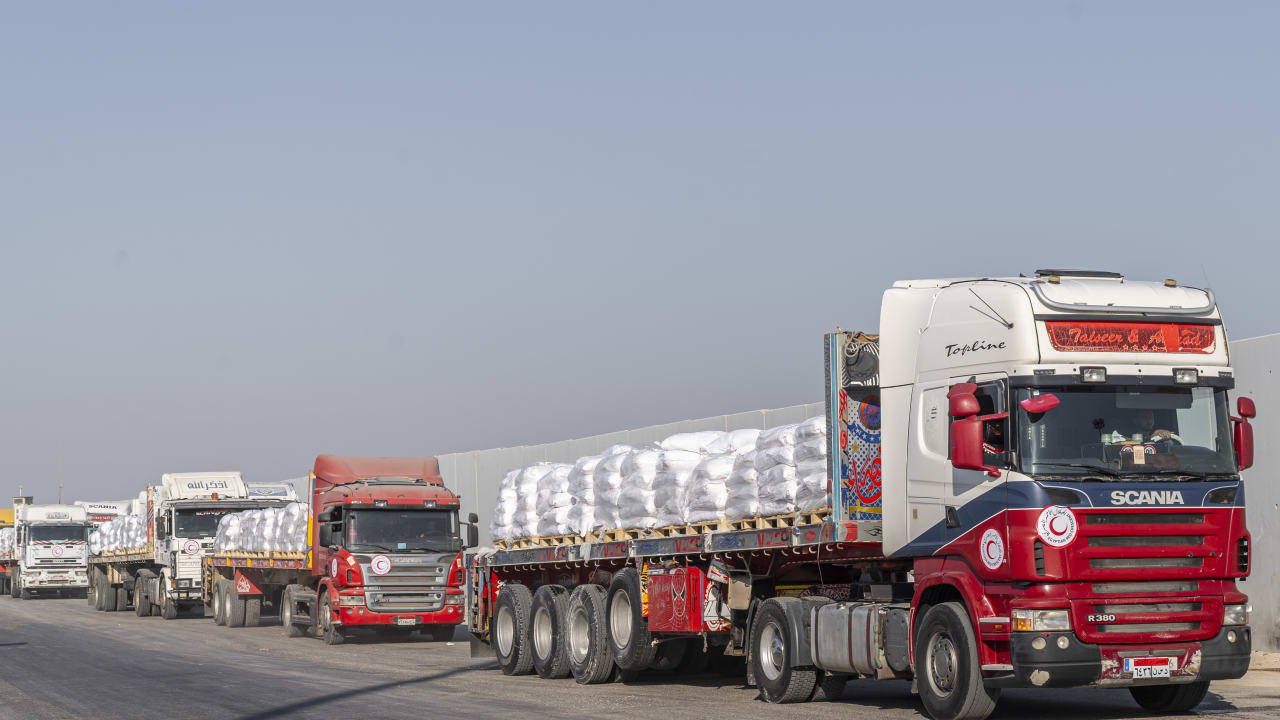
Aid trucks have begun moving toward Gaza from Egypt, according to Arab News in Saudi Arabia. Al-Ain in the UAE contained the same report. Both reports topped their news coverage on Sunday.
This highlights the significance of this for these countries and other Arab states. The UAE is a member of the Abraham Accords. Some people have assumed that Saudi Arabia might normalize relations with Israel in the future.
Both countries, along with their partners in the region, want to see an improvement in the humanitarian situation in Gaza. The UAE, for instance, has played a role in supporting aid drops and also medical support for Gazans since the war began.
Egyptian state-affiliated Al Qahera News (Cairo News Channel) reported that aid trucks were moved toward Gaza from Egypt, according to Arab news. This followed "months of international pressure and warnings from relief agencies of starvation spreading in the Palestinian enclave,” the report said.
Al-Ain news said something similar, noting that “early Sunday morning, aid trucks left Egypt for the Gaza Strip. Convoys of trucks were seen moving from the Rafah crossing on the Egyptian side, heading to the Gaza Strip.”

The reports say the trucks will then arrive at the Kerem Shalom crossing. It states that this location is approximately 3 kilometers from the Rafah border crossing and that trucks will be inspected before entering Gaza.
The movement of the trucks coincides with Israel’s decisions to enable air drops of food and also humanitarian pauses in fighting. The current plan is that the pauses will include around a quarter of Gaza, mostly areas near the coast. The pause in fighting, a de facto ceasefire, will take place during the day.
Arab News noted that “international aid organizations say there is mass hunger among Gaza’s 2.2 million people, with food running out after Israel cut off all supplies to the territory in March, before resuming it in May with new restrictions.”
The same report noted that “Israel’s announcement on airdrops came after indirect ceasefire talks in Doha between Israel and the Palestinian terrorist organization Hamas were broken off with no deal in sight.” It is unclear if the two issues are connected.
The same report says that the UN has said it will “scale up humanitarian assistance.” In addition, a power line has been connected to a desalination plant “expected to supply daily water needs for about 900,000 Gazans.”
IAF approves UAE desalination facility, pipeline
The IDF and COGAT approved the United Arab Emirates' initiative to advance a water pipeline project connecting the desalination facility in Egypt to the Al-Mawasi area along the Gaza coastline, the military said on Sunday.
The water pipeline is expected to serve approximately 600,000 residents in the area and will operate independently of Israel's water supply lines, the military said.
On Sunday, representatives from the UAE began transferring equipment for the project from Egypt, under supervision and following a security inspection via the Kerem Shalom crossing.
According to the IDF and COGAT, construction of the pipeline is expected to commence in the coming days and is anticipated to take several weeks to complete.
The reasons behind Israel's position shift on Gaza aid
The shift in Israel’s position is clearly seen as an achievement for the Gulf states. They want Gazans to receive aid. Other issues, such as the power connection for the desalination plant, appear so specific that this was likely a request.
The shift raises questions about the effectiveness of the decision to cut off aid in March, when the first phase of the ceasefire came to an end. The Gulf states and many other countries want the war to come to an end. Pressure on Israel is building in Europe in this regard.
The widespread reporting on the movement of aid is an indication of how important this issue is seen in the region. Hamas doesn’t appear to have changed its position over the last year and a half, despite changes in policy regarding aid.
This appears to illustrate that the issue will continue to be viewed as of great importance in the region, regardless of Hamas' stance and the changes on the ground.
Jerusalem Post Staff contributed to this report.