
Tal Barri, Head of the Research Department at the Alma Research Institute for Northern Security Challenges, recently spoke to Maariv about Hezbollah's expanding UAV (unmanned aerial vehicle) capabilities, warning of significant changes influenced by Iran’s involvement and the lessons Hezbollah has drawn from the Ukraine-Russia War.
In a comprehensive interview published Thursday, Barri highlighted the potential transformation of Hezbollah’s UAV unit. “Strengthening Hezbollah’s UAV fleet, particularly the suicide drones within it, is a key takeaway from the recent war,” Barri explained.
“The shift from a potential strategic threat to an actual one is driven by the quantity, quality, and operational deployment of these UAVs. The Iranians have learned to deploy them in large numbers simultaneously, a departure from their previous use.”
Barri further explained that "the Iranians made a strategic decision to rebuild Hezbollah following the last war, focusing on two primary elements: smuggling weapons and establishing an independent weapons manufacturing capability on Lebanese soil."
He also addressed recent Israeli attacks in Lebanon. "On June 5, 2025, Israel targeted several Hezbollah sites belonging to the organization’s air unit, Unit 127, which is responsible for UAV development and production. These strikes were aimed at locations in Dahieh, Beirut, and Ain Qana, in southern Lebanon. All these sites were located beneath or near civilian buildings."
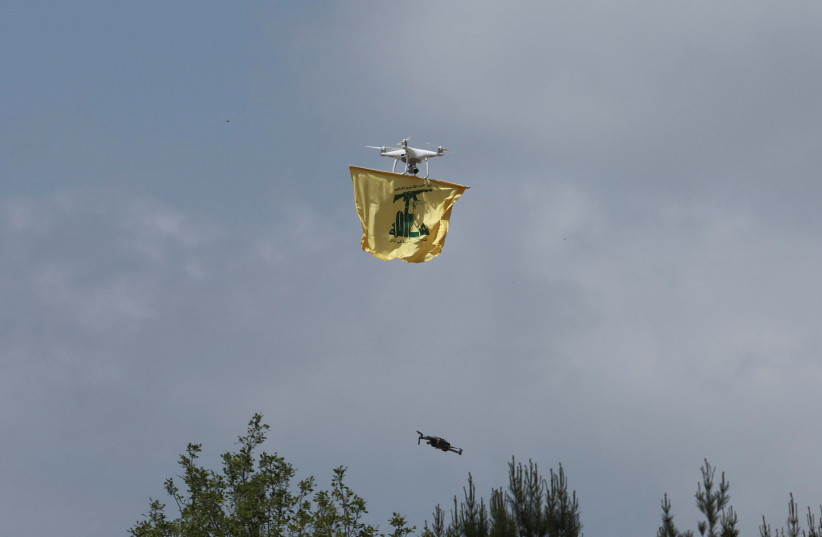
“These sites were used to manufacture, assemble, and store hundreds of UAVs. The intensity and location of the attacks during the ceasefire period, particularly in Dahieh, underscore the importance of these sites and demonstrate Hezbollah's determination, with Iranian assistance, to rebuild,” he said.
Clear intentions
Barri warned that Hezbollah’s intentions are clear. “According to various reports, Iran and Hezbollah intended to produce thousands of suicide UAVs at the manufacturing sites that were attacked. Based on lessons learned from the recent war, Iran and Hezbollah plan to create redundancy and operational flexibility, enabling large-scale UAV deployments in the future,” Barri said.
Barri also pointed to the broader geopolitical context, particularly Iran's role in supporting Russia. "Iran has become a key supplier of precision firepower for Russia, including both UAVs and missiles. Iranian advisors are physically present on the battlefield in Europe, fighting alongside Russian forces against Ukraine. From this experience, they are learning critical lessons regarding weapons deployment, tactics, and strategy."
“A key lesson Iran has learned is from Russia’s use of suicide UAVs — launching dozens or even hundreds of different UAVs simultaneously towards a designated urban area with targets, causing extensive damage to infrastructure, property, and lives,” Barri said.
The Alma Institute had previously raised concerns about this trend. "As early as October 2022, we identified a dramatic and worrying shift: Iran had become a primary supplier of precision firepower to Russia. We continued to track this development in articles published in January 2023 and March 2024, where we documented Russia’s growing arsenal of missiles and UAVs based on Iranian technology and knowledge."
However, Barri noted that Hezbollah has yet to fully utilize the potential of these UAVs. “Although Hezbollah’s UAVs were seen as a strategic threat before the war, in practice, despite some damage, they have only posed a tactical threat so far. Hezbollah has not yet succeeded in launching swarms of UAVs capable of causing significant destruction. Most launches consisted of one or two suicide UAVs at a time, targeting specific areas, with a maximum of four UAVs deployed in each attack.”
Now, Barri warns that Hezbollah and Iran are planning a significant change in their operational strategy. “We assess that Iran and Hezbollah are preparing to alter their tactics ahead of the next conflict with Israel. They have learned from Russia’s model: the ideal method is to flood the skies with UAV swarms, making it harder for Israel’s defense systems to intercept them simultaneously.”
Barri explains that Hezbollah has been using UAVs for over 25 years, gaining substantial experience. "Since the 1990s, Hezbollah has operated UAVs in Lebanon, Syria, and particularly against Israel. This experience, especially during the Syrian Civil War, has played a major role in enhancing Hezbollah's UAV capabilities."
Regarding UAV numbers, Barri noted significant growth: “In 2006, Hezbollah had dozens of UAVs. By 2013, we estimate about 200. In 2016, around 800. In 2021, approximately 2,000. By October 2023, we estimate Hezbollah had around 2,500 operational UAVs.”
While Israel has inflicted significant damage on Hezbollah’s UAV capabilities, Barri explained, much of the infrastructure remains intact: "Despite Israel’s efforts to damage Hezbollah’s UAV network, we estimate that the group still possesses hundreds of operational UAVs. To implement the 'Russian model,' Hezbollah needs thousands of UAVs, which is why there is significant emphasis on rebuilding their independent production capabilities in Lebanon."
Barri concludes by highlighting the ongoing threat posed by Hezbollah’s UAV development: “Despite the damage done, we believe there are still UAV production and assembly sites in Lebanon, and more will likely be established in the future. We expect UAV production to continue. As shown by the June 2025 strikes, Iran will continue prioritizing the rebuilding of Hezbollah’s UAV fleet, dedicating substantial resources to this effort.”
Finally, Barri emphasized the gravity of the situation: "We are at a critical juncture. The goal is to turn Hezbollah's UAV capabilities into a real strategic threat. This is the reality that is unfolding before us."