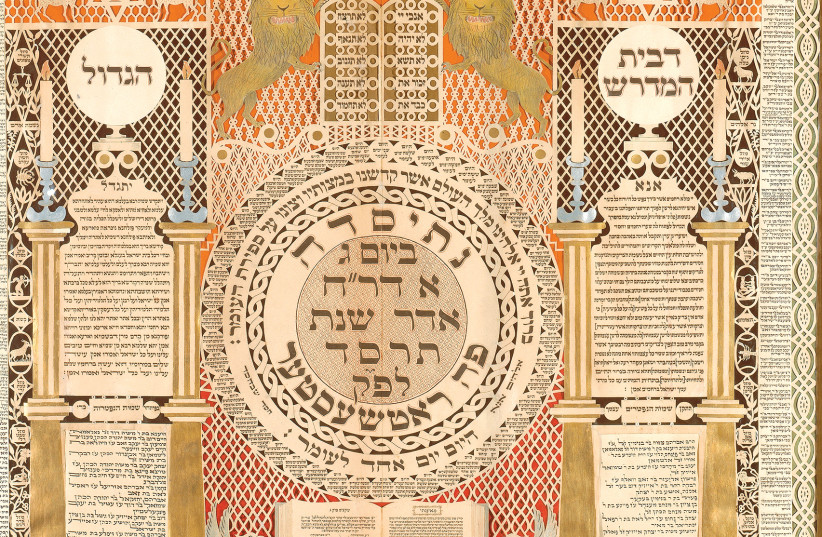
The counting of the Omer is observed each evening by reciting a special blessing and checking off each day of the Omer. If forgotten at night, the count can be performed during the day, but without the blessingAccording . to the Talmud (Menachot 65b-66a), the counting must follow a precise formula, mentioning both the number of days and the number of weeks. For example, on the first day the recitation is “Today is the first day of the Omer;” a week later, one says: “Today is the eighth day, making one week and one day of the Omer.” Special Omer calendars helped keep an accurate count of the days, with some containing movable numbers and often decorated with folk art motifs.
The Kabbalists considered the seven weeks of the Sefirah period as signifying the ascent of the Israelites through 49 “gates” of impurity as they passed from the depths of their slavery in Egypt to their pure state at the time of the giving of the Torah at Mount Sinai – when they were judged worthy of becoming a “kingdom of priests and a holy nation (Exodus 19.6). Each day represents a particular spiritual focus and opportunity for growth. The sages also associated this period of seven weeks with seven attributes personified by great ancestors of the Jewish people: lovingkindness (Abraham); strength of character and wholehearted devotion to the service of God (Isaac); glory and uprightness (Jacob); morality (Joseph); eternity and the conviction that only the Torah has lasting value (Moses); splendor and the pursuit of peace (Aaron); and God-given sovereignty (David).
The Omer period is observed as a time of semi-mourning because of the plague that struck Rabbi Akiva’s students during this period. Traditional Jews do not get haircuts, celebrate weddings, or attend public performances during this time. Initially, these restrictions may have related to the intense anxiety felt by the Israelites during the vulnerable weeks leading up to the harvest.
A special tradition during the Omer period is the study of the Mishnaic tractate Pirkei Avot (Ethics of the Fathers). Beginning after Passover, one of its six chapters is studied each Shabbat. In this way, the final chapter, dealing with the Torah, is read just before Shavuot, the festival commemorating the giving of the Torah at Mount Sinai. Sephardim only read Pirkei Avot during the Omer period, while most Ashkenazi congregations repeat the entire treatise three times until the Shabbat before Rosh Hashanah. A less observed custom is the study of the Talmudic tractate Shevuot during the Omer period. Not only are the Hebrew letters identical to the upcoming festival – though the word shevuot means “vows,” not “weeks” – but the tractate has 49 pages, which correspond to the 49 days of the Omer.■
Ronald Eisenberg is professor of radiology at Harvard Medical School and has a doctoral degree in Jewish studies.